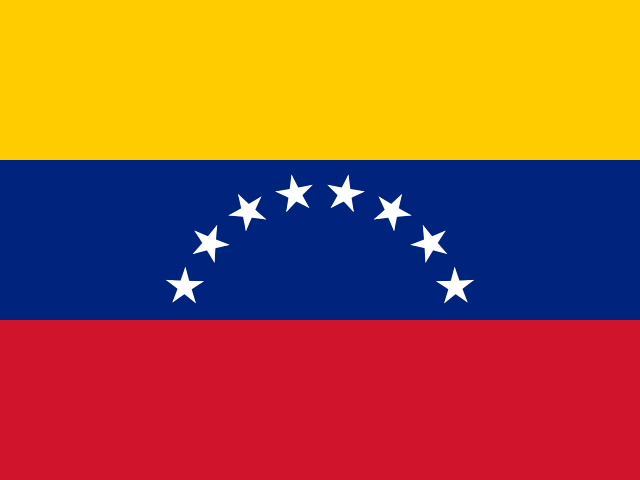
 Venezuela
Description of Venezuela
Venezuela, a country located in South America, is known for its rich oil reserves and turbulent political landscape. With a history marked by periods of economic prosperity and social unrest, Venezuela has faced significant challenges in recent years, including hyperinflation, political instability, and widespread social upheaval. As a nation with immense potential yet marred by internal and external pressures, understanding the macroeconomic dynamics and geopolitical implications of Venezuela is crucial for navigating its complex landscape.
Population And Age Structure
Population, total: Venezuela has a total population of 28,490,453, ranking 50th out of 194 countries. The population is below the average population of 40,097,746.58.
Population ages 0-14 (% of total population): In Venezuela, 28.48% of the population falls in this age group, ranking 85th out of 194 countries. This percentage is above the average of 27.34%.
Population ages 0-14, total: The total population in this age group in Venezuela is 8,115,290, which is below the average of 10,327,379.98. Venezuela ranks 51st out of 194 countries.
Population ages 15-64 (% of total population): Venezuelans aged 15-64 make up 63.52% of the population, ranking 117th out of 194 countries. This percentage is slightly above the average of 63.44%.
Population ages 15-64, total: The total population in the 15-64 age group in Venezuela is 18,097,538, placing Venezuela at rank 48 out of 194 countries. This figure is below the average of 26,003,407.49.
Population ages 65 and above (% of total population): Venezuelans aged 65 and above constitute 7.99% of the population, ranking 86th out of 194 countries. This percentage is below the average of 9.22%.
Population ages 65 and above, total: Venezuela has a total of 2,277,624 individuals aged 65 and above, ranking 45th out of 194 countries. The number is below the average of 3,766,959.08.
Summary
Venezuela has a total population of 28,490,453, with 28.48% below 14 years old, 63.52% between 15-64 years, and 7.99% aged 65 and above. Despite having a lower total population compared to the global average, Venezuela has a higher percentage of individuals below 14 years, which might indicate a need for increased investments in education and healthcare for the younger population.
Population Miscellaneous
Rural population in Venezuela is 3,339,366, significantly below the average of 18,044,041. The country ranks 89th out of 190 countries in this attribute.
Rural population (% of total population) in Venezuela is 11.721%, well below the average of 41.158%. Venezuela ranks 175th out of 190 countries in this metric.
Urban population in Venezuela is 25,151,087, above the average of 22,425,747. Venezuela ranks 36th out of 194 countries in urban population.
Urban population (% of total population) in Venezuela is 88.279%, higher than the average of 59.691%. The country ranks 20th out of 194 in this category.
Age dependency ratio (% of working-age population) in Venezuela is 57.43%, slightly below the average of 59.22%. Venezuela ranks 78th out of 194 countries in this ratio.
Birth rate, crude (per 1,000 people) in Venezuela is 16.213, lower than the average of 19.384. The country ranks 101st out of 192 countries in this statistic.
Death rate, crude (per 1,000 people) in Venezuela is 7.575, below the average of 8.214. Venezuela ranks 95th out of 192 countries in this metric.
Fertility rate, total (births per woman) in Venezuela is 2.23, lower than the average of 2.603. The country ranks 91st out of 190 countries in fertility rate.
Summary
Venezuela exhibits a rural population below the global average, with a relatively low rural population percentage and high urban population percentage. The country also has a slightly lower age dependency ratio and fertility rate, along with lower birth and death rates compared to the global averages. These indicators are crucial for understanding Venezuela's demographic landscape, economic development potential, and social welfare needs.
Military
Regarding Military expenditure (current USD), Venezuela's expenditure is $2,591,576,732.65, significantly below the average of $12,904,993,617.17. Venezuela ranks 149 out of 149 countries in this dataset.
For Military expenditure (% of GDP), Venezuela's spending accounts for 1.58% of its GDP, lower than the average of 1.90%. Venezuela is ranked 74th out of 148 countries.
In terms of Arms imports, Venezuela's value of $79,000,000 is below the average of $205,522,123.89, ranking 44th out of 113 countries.
Venezuela's total Armed forces personnel stand at 343,000, higher than the average of 165,908.54 personnel. This places Venezuela in the 18th position out of 164 countries.
As for Armed forces personnel (% of total labor force), Venezuela has 3.30% personnel, well above the average of 1.28%. Venezuela is ranked 14th out of 164 countries in this category.
Summary
Venezuela's military expenditure, though significantly below the average, allocates a higher percentage of its GDP to military spending compared to the global average. The country also maintains a larger armed forces personnel count and a higher percentage of personnel compared to the global averages. These indicators are crucial as they highlight Venezuela's prioritization of defense and the potential impact it may have on its economy, resource allocation, and regional security dynamics.
Natural Resources
For Forest area (sq. km), Venezuela has a value of 462,309, which is higher than the average of 211,606. Venezuela ranks 15 out of 191 countries in this attribute data.
Regarding Land area (sq. km), Venezuela's value is 882,050, above the average of 665,166. Venezuela ranks 32 out of 194 countries.
In terms of Surface area (sq. km), Venezuela has 912,050, surpassing the average of 689,779. The country ranks 32 out of 194 nations in this category.
For Arable land (hectares), Venezuela's value of 2,600,000 is below the average of 7,329,543. Venezuela is ranked 72 out of 190 countries.
Concerning Land under cereal production (hectares), Venezuela's value is 593,985, below the average of 4,206,011. Venezuela holds the 94th rank out of 174 countries.
Looking at Average precipitation in depth (mm per year), Venezuela's value of 2,044 is higher than the average of 1,157. Venezuela is ranked 29 out of 178 countries.
For Renewable internal freshwater resources (total billion cubic meters), Venezuela has 805, well above the average of 240. Venezuela ranks 13 out of 178 countries.
Summary
Venezuela stands out with its extensive forest area, above-average land area, and ample renewable internal freshwater resources. However, the country lags behind in arable land and land under cereal production. These statistics are crucial as they indicate Venezuela's potential for environmental conservation and water availability, while also highlighting areas that may hinder its agricultural productivity and food security.
Commodities
Analysis of key agricultural production and consumption statistics for Venezuela:
- Cereal production: Venezuela's production of 2,396,627.73 metric tons is significantly below the average of 17,249,945.93 metric tons, ranking 87th out of 174 countries.
- Aquaculture production: Venezuela's production of 40,261 metric tons is well below the average of 679,642.92 metric tons, ranking 49th out of 180 countries.
- Capture fisheries production: Venezuela's production of 195,900.02 metric tons is below the average of 467,453.06 metric tons, ranking 58th out of 190 countries.
- Total fisheries production: Venezuela's production of 236,161.02 metric tons is below the average of 1,153,914.85 metric tons, ranking 54th out of 182 countries.
- Fertilizer consumption: Venezuela's consumption of 53.98 kilograms per hectare of arable land is below the average of 159.04 kilograms, ranking 117th out of 187 countries.
Summary
Analysis of key agricultural production and consumption statistics for Venezuela:
Venezuela's agricultural sector is facing significant challenges based on the analyzed data. The country's low production levels in cereals, aquaculture, and fisheries, coupled with below-average fertilizer consumption, indicate inefficiencies and limitations in its agricultural output. These findings are crucial as they highlight areas needing improvement to enhance food security, self-sufficiency, and overall agricultural competitiveness within Venezuela's economy.
Intellectual Property
Venezuela's Scientific and technical journal articles stand at 657.27, well below the attribute average of 15,103.76, ranking 90 out of 192 countries. In terms of Researchers in R&D per million people, Venezuela has 289.18 researchers, also below the average of 2556.45. This places Venezuela at rank 64 out of 72 countries in the dataset.
Summary
Venezuela's low number of scientific and technical journal articles, well below the global average, and its below-average count of researchers in R&D per million people highlight a significant gap in research and innovation compared to other countries. These indicators are crucial as they reflect the country's level of investment in education, technology, and innovation, which are key drivers of economic development and competitiveness in the modern global economy.
Manufacturing Value Added
Venezuela's Medium and high-tech manufacturing value added accounts for 34.28% of the manufacturing value added, which is above the average of 24.49%. This places Venezuela at rank 42 out of 149 countries in this attribute.
Summary
Venezuela's medium and high-tech manufacturing sector contributes significantly more to its overall manufacturing value added compared to the global average, positioning the country at a competitive rank of 42 out of 149 nations. This indicates Venezuela's relative strength in producing advanced manufactured goods, which could enhance technological capabilities, economic diversification, and global competitiveness in the long term.
Investment
Regarding Foreign direct investment, net inflows (BoP, current US$), Venezuela received a net inflow of -456 million USD, significantly below the average of 5.75 billion USD. This places Venezuela at a rank of 163 out of 182 countries in the dataset.
As for Foreign direct investment, net outflows (BoP, current US$), Venezuela had a net outflow of 358 million USD, again notably lower than the average of 5.71 billion USD. In this category, Venezuela ranks 56 out of 156 countries included in the data.
Summary
Venezuela's foreign direct investment (FDI) indicators show a significant imbalance, with net inflows well below the global average and ranking low among all countries. Additionally, the country also experienced net outflows, further highlighting instability in its investment environment. These figures are crucial as they suggest challenges in attracting and retaining foreign investment, which is vital for economic growth and stability.
Debt
Debt service on external debt, total (TDS, current US$): Venezuela's focus country value of 926,692,924.5 is significantly below the attribute average of 9,811,195,839.23. It ranks 67 out of 123 countries in the dataset.
Debt service on external debt, public and publicly guaranteed (PPG) (TDS, current US$): The focus country value for Venezuela is 915,586,000, also below the attribute average of 3,310,612,057.59. Venezuela ranks 50 out of 123 countries.
External debt stocks, public and publicly guaranteed (PPG) (DOD, current US$): Venezuela's external debt stock of 69,340,728,907.1 surpasses the attribute average of 28,695,879,144.98. It holds the 13th rank out of 123 countries.
External debt stocks, private nonguaranteed (PNG) (DOD, current US$): Venezuela's focus country value of 57,730,248,000 exceeds the attribute average of 33,734,699,285.22. It ranks 11 out of 91 countries.
External debt stocks, total (DOD, current US$): Venezuela's total external debt stock of 189,396,431,067.6 is well above the attribute average of 73,845,530,111.82. It holds the 10th rank out of 123 countries.
Summary
Venezuela stands out in terms of its external debt indicators, with significantly lower debt service payments compared to the global average. However, its high levels of external debt, both public and private, indicate a potential risk of financial instability. Despite ranking relatively high in terms of debt stock, Venezuela's ability to service this debt is a critical consideration for its macroeconomic stability and future development.
Merchandise Exports
For Merchandise exports (current US$), Venezuela's value is $5,010,000,000. This is significantly below the attribute average of $89,542,711,229.95. Venezuela ranks 106 out of 187 countries in this data set.
Regarding Merchandise exports by the reporting economy, residual (% of total merchandise exports), Venezuela's value is 66.63%. This is substantially higher than the attribute average of 3.20%. Venezuela holds the 2nd rank out of 166 countries for this indicator.
Summary
Venezuela's merchandise exports in terms of value are far below the global average, ranking 106th out of 187 countries. However, in terms of the proportion of exports by the reporting economy, Venezuela ranks 2nd out of 166 countries, signifying a high level of dependency on these exports. These findings are crucial as they highlight Venezuela's heavy reliance on its exports to drive its economy while also indicating potential vulnerabilities due to the imbalance in trade.
Technology Exports
Medium and high-tech exports (% manufactured exports) in Venezuela stand at 9.65%, which is significantly below the attribute average of 34.29%. This places Venezuela at a rank of 121 out of 149 countries in terms of this statistic.
Summary
Venezuela's medium and high-tech exports as a percentage of manufactured exports are notably low at 9.65%, well below the global average of 34.29%. This places the country at a low rank of 121 out of 149 nations in this particular metric. The low level of medium and high-tech exports indicates a lack of diversification in the economy and potentially limited access to advanced technologies, hindering Venezuela's competitiveness in the global market and its ability to drive sustainable economic growth.
Merchandise Imports
For Merchandise imports (current US$), Venezuela has a value of 6,590,000,000. This figure is significantly below the average of 89,385,605,263.16, ranking Venezuela 106th out of 190 countries in the dataset.
As for Merchandise imports by the reporting economy, residual (% of total merchandise imports), Venezuela's value of 74.75% is substantially above the average of 2.51%. This places Venezuela in the top rank (1st out of 180 countries) for this metric.
Summary
Venezuela's low value of $6.59 billion for Merchandise imports is significantly below the global average of $89.39 billion, ranking 106th out of 190 countries. Additionally, Venezuela's high residual value of 74.75% for Merchandise imports relative to the reporting economy is far above the average of 2.51%, placing Venezuela in the top position (1st out of 180 countries) for this metric.
These findings indicate that Venezuela heavily relies on its domestic production rather than imported goods. This can have significant implications for its economy, such as limited access to a variety of goods and potentially stunting economic growth due to a lack of international trade and competitiveness.
Infrastructure
For the attribute "Air transport, freight (million ton-km)", Venezuela's value of 2.88 million ton-km is significantly below the average of 1384.37 million ton-km. This places Venezuela at rank 88 out of 126 countries in the dataset.
Regarding "Air transport, registered carrier departures worldwide", Venezuela's 3859 departures fall well below the average of 134365.61 departures. This positions Venezuela at rank 107 out of 149 countries.
Lastly, in "Air transport, passengers carried", Venezuela's 283524 passengers carried is substantially lower than the average of 11848242.70 passengers. This places Venezuela at rank 105 out of 149 countries in the dataset.
Summary
Venezuela lags behind the global average in key air transport indicators such as freight volume, registered carrier departures, and passenger numbers. With ranks of 88, 107, and 105 out of 126 and 149 countries respectively, these statistics highlight Venezuela's comparatively limited engagement in the global air transportation network. This could signify challenges in trade connectivity, tourism attractiveness, and economic competitiveness for Venezuela on the international stage.
Information Technology Infrastructure
Analysis of key statistics for Venezuela:
1. Secure Internet servers: Venezuela has 5531 secure internet servers, significantly below the average of 458,294. The country ranks 82 out of 193 countries in this aspect.
2. Secure Internet servers (per 1 million people): Venezuela has 194 secure internet servers per 1 million people, well below the average of 14,067. The country is ranked 121 out of 193 countries.
3. Fixed broadband subscriptions: Venezuela has 2,561,692 fixed broadband subscriptions, below the average of 6,591,956. This places Venezuela at rank 50 out of 185 countries in this category.
4. Mobile cellular subscriptions: Venezuela has 16,543,805 mobile cellular subscriptions, below the average of 42,526,464. The country ranks 63 out of 193 countries for mobile cellular subscriptions.
Summary
Venezuela lags behind global averages in key technological indicators such as secure internet servers, fixed broadband subscriptions, and mobile cellular subscriptions. With significantly lower numbers in these areas, Venezuela's digital infrastructure may face challenges in keeping up with the connectivity needs of its population and businesses. This could potentially hinder the country's competitiveness in the global digital economy and limit opportunities for innovation and growth.
Energy Consumption
1. Venezuela's renewable energy consumption stands at 23.33% of total final energy consumption, which is below the global average of 32.18%. This places Venezuela at rank 99 out of 191 countries in the dataset.
2. In terms of CO2 emissions, Venezuela emits 72,509 kt, significantly lower than the average of 171,895.94 kt. This places Venezuela at rank 44 out of 188 countries in the dataset.
Summary
Venezuela's renewable energy consumption is below the global average, ranking 99th out of 191 countries. However, its CO2 emissions are significantly lower than the average, placing it at 44th out of 188 countries. These indicators are crucial as they reflect Venezuela's current stance on environmental sustainability and its contribution to global climate change efforts. Improving renewable energy consumption further could help Venezuela move up the ranks and positively impact its environmental reputation on the global stage.
Taxes
The Tariff rate, applied, weighted mean, all products (%) for Venezuela is 14.06, which is significantly higher than the attribute average of 5.21. Venezuela ranks 5th out of 153 countries in this attribute, indicating a relatively high tariff rate compared to other nations.
Summary
Venezuela's applied weighted mean tariff rate of 14.06% is notably above the global average of 5.21%, positioning the country in 5th place out of 153 nations. This high tariff rate suggests that Venezuela imposes relatively heavy trade barriers compared to other countries, potentially affecting its international trade competitiveness and economic relations with other nations.
Top Stats
Ranks in Top Decile For:
| Attribute | Rank/Total |
|---|---|
| Armed forces personnel (% of total labor force) | 14/164 |
| Forest area (sq. km) | 15/191 |
| Renewable internal freshwater resources, total (billion cubic meters) | 13/178 |
| External debt stocks, total (DOD, current US$) | 10/123 |
| Merchandise exports by the reporting economy, residual (% of total merchandise exports) | 2/166 |
| Merchandise imports by the reporting economy, residual (% of total merchandise imports) | 1/180 |
| Tariff rate, applied, weighted mean, all products (%) | 5/153 |
Ranks in Bottom Decile For:
| Attribute | Rank/Total |
|---|---|
| Rural population (% of total population) | 175/190 |
| Military expenditure (current USD) | 149/149 |