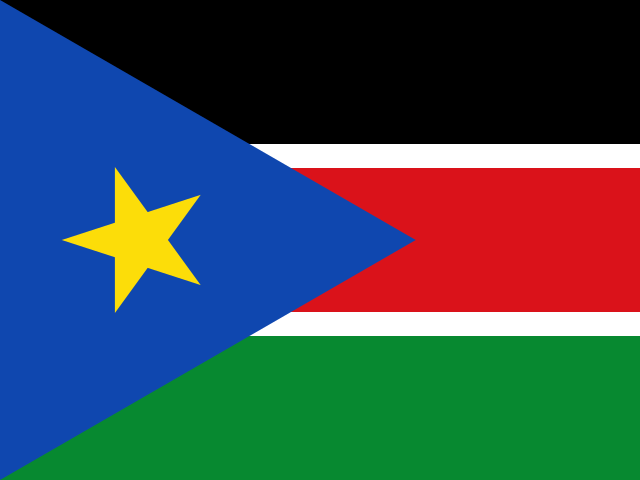
 South Sudan
Description of South Sudan
South Sudan, the youngest country in the world, gained its independence in 2011. Located in East-Central Africa, South Sudan is a nation brimming with potential yet facing numerous challenges. As the country navigates through a complex web of political, economic, and social issues, understanding the macroeconomic landscape is crucial in exploring its development trajectory. By delving into key macroeconomic statistics and indicators, we can gain valuable insights into South Sudan's position in the region and its potential for growth and stability.
Population And Age Structure
1. The total population of South Sudan is 10,606,227, which is significantly below the average total population of 40,097,746. South Sudan ranks 87th out of 194 countries in terms of total population.
2. 45.5% of South Sudan's population falls between the ages of 0-14, which is above the average of 27.3%. This places South Sudan at the 9th position out of 194 countries for this age group distribution.
3. The total number of individuals aged 0-14 in South Sudan is 4,825,570, below the average of 10,327,380. South Sudan ranks 73rd out of 194 countries in this age group category.
4. 51.7% of the population falls between the ages of 15-64 in South Sudan, which is below the average of 63.4%. South Sudan ranks 186th out of 194 countries in this age category distribution.
5. The total population of individuals aged 15-64 in South Sudan is 5,483,618, significantly below the average of 26,003,407. South Sudan ranks 99th out of 194 countries in this age group.
6. Individuals aged 65 and above constitute 2.8% of South Sudan's population, much below the average of 9.2%. South Sudan ranks 170th out of 194 countries for this age category.
7. The total number of individuals aged 65 and above in South Sudan is 297,038, significantly lower than the average of 3,766,959. South Sudan ranks 125th out of 194 countries for this age group.
Summary
The analysis reveals that South Sudan has a relatively small total population compared to the global average, with a significant percentage of individuals aged 0-14 and a lower percentage in the working-age group (15-64). This demographic structure could indicate challenges in terms of supporting a productive workforce and economic growth, as a large youth population requires adequate resources for education and healthcare, while a smaller working-age population may impact the country's labor force and economic productivity.
Population Miscellaneous
In South Sudan, the rural population is 8,463,875, significantly below the attribute average of 18,044,041. South Sudan ranks 64 out of 190 countries in this category. Regarding rural population as a percentage of the total population, South Sudan's value of 79.801% is well above the average of 41.158%. The country is ranked 10 out of 190. South Sudan's urban population is 2,142,352, much lower than the average of 22,425,747. South Sudan ranks 130 out of 194 countries in urban population, out of a total of 194 countries. The urban population as a percentage of the total population in South Sudan is 20.199%, which is below the average of 59.691%. The country is ranked 185 out of 194 countries. South Sudan has an age dependency ratio of 93.416%, significantly higher than the average of 59.219%. This places South Sudan at rank 9 out of 194 countries. The crude birth rate in South Sudan is 29.166 per 1,000 people, higher than the average of 19.384. South Sudan ranks 39 out of 192 in this category. The crude death rate in South Sudan is 10.759 per 1,000 people, above the average of 8.214. South Sudan is ranked 35 out of 192 countries based on this statistic. Finally, the total fertility rate in South Sudan is 4.543 births per woman, higher than the average of 2.603. The country ranks 18 out of 190 countries in this regard.
Summary
South Sudan has a predominantly rural population, with 79.801% of its total population residing in rural areas, which is well above the global average. This high rural population percentage indicates a potential reliance on agriculture and highlights the need for infrastructure development in urban areas to support economic diversification and growth.
Military
South Sudan's military expenditure is significantly below the average, standing at $128,916,014.13, ranking 120th out of 149 countries. The country allocates 2.28% of its GDP to military expenditure, which is higher than the average of 1.90%, placing it at the 36th rank out of 148 countries. With 53,000 armed forces personnel, South Sudan is below the average of 165,908 personnel, ranking 67th out of 164 countries. Additionally, the country has 1.31% of its total labor force as armed forces personnel, slightly above the average of 1.28%, ranking 48th out of 164 countries.
Summary
South Sudan's military expenditure is relatively low compared to the global average, but it allocates a higher percentage of its GDP to the military than many other countries. Despite having fewer armed forces personnel than average, the country still maintains a higher proportion of its labor force in the military. These indicators are crucial as they reflect South Sudan's prioritization of military spending in relation to its economic output and workforce composition, potentially impacting its budget allocation, security capabilities, and overall national development.
Natural Resources
South Sudan has a forest area of 71,570 sq. km, which is below the global average of 211,606.11 sq. km, ranking 63 out of 191 countries.
The land area in South Sudan is 631,930 sq. km, also below the average of 665,166.51 sq. km, ranking 40 out of 194 countries.
South Sudan's surface area is 646,883 sq. km, below the average of 689,779.56 sq. km, with the same rank of 40 out of 194 countries.
The country has 2,394,700 hectares of arable land, significantly below the average of 7,329,543.16 hectares, ranking 75 out of 190 countries.
South Sudan's land under cereal production is 987,496 hectares, far lower than the average of 4,206,011.63 hectares, ranking 79 out of 174 countries.
The average precipitation in South Sudan is 900 mm per year, below the average of 1,157.83 mm per year, with a rank of 96 out of 178 countries.
South Sudan has a total renewable internal freshwater resources of 26 billion cubic meters, significantly below the average of 240.41 billion cubic meters, ranking 98 out of 178 countries.
Summary
South Sudan's environmental indicators, such as forest area, land area, arable land, cereal production, precipitation, and freshwater resources, all fall below global averages, indicating potential challenges in terms of environmental sustainability and resource availability. These statistics are crucial as they highlight the country's limited natural resources, which could impact agriculture, water security, and overall ecosystem health, potentially influencing the country's development trajectory and necessitating careful resource management and conservation efforts.
Commodities
South Sudan's cereal production of 874,410 metric tons is significantly below the average of 17,249,945.92 metric tons, ranking 112th out of 174 countries.
With an aquaculture production of 40 metric tons, South Sudan is far below the average of 679,642.92 metric tons, ranking 154th out of 180 countries.
The capture fisheries production in South Sudan is 30,000 metric tons, well below the average of 467,453.06 metric tons, placing the country at 111th out of 190 countries.
South Sudan's total fisheries production of 30,040 metric tons is significantly lower than the average of 1,153,914.85 metric tons, ranking 115th out of 182 countries.
The fertilizer consumption in South Sudan is very low at 0.08 kilograms per hectare of arable land, compared to the average of 159.04 kilograms per hectare. This places South Sudan at a low rank of 187th out of 187 countries.
Summary
South Sudan is facing significant challenges in various sectors of its economy. The country's low cereal, aquaculture, capture fisheries, and total fisheries production levels highlight the struggles in its agriculture and fisheries industries. Additionally, the extremely low fertilizer consumption indicates a lack of investment in agricultural inputs, which is crucial for improving crop yields and ensuring food security.
These findings are crucial as they reveal the urgent need for interventions to boost agricultural and fisheries productivity in South Sudan. Improving production levels in these key sectors is essential for enhancing food security, stimulating economic growth, and reducing reliance on food imports.
Intellectual Property
South Sudan's scientific and technical journal articles are significantly below the global average of 15103.76, with a value of 14.27, ranking 170 out of 192 countries included in the data.
Similarly, South Sudan's charges for the use of intellectual property, receipts, stand well below the average of $3,191,687,117.58, with a value of $7,700,000. This places South Sudan at rank 70 out of 122 countries in the dataset.
Summary
South Sudan's scientific and technical journal articles and charges for the use of intellectual property are significantly below the global averages. This indicates a lack of investment and focus on innovation and intellectual property protection in the country. These indicators are crucial for economic growth and competitiveness in the modern global economy, and the low values suggest a potential need for policy interventions to promote research, innovation, and intellectual property rights in South Sudan to enhance its development and global standing.
Money
South Sudan's consumer price inflation is significantly high at 29.68%, ranking 6th out of 165 countries with available data, well above the average of 8.26%. This indicates a concerning level of inflation that the country is experiencing.
Regarding broad money growth, South Sudan is experiencing rapid growth at 56.50%, ranking 5th out of 139 countries, much higher than the average of 18.03%. This suggests a robust expansion in the country's money supply.
However, South Sudan's broad money as a percentage of GDP is relatively low at 26.42%, ranking 128th out of 139 countries, significantly below the average of 71.75%. This implies a relatively smaller financial sector in proportion to the country's economy.
Lastly, the broad money to total reserves ratio in South Sudan is 7.05%, ranking 16th out of 126 countries, above the average of 5.17%. This indicates that the country holds a higher level of money in reserves compared to the average of other nations.
Summary
South Sudan exhibits high consumer price inflation and rapid broad money growth, indicating significant economic challenges and potential instability. Despite the growth in money supply, its proportion to GDP is low, suggesting a less developed financial sector. However, the country maintains a relatively high level of money in reserves, which could provide stability in times of economic volatility.
These indicators are crucial as they highlight the economic imbalances and vulnerabilities in South Sudan, such as high inflation and underdeveloped financial sector. The high money reserves, however, may offer a buffer against external shocks and financial crises, underscoring the importance of prudent economic management and policy decisions to address these disparities and ensure long-term stability.
Investment
South Sudan received $17,500,000 in net foreign direct investment, which is significantly below the average of $5,749,271,080. The country ranks 143 out of 182 countries in this metric.
Summary
South Sudan's net foreign direct investment of $17,500,000 is notably lower than the average of $5,749,271,080, positioning it at 143 out of 182 countries in this aspect. This indicates a significant gap between South Sudan's level of foreign direct investment and the global average, suggesting potential challenges in attracting foreign capital for economic development and growth.
Broad Trade Attributes
South Sudan's merchandise trade is at 36.04% of GDP, below the average of 60.01%. It ranks 149th out of 186 countries in this attribute. For trade in services, South Sudan's value is 50.63% of GDP, above the average of 24.63%. It holds the 15th rank out of 171 countries in this category.
Summary
South Sudan's merchandise trade as a percentage of GDP is below the global average, ranking 149th out of 186 countries, indicating a potential imbalance in its trade activities. Conversely, its trade in services outperforms the average, placing it in the 15th position globally, reflecting a strong services sector. These indicators are crucial as they highlight South Sudan's reliance on services for economic growth and the need to diversify and strengthen its merchandise trade to enhance overall trade stability and resilience.
Net Trade
1. South Sudan has a current account balance (BoP, current US$) of -1717500000, which is significantly below the average of 1443864831.4940138. This places South Sudan at rank 127 out of 170 countries.
2. The current account balance (% of GDP) for South Sudan is -35.05%, much lower than the average of -2.36%. South Sudan ranks 167 out of 170 countries in this attribute data.
3. In terms of net trade in goods and services (BoP, current US$), South Sudan's value is -1900870000, well below the average of 2604730003.5650773. This puts South Sudan at rank 118 out of 171 countries.
4. South Sudan's net primary income (BoP, current US$) is -523780000, higher than the average of -903807529.7376518. The country ranks 90 out of 170 in this attribute.
5. For net secondary income (BoP, current US$), South Sudan has a value of 707150000, surpassing the average of -269227340.40242267. The country ranks 65 out of 170.
6. South Sudan's net trade in goods (BoP, current US$) stands at 272780000, which is below the average of 1302831005.6800897. The country ranks 62 out of 171 in this aspect.
7. The net capital account (BoP, current US$) for South Sudan is 161870000, slightly above the average of 136543824.04518417. The country ranks 56 out of 159 nations in this category.
8. In the net financial account (BoP, current US$) attribute, South Sudan records -2437340000, significantly lower than the average of -469840994.6309935. This places South Sudan at rank 140 out of 170 countries.
Summary
South Sudan exhibits significant imbalances in its key macroeconomic indicators, with consistently negative values across various aspects such as current account balance, net trade, and net financial account. These indicators reflect a concerning trend of reliance on external sources of income and capital, potentially indicating vulnerability to external shocks and a lack of domestic economic diversification. Addressing these imbalances is crucial for South Sudan's economic stability, sustainability, and resilience in the face of global economic uncertainties.
Broad Export Attributes
South Sudan's exports of goods, services, and primary income amount to $2.43 billion, ranking 132 out of 170 countries. This figure is significantly below the average of $146.24 billion.
The country's exports of goods and services total $2.34 billion, placing it at 131 out of 170 countries. Similarly, this amount is notably lower than the average of $122.94 billion.
South Sudan's goods exports stand at $2.19 billion, ranking 124 out of 171 countries. This figure falls well below the average of $93.31 billion.
Summary
South Sudan's export performance, across goods, services, and primary income, ranks significantly lower compared to the global average and its peers. The country's lower-than-average export figures indicate potential challenges in diversifying its economy, reducing dependency on specific sectors, and boosting overall economic growth and stability.
Merchandise Exports
South Sudan's Merchandise exports amount to $783,000,000, which is significantly below the average of $89,542,711,229.95. The country ranks 150th out of 187 countries in this attribute.
Summary
South Sudan's merchandise exports are notably low at $783 million, far below the global average of $89.5 billion. This places the country at 150th out of 187 nations in this aspect. Such a low export value indicates a potential lack of diversified economy, heavy reliance on imports, and limited access to international markets. This could hinder South Sudan's economic growth, development, and ability to generate foreign exchange reserves for sustainable development initiatives.
Service Exports
- Service exports (BoP, current US$): South Sudan's value of $153,570,000 is significantly below the
average of $28,917,292,503.82, ranking 145th out of 171 countries in the dataset.
- ICT service exports (BoP, current US$): With a value of $13,480,000, South Sudan falls far below the
average of $4,578,501,153.77, ranking 131st out of 166 countries.
- ICT service exports (% of service exports, BoP): South Sudan's percentage of 8.78% is lower than the
average of 11.75%, placing it at the 82nd rank out of 166 countries.
- Communications, computer, etc. (% of service exports, BoP): At 80.26%, South Sudan outperforms the
average of 45.85%, ranking 13th out of 169 countries.
- Transport services (% of service exports, BoP): South Sudan's ratio of 5.94% is notably below the
average of 21.80%, positioned at the 141st rank out of 169 countries.
- Insurance and financial services (% of service exports, BoP): With 13.80%, South Sudan exceeds the
average of 6.45%, ranking 18th out of 161 countries.
Summary
South Sudan's service exports and ICT service exports are considerably lower than the global averages, placing the country at lower ranks in the dataset. However, South Sudan performs relatively well in communications, computer, etc. service exports and insurance and financial services compared to other countries. These findings are crucial as they highlight South Sudan's strengths and weaknesses in its service export sectors, indicating areas that may require enhancement to boost economic growth and competitiveness on a global scale.
Commercial Service Exports
South Sudan's commercial service exports amount to $148,980,000, ranking 144th out of 171 countries in the dataset. This value is significantly below the attribute average of $28,508,218,402.80.
In terms of computer, communications, and other services as a percentage of commercial service exports, South Sudan performs well with a value of 79.65%. This places South Sudan at the 11th rank out of 169 countries, showcasing a significant difference from the average of 42.44%.
South Sudan's insurance and financial services as a percentage of commercial service exports stand at 14.23%, ranking 19th out of 161 countries. This value is notably above the attribute average of 6.97%.
Transport services as a percentage of commercial service exports in South Sudan are at 6.12%, placing the country at the 142nd rank out of 169 countries. This value is well below the attribute average of 23.37%.
Summary
South Sudan's commercial service exports are considerably lower than the dataset average, highlighting possible opportunities for growth and expansion in this sector. Despite its low overall commercial service export value, South Sudan excels in computer, communications, and other services, as well as insurance and financial services, showcasing strengths in specific service areas. However, the country lags behind in transport services, indicating potential areas for improvement to enhance its overall commercial service export performance.
These findings are significant as they provide insights into South Sudan's economic strengths and weaknesses in the global market. By capitalizing on its strong performance in certain service sectors and addressing deficiencies in others, South Sudan can strategically enhance its commercial service exports, diversify its revenue streams, and improve its overall economic resilience and competitiveness on the world stage.
Broad Import Attributes
South Sudan's expenditures on international tourism account for 11.05% of its total imports, which is above the average of 3.98%. This places South Sudan at rank 10 out of 131 countries in terms of this statistic.
South Sudan's goods imports amount to $1,918,080,000, significantly below the average of $92,007,788,027.17. This places South Sudan at rank 140 out of 171 countries in this category.
South Sudan's imports of goods and services total $4,245,300,000, well below the average of $120,321,577,988.12. This places South Sudan at rank 125 out of 170 countries for this metric.
South Sudan's imports of goods, services, and primary income amount to $4,855,590,000, also below the average of $144,514,428,722.28. This places South Sudan at rank 125 out of 170 countries for this statistic.
Summary
South Sudan's expenditures on international tourism, goods imports, imports of goods and services, and imports of goods, services, and primary income are all significantly below global averages, positioning the country at lower ranks compared to other nations. These statistics indicate that South Sudan has limited participation in international trade and tourism activities, potentially signaling challenges in diversifying its economy and engaging with the global market effectively.
Merchandise Imports
Merchandise imports in South Sudan amount to $983,000,000, which is significantly lower than the attribute average of $89,385,605,263. South Sudan ranks 161st out of 190 countries included in the data for this attribute.
Summary
South Sudan's merchandise imports of $983,000,000 are notably below the attribute average of $89,385,605,263, positioning the country in 161st place out of 190 countries in the dataset. This low level of imports suggests limited economic activity and integration with global markets, potentially indicating challenges in domestic production, trade relations, and overall economic development.
Service Imports
1. Service imports (BoP, current US$): South Sudan's focus country value for service imports is significantly lower than the average, ranking 92 out of 171 countries. This indicates a potential reliance on domestic services rather than imported services.
2. Communications, computer, etc. (% of service imports, BoP): With a value slightly below the average, South Sudan ranks 91 out of 169 countries in this category. This suggests a relatively balanced use of communications and computer services in relation to overall service imports.
3. Transport services (% of service imports, BoP): South Sudan's focus country value for transport services is notably higher than the average, ranking 18 out of 169 countries. This indicates a significant portion of service imports are attributed to transport services, possibly due to infrastructural development needs.
4. Travel services (% of service imports, BoP): The focus country value for travel services is well below the average, ranking 169 out of 169 countries. This suggests that South Sudan may not heavily rely on imported travel services compared to other nations in the dataset.
5. Insurance and financial services (% of service imports, BoP): South Sudan's focus country value for insurance and financial services is substantially below the average, ranking 166 out of 169 countries. This highlights a limited reliance on imported insurance and financial services, potentially indicating a developing financial sector.
Summary
The analysis of key macroeconomic indicators for South Sudan reveals a notable emphasis on domestic services over imported services, particularly in travel, insurance, and financial sectors. The country displays a higher reliance on transport services, possibly due to infrastructural development requirements. These findings are crucial as they suggest South Sudan is prioritizing the development of its domestic service sectors and infrastructure, which could be a strategic move towards self-sufficiency and economic stability.
Commercial Service Imports
South Sudan's commercial service imports amount to $1.44 billion. This is significantly below the average of $27.10 billion, ranking the country 105th out of 171 countries in the dataset.
Computer, communications, and other services account for 10.14% of South Sudan's commercial service imports, well below the average of 41.71%. South Sudan ranks 158th out of 169 countries in this category.
Insurance and financial services make up 1.82% of South Sudan's commercial service imports, significantly lower than the average of 8.85%. The country ranks 157th out of 169 countries.
Transport services represent a large portion of South Sudan's commercial service imports at 87.96%, far above the average of 34.71%. This places South Sudan 3rd out of 169 countries.
Travel services constitute a very small percentage (0.07%) of South Sudan's commercial service imports, much lower than the average of 14.73%. South Sudan ranks 169th out of 169 countries in this aspect.
Summary
South Sudan has a significantly lower total commercial service imports compared to the global average, ranking 105th out of 171 countries. The country's reliance on transport services for imports is notably high, ranking 3rd globally, while its utilization of computer, communications, and other services is considerably lower, placing it at 158th position.
These findings are important as they indicate South Sudan's heavy dependence on transport services for import activities, potentially highlighting infrastructure development needs in other service sectors. The low utilization of computer and communication services suggests potential areas for growth and modernization in the country's commercial services sector to align with global standards and competitiveness.
Information Technology Infrastructure
For Secure Internet servers, South Sudan has 46 servers, which is significantly below the average of 458,294 servers per country, ranking 177th out of 193 countries.
Regarding Secure Internet servers (per 1 million people), South Sudan has 4.34 servers per 1 million people, well below the average of 14,067 servers per 1 million people. This places South Sudan at the 185th position out of 193 countries.
In terms of Individuals using the Internet (% of population), South Sudan has a rate of 6.5%, much lower than the average of 64.77%. This places South Sudan at the 178th position out of 180 countries included in the data.
When it comes to Mobile cellular subscriptions, South Sudan has 1,344,000 subscriptions, significantly lower than the average of 42,526,464 subscriptions per country. This positions South Sudan at the 152nd rank out of 193 countries.
Summary
South Sudan lags behind global averages in key indicators of internet infrastructure and usage. With significantly fewer secure internet servers and mobile cellular subscriptions per capita, as well as a much lower percentage of the population using the internet compared to the average, South Sudan faces challenges in accessing and benefiting from digital technologies. This digital divide may hinder economic development, education, and connectivity with the rest of the world, impacting the country's ability to compete on a global scale and participate fully in the digital economy.
Energy Consumption
South Sudan's renewable energy consumption accounts for 33.22% of its total final energy consumption, slightly above the global average of 32.18%. The country ranks 72 out of 191 countries included in the data for this attribute.
On the other hand, South Sudan's CO2 emissions stand at 1742.7 kt, significantly below the average of 171895.94 kt. This places South Sudan at a rank of 147 out of 188 countries in the dataset for CO2 emissions.
Summary
South Sudan's renewable energy consumption is higher than the global average, showcasing a positive trend towards sustainability. However, its CO2 emissions are significantly lower than the global average, reflecting a lesser impact on the environment. These indicators are crucial as they demonstrate South Sudan's potential for sustainable development and environmental conservation amidst global concerns over climate change and greenhouse gas emissions.
Government Balance Sheet
South Sudan has reserves and related items valued at approximately -1.97 billion current US dollars, ranking 146th out of 171 countries. This value is notably below the average of about 1.92 billion, indicating a significant difference.
In terms of total reserves minus gold, South Sudan's value is approximately 183.61 million current US dollars, placing it at the 157th rank out of 161 countries. This value is well below the average of around 74.22 billion, highlighting a substantial deviation from the norm.
When considering total reserves including gold, South Sudan's value remains at about 183.61 million current US dollars, once again ranking 157th out of 161 countries. This value is significantly lower than the average of about 85.71 billion, indicating a considerable disparity.
South Sudan's total reserves in months of imports are approximately 0.45, positioning it at the 145th rank out of 151 countries. This value is considerably below the average of around 7.10, demonstrating a notable difference from the typical value seen across countries.
Summary
South Sudan's reserves and related items, total reserves minus gold, total reserves including gold, and total reserves in months of imports all rank below average when compared to global data. This indicates that South Sudan faces significant economic challenges in terms of financial stability and ability to cover import costs, highlighting the country's vulnerability in the global economic landscape.
Top Stats
Ranks in Top Decile For:
| Attribute | Rank/Total |
|---|---|
| Population ages 0-14 (% of total population) | 9/194 |
| Rural population (% of total population) | 10/190 |
| Age dependency ratio (% of working-age population) | 9/194 |
| Fertility rate, total (births per woman) | 18/190 |
| Inflation, consumer prices (annual %) | 6/165 |
| Broad money growth (annual %) | 5/139 |
| Trade in services (% of GDP) | 15/171 |
| Communications, computer, etc. (% of service exports, BoP) | 13/169 |
| Computer, communications and other services (% of commercial service exports) | 11/169 |
| International tourism, expenditures (% of total imports) | 10/131 |
| Transport services (% of commercial service imports) | 3/169 |
Ranks in Bottom Decile For:
| Attribute | Rank/Total |
|---|---|
| Population ages 15-64 (% of total population) | 186/194 |
| Urban population (% of total population) | 185/194 |
| Fertilizer consumption (kilograms per hectare of arable land) | 187/187 |
| Broad money (% of GDP) | 128/139 |
| Current account balance (% of GDP) | 167/170 |
| Travel services (% of service imports, BoP) | 169/169 |
| Insurance and financial services (% of service imports, BoP) | 166/169 |
| Computer, communications and other services (% of commercial service imports) | 158/169 |
| Insurance and financial services (% of commercial service imports) | 157/169 |
| Travel services (% of commercial service imports) | 169/169 |
| Secure Internet servers | 177/193 |
| Secure Internet servers (per 1 million people) | 185/193 |
| Individuals using the Internet (% of population) | 178/180 |
| Total reserves minus gold (current US$) | 157/161 |
| Total reserves (includes gold, current US$) | 157/161 |
| Total reserves in months of imports | 145/151 |