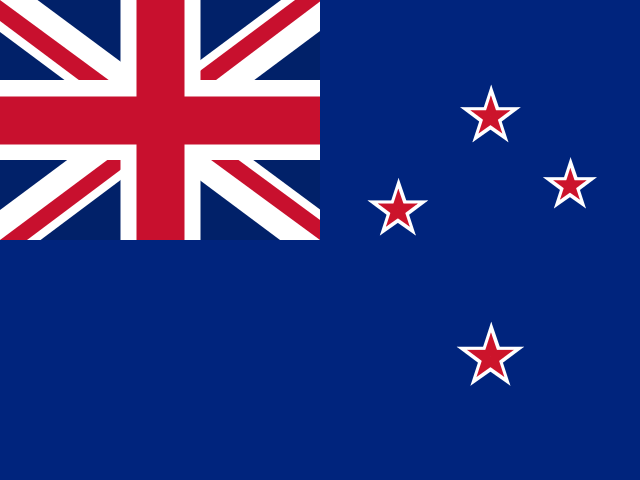
 New Zealand
Description of New Zealand
New Zealand, a picturesque island nation in the southwestern Pacific Ocean, is renowned for its stunning natural landscapes, vibrant Maori culture, and progressive society. With a population known for its warmth and friendliness, New Zealand offers a unique blend of modernity and tradition. From the snow-capped peaks of the Southern Alps to the sandy beaches of its North Island, this country is a playground for outdoor enthusiasts and adventure seekers. As a nation that values sustainability and innovation, New Zealand has made significant strides in various sectors, making it an intriguing subject for geopolitical and macroeconomic analysis.
Population And Age Structure
Population, total: New Zealand has a population of 5,090,200. This is below the average population of 40,097,746. New Zealand ranks 120 out of 194 countries in terms of population.
Population ages 0-14 (% of total population): In New Zealand, 19.07% of the population is aged 0-14. This percentage is below the average of 27.34%. New Zealand ranks 135 out of 194 countries in this age group.
Population ages 0-14, total: With a total of 970,608 children aged 0-14, New Zealand is below the average of 10,327,379. New Zealand ranks 124 out of 194 countries in this category.
Population ages 15-64 (% of total population): The working-age population (15-64 years) in New Zealand accounts for 65.35% of the total population, slightly above the average of 63.44%. New Zealand ranks 77 out of 194 countries in this age group.
Population ages 15-64, total: New Zealand has 3,326,620 individuals aged 15-64, which is below the average of 26,003,407. New Zealand ranks 118 out of 194 countries for this age group.
Population ages 65 and above (% of total population): The elderly population (65 and above) in New Zealand constitutes 15.58% of the total population, significantly above the average of 9.22%. New Zealand ranks 42 out of 194 countries in this age category.
Population ages 65 and above, total: With a total of 792,972 individuals aged 65 and above, New Zealand is below the average of 3,766,959. New Zealand ranks 81 out of 194 countries in this age group.
Summary
New Zealand has a relatively small total population compared to the global average, with a higher proportion of working-age individuals and elderly citizens. The country has a lower number of children aged 0-14 compared to the average. These demographic indicators are crucial for policymakers as they highlight New Zealand's aging population trend, which can impact healthcare systems, pension schemes, labor force dynamics, and overall economic productivity.
Population Miscellaneous
1. The rural population of New Zealand is 677,048, significantly below the attribute average of 18,044,041. New Zealand ranks 142 out of 190 countries in this category.
2. The percentage of rural population in New Zealand is 13.301%, well below the average of 41.158%. The country ranks 166 out of 190 countries for this indicator.
3. New Zealand's urban population stands at 4,413,152, much lower than the attribute average of 22,425,747. The country ranks 98 out of 194 countries in urban population.
4. With 86.699% of its population living in urban areas, New Zealand exceeds the attribute average of 59.691%. The country is ranked 29 out of 194 in this aspect.
5. The age dependency ratio in New Zealand is 53.014%, slightly lower than the average of 59.219%. The country ranks 118 out of 194 countries for this ratio.
6. The crude birth rate in New Zealand is 11.32 births per 1,000 people, lower than the average of 19.384. The country ranks 139 out of 192 countries in terms of birth rate.
7. New Zealand's crude death rate is 6.41 deaths per 1,000 people, slightly below the average of 8.214. The country ranks 138 out of 192 countries for this rate.
8. The total fertility rate in New Zealand is 1.61 births per woman, significantly lower than the average of 2.603. The country ranks 136 out of 190 countries for fertility rate.
Summary
New Zealand exhibits a unique demographic profile with a relatively low rural population, high urbanization rate, and comparatively lower birth and death rates. The country's total fertility rate is notably below the global average. These indicators are crucial as they reflect New Zealand's demographic structure, urbanization trends, and potential implications for future population growth and workforce dynamics.
Military
1. Military expenditure (current USD): New Zealand's military expenditure of 2.81 billion USD is below the average of 12.91 billion USD. New Zealand is ranked 51st out of 149 countries in the dataset.
2. Military expenditure (% of GDP): New Zealand's military expenditure as a percentage of GDP is 1.34%, below the average of 1.90%. The country is ranked 92nd out of 148 countries.
3. Arms imports (SIPRI trend indicator values): New Zealand's arms imports amount to 125 million USD, lower than the average of 205.52 million USD. It ranks 34th out of 113 countries.
4. Armed forces personnel, total: New Zealand has 10,000 armed forces personnel, significantly lower than the average of 165,908 personnel. The country is ranked 132nd out of 164 countries.
5. Armed forces personnel (% of total labor force): Only 0.35% of New Zealand's total labor force is comprised of armed forces personnel, well below the average of 1.28%. The country is ranked 138th out of 164 countries.
Summary
New Zealand has a relatively low military expenditure compared to the average, ranking 51st in total expenditure and 92nd in percentage of GDP. The country also imports fewer arms and has a significantly smaller number of armed forces personnel compared to the average, ranking 34th and 132nd respectively. With only 0.35% of its total labor force in the armed forces, New Zealand ranks 138th in this category. These indicators suggest that New Zealand prioritizes other areas of development over military investment, potentially focusing more on economic and social welfare programs.
Natural Resources
1. Forest area (sq. km): New Zealand has a forest area of 98,925.9 sq. km, which is below the average of 211,606.11 sq. km. This ranks New Zealand 53rd out of 191 countries in the dataset.
2. Land area (sq. km): With a land area of 263,310 sq. km, New Zealand falls below the average of 665,166.51 sq. km. It ranks 74th out of 194 countries in the dataset.
3. Surface area (sq. km): New Zealand's surface area of 267,710 sq. km is also below the average of 689,779.56 sq. km. This places New Zealand at the 74th position out of 194 countries.
4. Arable land (hectares): New Zealand has 527,000 hectares of arable land, significantly lower than the average of 7,329,543.16 hectares. It ranks 123rd out of 190 countries.
5. Land under cereal production (hectares): The land under cereal production in New Zealand is 112,694 hectares, well below the average of 4,206,011.63 hectares. This places New Zealand at the 133rd position out of 174 countries.
6. Average precipitation in depth (mm per year): New Zealand receives an average precipitation depth of 1,732 mm per year, which is higher than the average of 1,157.83 mm per year. This ranks New Zealand 43rd out of 178 countries.
7. Renewable internal freshwater resources, total (billion cubic meters): With 327 billion cubic meters of renewable internal freshwater resources, New Zealand surpasses the average of 240.41 billion cubic meters. This ranks New Zealand 24th out of 178 countries.
Summary
New Zealand's key macroeconomic indicators show that it has a relatively small forest area, land area, and arable land compared to the global averages. However, the country receives above-average precipitation and has abundant renewable internal freshwater resources. These indicators are crucial as they highlight New Zealand's environmental characteristics and potential limitations for agricultural development, while also pointing out its water resource abundance which could be leveraged for various economic activities.
Resource Rents
Total natural resources rents (% of GDP): New Zealand's value is 1.27% of GDP, below the average of 4.63%. It ranks 94 out of 175 countries in this dataset.
Coal rents (% of GDP): New Zealand's value is 0.02% of GDP, significantly below the average of 0.40%. It ranks 36 out of 65 countries in this dataset.
Forest rents (% of GDP): New Zealand's value is 0.94% of GDP, below the average of 1.53%. It ranks 59 out of 174 countries in this dataset.
Oil rents (% of GDP): New Zealand's value is 0.04% of GDP, well below the average of 2.51%. It ranks 77 out of 117 countries in this dataset.
Natural gas rents (% of GDP): New Zealand's value is 0.23% of GDP, below the average of 1.25%. It ranks 41 out of 96 countries in this dataset.
Mineral rents (% of GDP): New Zealand's value is 0.04% of GDP, significantly below the average of 1.23%. It ranks 64 out of 86 countries in this dataset.
Summary
New Zealand shows lower than average values in natural resources rents, including coal, forest, oil, natural gas, and mineral rents as a percentage of GDP. Despite having rich natural resources, the country's rankings are moderate to low compared to global averages. These indicators are crucial as they reflect the country's utilization and monetization of its natural resources, impacting its economic growth, competitiveness, and sustainability.
Commodities
- In terms of Cereal production (metric tons), New Zealand's value of 1,018,704.8 metric tons is significantly below the average of 17,249,945.93 metric tons. New Zealand ranks 108 out of 174 countries.
- For Aquaculture production (metric tons), New Zealand's 118,582 metric tons is below the average of 679,642.92 metric tons. It ranks 36 out of 180 countries.
- New Zealand's Capture fisheries production stands at 364,964.03 metric tons, which is below the average of 467,453.06 metric tons. The country ranks 43 out of 190 nations.
- Concerning Total fisheries production, New Zealand's 483,546.03 metric tons are below the average of 1,153,914.85 metric tons. The country ranks 39 out of 182 countries.
- In Fertilizer consumption (kilograms per hectare of arable land), New Zealand's value of 1,725.89 kilograms per hectare is significantly above the average of 159.04 kilograms per hectare. The country ranks 1 out of 187 nations.
Summary
Overall, in key macroeconomic indicators related to food production and resource management, New Zealand shows lower production levels in cereal, aquaculture, capture fisheries, and total fisheries compared to global averages. However, it excels in fertilizer consumption per hectare of arable land, surpassing the average consumption by a significant margin and ranking first globally in this aspect.
These findings are important as they highlight New Zealand's strength in resource management through efficient fertilizer use despite lower production levels in certain food sectors. This underscores the country's ability to maximize agricultural output and sustainability per unit of arable land, showcasing a strategic advantage in ensuring food security and environmental stewardship.
Intellectual Property
Industrial design applications, nonresident, by count: New Zealand has 1015 applications, which is below the average of 1415.83. It ranks 25 out of 112 countries.
Industrial design applications, resident, by count: New Zealand has 352 applications, significantly below the average of 9799.58. It ranks 47 out of 113 countries.
Patent applications, nonresidents: New Zealand has 5417 applications, lower than the average of 6538.40. It ranks 20 out of 129 countries.
Patent applications, residents: New Zealand has 348 applications, much lower than the average of 19037.56. It ranks 52 out of 117 countries.
Trademark applications, nonresident, by count: New Zealand has 33014 applications, above the average of 15878.93. It ranks 15 out of 130 countries.
Trademark applications, resident, by count: New Zealand has 22625 applications, well below the average of 111055.78. It ranks 32 out of 129 countries.
Scientific and technical journal articles: New Zealand has 8983.48 articles, below the average of 15103.76. It ranks 44 out of 192 countries.
Charges for the use of intellectual property, payments (BoP, current US$): New Zealand's value is $835,111,263.19, much lower than the average of $3,218,843,494.39. It ranks 41 out of 143 countries.
Charges for the use of intellectual property, receipts (BoP, current US$): New Zealand's value is $835,384,144.14, significantly below the average of $3,191,687,117.58. It ranks 28 out of 122 countries.
Summary
New Zealand consistently ranks below average in various key macroeconomic indicators such as industrial design applications, patent applications, trademark applications, scientific and technical journal articles, and charges for the use of intellectual property. These rankings suggest a relatively lower level of innovation and intellectual property activity compared to the global average, which could impact New Zealand's competitiveness and ability to generate income from intellectual property assets.
Broad Economy Attributes
The GDP (current US$) of New Zealand is $212.57 billion, ranking 48th out of 189 countries, which is below the average GDP for this attribute.
New Zealand's GDP, PPP (current international $) is $230.36 billion, ranking 62nd out of 181 countries. This figure is significantly below the attribute average.
With a GDP per capita (current US$) of $41,760.59, New Zealand ranks 23rd out of 190 countries, showcasing an income above the attribute average.
The GDP per capita, PPP (current international $) for New Zealand is $45,256.27, placing it 27th out of 181 countries. This is again above the attribute average.
New Zealand's GNI (current US$) is $208.32 billion, ranking 48th out of 185 countries, falling below the average for this attribute.
The country's GNI, PPP (current international $) stands at $225.76 billion, placing it 63rd out of 181 countries, significantly below the attribute average.
With a GNI per capita, PPP (current international $) of $44,350, New Zealand ranks 28th out of 181 countries. This figure is above the attribute average.
Summary
Overall, New Zealand's GDP and GNI figures are below the global average, indicating a relatively smaller economy on a total output and income basis. However, the country performs well in terms of GDP and GNI per capita, ranking above average internationally. This signifies that while New Zealand may have a smaller overall economic size compared to other nations, its citizens enjoy a higher standard of living and income levels relative to many countries.
These statistics are crucial as they provide insights into the economic well-being of the country and its citizens. The strong performance in GDP and GNI per capita indicates a higher level of wealth distribution and quality of life within New Zealand, which can attract investments, support domestic consumption, and contribute to overall social stability and development.
Broad Value Added
New Zealand's Gross Value Added at Basic Prices (GVA) is $195,622,301,361.28, ranking 44th out of 176 countries. This is below the average GVA of $360,070,943,595.12.
For Agriculture, forestry, and fishing value added (% of GDP), New Zealand's value is 5.65%, ranking 108th out of 182 countries, which is below the average of 10.86%.
New Zealand's Agriculture, forestry, and fishing value added in current US dollars is $12,014,461,190.94, placing it 43rd out of 182 countries, below the average of $19,924,732,828.07.
In Services value added (% of GDP), New Zealand ranks 38th out of 183 countries, with a value of 66.67%, higher than the average of 56.72%.
Regarding Services value added in current US dollars, New Zealand's value is $141,713,834,863.58, ranking 47th out of 183 countries and below the average of $295,837,711,130.69.
Finally, New Zealand's Industry (including construction) value added in current US dollars is $41,894,005,306.76, placing it 54th out of 183 countries, which is below the average of $118,421,095,413.50.
Summary
New Zealand demonstrates a relatively strong presence in the services sector compared to agriculture and industry, as indicated by its higher rankings in Services value added (% of GDP) and value added in current US dollars. The country's lower rankings in Agriculture, forestry, and fishing value added (% of GDP) and Industry value added in current US dollars suggest room for further development in these sectors. These indicators are crucial as they highlight New Zealand's economic structure, showing areas of strength and potential improvement for policymakers and investors.
Manufacturing Value Added
Manufacturing, value added (current US$): New Zealand's value is significantly below the attribute average, ranking 52 out of 173 countries in the dataset.
Manufacturing, value added (% of GDP): New Zealand's value is below the attribute average, ranking 108 out of 173 countries in the dataset.
Medium and high-tech manufacturing value added (% manufacturing value added): New Zealand's value is below the attribute average, ranking 79 out of 149 countries in the dataset.
Chemicals (% of value added in manufacturing): New Zealand's value is below the attribute average, ranking 76 out of 89 countries in the dataset.
Food, beverages and tobacco (% of value added in manufacturing): New Zealand's value is above the attribute average, ranking 15 out of 92 countries in the dataset.
Machinery and transport equipment (% of value added in manufacturing): New Zealand's value is slightly above the attribute average, ranking 43 out of 93 countries in the dataset.
Textiles and clothing (% of value added in manufacturing): New Zealand's value is below the attribute average, ranking 61 out of 93 countries in the dataset.
Other manufacturing (% of value added in manufacturing): New Zealand's value is below the attribute average, ranking 57 out of 94 countries in the dataset.
Summary
New Zealand's manufacturing sector shows mixed performance compared to global averages. While the country excels in the food, beverages, and tobacco sub-sector, it lags in chemicals and textiles. This is crucial as it indicates New Zealand's strengths and weaknesses in different manufacturing industries, highlighting areas for improvement and potential for growth in diversifying its manufacturing base.
Money
1. Inflation, consumer prices (annual %): New Zealand's inflation rate of 1.71% is below the average of 8.26% and ranks 91 out of 165 countries.
2. Inflation, GDP deflator (annual %): New Zealand's GDP deflator inflation rate of 2.01% is below the average of 6.90% and also ranks 91 out of 188 countries.
3. Broad money growth (annual %): New Zealand's broad money growth rate of 12.18% is below the average of 18.03% and ranks 80 out of 139 countries.
4. Broad money (% of GDP): New Zealand's broad money as a percentage of GDP is 111.59%, above the average of 71.75% and ranks 22 out of 139 countries.
5. Broad money to total reserves ratio: New Zealand's ratio of broad money to total reserves is 17.27, above the average of 5.17 and ranks 7 out of 126 countries.
Summary
New Zealand performs below the global average in key macroeconomic indicators such as inflation rates and broad money growth. However, it stands out with a high broad money percentage of GDP and a strong broad money to total reserves ratio compared to other countries. These statistics are crucial as they reflect New Zealand's monetary stability, economic growth potential, and ability to manage financial risks effectively in the international arena.
Consumption Expenditure
Final consumption expenditure (current US$): New Zealand's final consumption expenditure is 164,476,916,675.23, which is significantly below the average of 381,630,252,515.38. New Zealand ranks 45th out of 159 countries in this category.
Final consumption expenditure (% of GDP): New Zealand's final consumption expenditure as a percentage of GDP is 77.38%, slightly below the average of 82.37%. New Zealand is ranked 96th out of 159 countries in this metric.
General government final consumption expenditure (current US$): New Zealand's general government final consumption expenditure is 43,557,366,506.89, well below the average of 93,676,578,238.03. The country ranks 39th out of 158 nations.
General government final consumption expenditure (% of GDP): New Zealand's general government final consumption expenditure as a percentage of GDP is 20.49%, above the average of 18.71%. New Zealand holds the 56th rank out of 158 countries.
Household and NPISHs Final consumption expenditure (current US$): New Zealand's expenditure in this category is 120,919,550,168.34, significantly below the average of 290,127,571,157.69. The country is ranked 45th out of 158 nations.
Households and NPISHs final consumption expenditure (% of GDP): New Zealand's household and NPISHs final consumption expenditure as a percentage of GDP stands at 56.88%, below the average of 63.68%. The country holds the 103rd rank out of 158 countries in this aspect.
Summary
New Zealand's final consumption expenditure, general government final consumption expenditure, and household expenditure are all below global averages, indicating a relatively conservative approach to spending. This could imply potential opportunities for increased government or private sector investment to stimulate economic growth and consumption within the country.
Equities
- Listed domestic companies, total: New Zealand has 122 listed domestic companies, ranking 38th out of 72 countries in the dataset. The number is significantly below the average of 636.625 companies.
- Stocks traded, total value (current US$): New Zealand's total value of $22,199,380,000 ranks 29th out of 71 countries. This value is substantially lower than the average of $1,379,501,950,182.91.
- Stocks traded, total value (% of GDP): With a value of 10.44% of GDP, New Zealand ranks 27th out of 71 countries. This percentage is notably below the average of 31.65%.
- Market capitalization of listed domestic companies (current US$): New Zealand's market capitalization stands at $132,198,460,000, placing it 29th out of 73 countries. This figure is well below the average of $1,196,037,851,618.88.
- Market capitalization of listed domestic companies (% of GDP): At 62.19% of GDP, New Zealand ranks 26th out of 73 countries. This percentage is slightly below the average of 71.24%.
- S&P Global Equity Indices (annual % change): New Zealand's equity indices show significant growth with an annual change of 25.54%, ranking 8th out of 79 countries. This figure is substantially above the average annual change of 2.06%.
Summary
New Zealand performs below average in terms of the number of listed domestic companies, total value of stocks traded, market capitalization of listed domestic companies, and their respective percentages of GDP compared to the dataset averages. However, the country stands out with a remarkable 25.54% annual change in S&P Global Equity Indices, placing it 8th among the listed countries.
These indicators are crucial as they reflect the depth and activity of New Zealand's financial markets. The low rankings in the number of listed companies and stock market values suggest potential room for growth and increased participation in the financial sector. On the other hand, the significant growth in equity indices indicates a positive trend in the country's stock market performance, which can attract investors and boost confidence in the economy.
Investment
Analysis of Key Investment Statistics for New Zealand:
1. Foreign direct investment, net (BoP, current US$): New Zealand's value of -3413149095.32 is below the average of -1615235980.51. This places New Zealand at rank 141 out of 169 countries.
2. Foreign direct investment, net inflows (BoP, current US$): With a value of 4135119591.15, New Zealand is below the average of 5749271080.15. The country ranks 35 out of 182 countries for this statistic.
3. Foreign direct investment, net inflows (% of GDP): New Zealand's value of 1.95% is lower than the average of 2.61%. This places New Zealand at rank 83 out of 178 countries.
4. Foreign direct investment, net outflows (BoP, current US$): New Zealand's value of 721970495.83 is significantly below the average of 5707991116.07. This ranks New Zealand at position 45 out of 156 countries.
5. Foreign direct investment, net outflows (% of GDP): At 0.34%, New Zealand's value is lower than the average of 1.00%. The country ranks 65 out of 155 countries in this metric.
6. Portfolio Investment, net (BoP, current US$): New Zealand's value of 9231640746.92 is significantly higher than the average of 679559169.57. This places New Zealand at a high rank of 21 out of 159 countries.
7. Portfolio equity, net inflows (BoP, current US$): With a value of 1419134920.46, New Zealand is below the average of 9197145994.70. The country ranks 18 out of 125 countries for this statistic.
Summary
New Zealand performs below the global averages in foreign direct investment metrics, both in terms of inflows and outflows as a percentage of GDP. However, the country excels in portfolio investments, with significantly higher net values compared to the global average. These statistics are crucial as they indicate New Zealand's reliance on portfolio investments rather than foreign direct investments, which can have implications on the country's economic stability and growth trajectory.
Broad Trade Attributes
Trade (% of GDP): New Zealand's trade as a percentage of GDP is 43.98%, which is below the average of 82.34%. The country is ranked 132 out of 163 countries in this aspect.
Merchandise trade (% of GDP): New Zealand's merchandise trade as a percentage of GDP is 35.53%, lower than the average of 60.01%. The country is ranked 151 out of 186 countries in this category.
Trade in services (% of GDP): New Zealand's trade in services as a percentage of GDP is 10.92%, below the average of 24.63%. The country holds the 114th rank out of 171 countries in this metric.
External balance on goods and services (current US$): New Zealand has an external balance on goods and services of -1,050,543,915.87 USD, which is lower than the average of 3,405,509,011.13 USD. The country ranks 105 out of 163 countries in this aspect.
External balance on goods and services (% of GDP): New Zealand's external balance on goods and services as a percentage of GDP is -0.49%, whereas the average is -5.97%. The country is ranked 69 out of 163 countries based on this indicator.
Summary
New Zealand displays a below-average performance in key macroeconomic indicators related to trade, merchandise trade, trade in services, and external balance on goods and services. The country ranks relatively low compared to global averages in these aspects, indicating potential challenges in maintaining a balance between imports and exports and in leveraging the services sector for economic growth.
These indicators are essential as they provide insights into the country's economic openness, competitiveness in international trade, and ability to generate revenue through services. Understanding these metrics helps policymakers, businesses, and investors make informed decisions to enhance trade relations, boost economic growth, and ensure sustainable development.
Net Trade
1. Current account balance (BoP, current US$): New Zealand's current account balance is significantly below the average, with a value of -2400615210.43. This places New Zealand at rank 136 out of 170 countries included in the data.
2. Current account balance (% of GDP): New Zealand's current account balance as a percentage of GDP is below average at -1.13%. The country ranks 80 out of 170 in this aspect.
3. Net trade in goods and services (BoP, current US$): New Zealand's net trade in goods and services is below average at 2054344452.08, placing the country at rank 47 out of 171.
4. Net primary income (BoP, current US$): New Zealand's net primary income is significantly below the average at -4004255396.88. The country ranks 139 out of 170.
5. Net secondary income (BoP, current US$): New Zealand's net secondary income is below the average at -450704265.62. The country ranks 134 out of 170.
6. Net trade in goods (BoP, current US$): New Zealand's net trade in goods is above the average at 1478350428.38, placing the country at rank 50 out of 171.
7. Net capital account (BoP, current US$): New Zealand's net capital account is below average at -29356205.56. The country ranks 131 out of 159.
8. Net financial account (BoP, current US$): New Zealand's net financial account is significantly below the average at -5349139177.11. This places New Zealand at rank 150 out of 170 countries included in the data.
Summary
New Zealand's macroeconomic indicators, such as its current account balance, net trade in goods and services, and net financial account, consistently rank below average compared to other countries included in the data. These indicators suggest that New Zealand may be facing challenges in terms of international trade competitiveness, income generation, and financial stability. It is crucial for policymakers and investors to closely monitor and address these indicators to ensure sustainable economic growth and stability for the country.
Broad Export Attributes
1. Exports of goods, services and primary income (BoP, current US$): New Zealand's value for this attribute is $55,676,388,453.00, which is below the average of $146,238,908,936.30. New Zealand ranks 48th out of 170 countries in this dataset.
2. Exports of goods and services (BoP, current US$): New Zealand's value is $50,172,608,101.86, below the average of $122,938,540,059.78. The country ranks 48th out of 170 countries in this category.
3. Exports of goods and services (current US$): New Zealand's value is $46,213,556,555.90, below the average of $129,596,864,610.19. The country ranks 52nd out of 163 countries for this attribute.
4. Exports of goods and services (% of GDP): New Zealand's percentage is 21.74%, lower than the average of 38.19%. The country ranks 115th out of 163 countries in this dataset.
5. Goods exports (BoP, current US$): New Zealand's value is $38,280,232,661.95, which is below the average of $93,310,581,697.39. New Zealand ranks 49th out of 171 countries for this attribute.
6. ICT goods exports (% of total goods exports): The percentage for New Zealand is 0.9999%, lower than the average of 3.8062%. The country ranks 65th out of 142 countries in this category.
Summary
New Zealand's export performance across various categories such as goods, services, and primary income falls below the global averages, with rankings ranging from 48th to 115th out of the countries analyzed. The lower export values and rankings indicate that New Zealand may face challenges in diversifying its exports and maximizing its trade potential on the global stage. Improving export competitiveness and expanding into new markets could be crucial for enhancing economic growth and stability in New Zealand.
Merchandise Exports
Merchandise exports (current US$): New Zealand's merchandise exports amount to $38.38 billion, ranking 52nd out of 187 countries. This value is below the attribute average of $89.54 billion.
Agricultural raw materials exports (% of merchandise exports): New Zealand's export of agricultural raw materials accounts for 10.45% of its merchandise exports. This places New Zealand in the 9th position out of 151 countries, well above the attribute average of 2.97%.
Food exports (% of merchandise exports): 67.85% of New Zealand's merchandise exports are food products, ranking the country 10th out of 152 countries. This percentage is significantly higher than the attribute average of 24.06%.
Fuel exports (% of merchandise exports): New Zealand's fuel exports represent only 1.10% of its merchandise exports, placing the country in the 106th position out of 147 countries. This value is notably below the attribute average of 13.70%.
Ores and metals exports (% of merchandise exports): New Zealand's ores and metals exports constitute 2.46% of its merchandise exports, ranking the country 89th out of 152 countries. This percentage is lower than the attribute average of 9.10%.
Merchandise exports by the reporting economy, residual (% of total merchandise exports): New Zealand's residual merchandise exports make up 2.03% of its total merchandise exports, placing the country 41st out of 166 countries. New Zealand's value is below the attribute average of 3.20%.
Summary
New Zealand has a diverse export profile, with a strong focus on food products, which account for a significant portion of its merchandise exports. While the country's agricultural raw materials exports are also substantial, its fuel and ores/metals exports contribute less to its overall exports. Understanding these export compositions is crucial for New Zealand's economic strategy and trade relationships, as it highlights the country's strengths and areas for potential growth and diversification in the global market.
Technology Exports
Manufactures exports (% of merchandise exports): New Zealand's value of 16.66% is below the average of 42.62%. It ranks 109 out of 152 countries.
High-technology exports (current US$): New Zealand's value of $588,997,833 is significantly below the average of $16,655,934,078.80. It ranks 60 out of 151 countries.
High-technology exports (% of manufactured exports): New Zealand's value of 9.61% is slightly below the average of 10.15%. It ranks 55 out of 150 countries.
Medium and high-tech exports (% manufactured exports): New Zealand's value of 17.99% is below the average of 34.29%. It ranks 99 out of 149 countries.
Summary
New Zealand performs below the global average in key macroeconomic indicators related to exports. It has lower percentages in manufactures exports, high-technology exports, high-technology exports as a percentage of manufactured exports, and medium and high-tech exports compared to the global average. These findings are important as they suggest that New Zealand may need to focus on diversifying and increasing the technological capabilities of its export sector to enhance its competitiveness in the global market and potentially boost economic growth.
Service Exports
1. Service exports (BoP, current US$): New Zealand's value of $11,892,375,439.91 is below the average of $28,917,292,503.82. It ranks 46th out of 171 countries.
2. ICT service exports (BoP, current US$): New Zealand's value of $975,536,034.75 is below the average of $4,578,501,153.77. It ranks 57th out of 166 countries.
3. ICT service exports (% of service exports, BoP): New Zealand's value of 8.20% is below the average of 11.75%. It ranks 89th out of 166 countries.
4. Communications, computer, etc. (% of service exports, BoP): New Zealand's value of 32.02% is below the average of 45.85%. It ranks 116th out of 169 countries.
5. Transport services (% of service exports, BoP): New Zealand's value of 10.81% is below the average of 21.80%. It ranks 114th out of 169 countries.
6. Travel services (% of service exports, BoP): New Zealand's value of 47.81% is above the average of 26.40%. It ranks 28th out of 167 countries.
7. Insurance and financial services (% of service exports, BoP): New Zealand's value of 4.09% is below the average of 6.46%. It ranks 74th out of 161 countries.
Summary
New Zealand performs below the global average in key macroeconomic indicators such as Service exports, ICT service exports, and various service export components like Communications, computer, Transport services, and Insurance and financial services. Its ranking in these indicators ranges from 28th to 116th out of various countries. These indicators are crucial as they reflect New Zealand's competitiveness and integration in the global economy, highlighting areas where the country may need to enhance its export capabilities to improve its economic standing and reach.
Commercial Service Exports
New Zealand's commercial service exports amount to $11,758,787,756.78, ranking 46th out of 171 countries. This is below the average of $28,508,218,402.80.
The country's travel services account for 48.35% of its commercial service exports, ranking 30th out of 167 countries. This percentage is above the average of 27.89%.
New Zealand's computer, communications, and other services contribute 36.57% to its commercial service exports, placing it 100th out of 169 countries. This is below the average of 42.44%.
The insurance and financial services sector in New Zealand represents 4.14% of its commercial service exports, ranking 77th out of 161 countries. This figure is below the average of 6.97%.
In terms of transport services, New Zealand's contribution is 10.93% of its commercial service exports, ranking 115th out of 169 countries. This is below the average percentage of 23.37%.
Summary
New Zealand's commercial service exports are below the global average, with a significant portion coming from travel services, which is above the average. However, the contribution from computer, communications, and other services is below average. The country also lags in insurance and financial services as well as transport services compared to global averages.
These findings are crucial as they highlight New Zealand's reliance on travel services for export income, potentially exposing the economy to fluctuations in the tourism industry. The below-average contributions from other service sectors could indicate areas for potential growth and diversification to enhance the country's export resilience and competitiveness in the global market.
Broad Import Attributes
1. Imports of goods and services (current US$): New Zealand's value of $47,264,100,471.77 is below the average of $126,191,355,599.06. It ranks 54th out of 163 countries in the dataset.
2. Imports of goods and services (% of GDP): New Zealand's value of 22.23% is below the average of 44.15%. It ranks 136th out of 163 countries in the dataset.
3. ICT goods imports (% total goods imports): New Zealand's value of 8.21% is above the average of 6.85%. It ranks 36th out of 143 countries in the dataset.
4. Goods imports (BoP, current US$): New Zealand's value of $36,801,248,037.73 is below the average of $92,007,788,027.17. It ranks 53rd out of 171 countries in the dataset.
5. Imports of goods and services (BoP, current US$): New Zealand's value of $48,118,263,649.79 is below the average of $120,321,577,988.12. It ranks 53rd out of 170 countries in the dataset.
6. Imports of goods, services and primary income (BoP, current US$): New Zealand's value of $57,625,682,494.66 is below the average of $144,514,428,722.28. It ranks 52nd out of 170 countries in the dataset.
Summary
New Zealand's imports of goods and services, both in absolute terms and as a percentage of its GDP, are below global averages, ranking 54th and 136th out of 163 countries respectively. However, the country imports a relatively higher percentage of ICT goods compared to other nations, ranking 36th in this category. These indicators are important as they reflect New Zealand's level of integration in the global economy and its investment in digital technology, which can impact its competitiveness and economic growth in the long run.
Merchandise Imports
1. Merchandise imports (current US$): New Zealand's value of $37,152,000,000 is below the average of $89,385,605,263. New Zealand ranks 55th out of 190 countries in this attribute data.
2. Manufactures imports (% of merchandise imports): With a value of 74.96%, New Zealand exceeds the average of 66.76%. The country ranks 32nd out of 152 countries.
3. Agricultural raw materials imports (% of merchandise imports): New Zealand's value of 0.83% is less than the average of 1.27%. It ranks 105th out of 152 countries in this category.
4. Food imports (% of merchandise imports): At 13.41%, New Zealand falls below the average of 15.89%. The country ranks 86th out of 152 countries.
5. Fuel imports (% of merchandise imports): New Zealand's value of 8.60% is lower than the average of 11.38%. It ranks 96th out of 152 countries.
6. Ores and metals imports (% of merchandise imports): With a value of 1.85%, New Zealand is below the average of 2.57%. The country ranks 72nd out of 152 countries.
7. Merchandise imports by the reporting economy, residual (% of total merchandise imports): New Zealand's value of 0.14% is significantly lower than the average of 2.51%. It ranks 123rd out of 180 countries in this attribute.
Summary
New Zealand's key macroeconomic indicators for merchandise imports reveal that the country generally imports less in value compared to the global average, but it tends to prioritize manufactured goods over agricultural raw materials, food, fuel, and ores/metals. The low percentage of residual imports by the reporting economy indicates a more streamlined and efficient import process. These indicators are important as they reflect New Zealand's trade preferences, economic priorities, and efficiency in managing imports.
Service Imports
Service imports (BoP, current US$): New Zealand's value for service imports is $11,317,015,612.06, which is below the average of $27,615,356,170.47. This places New Zealand at rank 51 out of 171 countries.
Communications, computer, etc. (% of service imports, BoP): New Zealand's percentage for this attribute is 53.61%, above the average of 44.40%. New Zealand is ranked 58 out of 169 countries.
Transport services (% of service imports, BoP): New Zealand's percentage for transport services is 18.46%, below the average of 32.90%. This places New Zealand at rank 138 out of 169 countries.
Travel services (% of service imports, BoP): New Zealand's percentage for travel services is 12.81%, below the average of 14.14%. New Zealand ranks 72 out of 169 countries.
Insurance and financial services (% of service imports, BoP): New Zealand's percentage for insurance and financial services is 15.13%, above the average of 8.53%. This places New Zealand at rank 24 out of 169 countries.
Summary
New Zealand has a below-average value for service imports, ranking 51 out of 171 countries, with a significant portion allocated to communications, computer, etc. services. However, its percentages for transport and travel services are below average, leading to lower rankings in these categories. The country excels in importing insurance and financial services, ranking 24th globally. These indicators are crucial as they reflect New Zealand's reliance on specific service sectors for imports, highlighting strengths and areas for potential growth in the country's economy.
Commercial Service Imports
Commercial service imports in New Zealand amount to $11,191,419,374.95, ranking 50th out of 171 countries. This value is significantly below the average of $27,102,746,128.60.
Computer, communications, and other services as a percentage of commercial service imports in New Zealand stand at 53.09%, ranking 56th out of 169 countries. This figure is above the average of 41.71%.
New Zealand's insurance and financial services as a percentage of commercial service imports are 15.30%, placing it 25th out of 169 countries. This value is notably higher than the average of 8.85%.
Transport services as a percentage of commercial service imports in New Zealand stand at 18.66%, ranking 142nd out of 169 countries. This figure is below the average of 34.71%.
Travel services as a percentage of commercial service imports in New Zealand are 12.95%, placing it 73rd out of 169 countries. This value is slightly below the average of 14.73%.
Summary
New Zealand's commercial service imports are relatively low compared to the global average, but it allocates a significant portion of these imports towards computer, communications, and other services as well as insurance and financial services. However, it lags behind in allocating funds to transport services. These indicators are crucial as they reflect New Zealand's reliance on services for its economy, highlighting areas of strength and potential areas for improvement in its international trade and economic development strategies.
Infrastructure
1. Railways, passengers carried: New Zealand's value of 802.03 million passenger-km is significantly below the average of 32,281.92 million passenger-km. With a rank of 37 out of 64 countries, there is room for potential growth in this sector.
2. Railways, goods transported: New Zealand's value of 4,131 million ton-km is well below the average of 119,231.19 million ton-km. Ranked 35 out of 62 countries, there is an opportunity to enhance the transportation of goods via railways.
3. Air transport, freight: New Zealand's value of 773.95 million ton-km is below the average of 1,384.37 million ton-km. With a rank of 28 out of 126 countries, improvements in air freight services could be pursued.
4. Air transport, registered carrier departures worldwide: New Zealand's value of 123,038.32 departures is slightly below the average of 134,365.61 departures. Ranked 29 out of 149 countries, the country maintains a decent position in terms of air transport departures.
5. Air transport, passengers carried: New Zealand's value of 8,516,619.50 passengers carried falls below the average of 11,848,242.70 passengers carried. Ranked 32 out of 149 countries, there could be opportunities to attract more air passengers to and from New Zealand.
6. Container port traffic: New Zealand's container port traffic of 3,445,621 TEU is below the average of 6,907,110.27 TEU. With a rank of 36 out of 110 countries, there is potential for growth in container port activity to enhance trade.
Summary
New Zealand lags behind the global averages in key transportation indicators such as railways passengers carried, goods transported, air transport freight, registered carrier departures, passengers carried, and container port traffic. These statistics suggest that there is considerable room for improvement and growth in New Zealand's transportation infrastructure and services to enhance connectivity, trade, and economic development. Strengthening these sectors can lead to increased efficiency, competitiveness, and integration with the global economy, ultimately contributing to New Zealand's overall economic growth and prosperity.
Information Technology Infrastructure
When it comes to Secure Internet servers, New Zealand boasts 104,397 servers, which is below the attribute average of 458,294. New Zealand ranks 45th out of 193 countries in this category.
For Secure Internet servers per 1 million people, New Zealand has 20,509 servers, surpassing the attribute average of 14,067. New Zealand ranks 39th out of 193 countries in this metric.
New Zealand excels in Individuals using the Internet (% of population) with 92.87% of its population online, significantly higher than the average of 64.77%. The country ranks 21st out of 180 nations.
In terms of Fixed broadband subscriptions, New Zealand has 1,764,984 subscriptions, falling below the attribute average of 6,591,956. New Zealand ranks 59th out of 185 countries in this aspect.
Regarding Mobile cellular subscriptions, New Zealand has 6,236,000 subscriptions, also below the attribute average of 42,526,464. The country ranks 112th out of 193 nations for mobile cellular subscriptions.
Summary
New Zealand performs below average in terms of Secure Internet servers and Fixed broadband subscriptions compared to global standards. However, the country excels in Secure Internet servers per 1 million people, Individuals using the Internet (% of population), and Mobile cellular subscriptions. These findings are important as they indicate New Zealand's strong connectivity infrastructure at the individual level, despite lagging in overall server and broadband subscription numbers. This suggests a high level of digital inclusivity and internet usage among the population, which is crucial for economic development and social connectivity in the modern age.
Energy Consumption
For Renewable energy consumption, New Zealand's value of 28.61% is below the average of 32.18%. The country ranks 83 out of 191 countries in this data set.
As for CO2 emissions, New Zealand's value of 31,359.7 kt is well below the average of 171,895.94 kt. It ranks 70 out of 188 countries in this data set.
Summary
New Zealand's renewable energy consumption rate of 28.61% places it below the global average of 32.18%, ranking 83rd out of 191 countries. Additionally, its CO2 emissions of 31,359.7 kt are significantly lower than the average of 171,895.94 kt, placing New Zealand at 70th out of 188 countries. These statistics indicate that New Zealand is relatively more environmentally conscious compared to many other nations, showcasing its commitment to sustainability and potentially leading to a positive international reputation and partnerships in the fight against climate change.
Government Balance Sheet
1. Central government debt, total (% of GDP): New Zealand's central government debt as a percentage of GDP is 46.15%, which is below the average of 74.12%. The country ranks 42nd out of 61 countries in this attribute data.
2. Reserves and related items (BoP, current US$): New Zealand's value for reserves and related items is -4,593,473,933.20 USD, considerably lower than the average of 1,924,407,186.58 USD. The country ranks 157th out of 171 countries in this metric.
3. Total reserves minus gold (current US$): With a value of 13,733,288,688.85 USD, New Zealand is below the average of 74,221,588,171.61 USD in this category. The country holds the 62nd position out of 161 countries.
4. Total reserves (includes gold, current US$): New Zealand's total reserves amount to 13,733,288,688.85 USD, falling short of the average of 85,708,019,773.47 USD. The country ranks 65th out of 161 nations.
5. Total reserves in months of imports: New Zealand's total reserves in months of imports stand at 2.86, lower than the average of 7.10 months. This places New Zealand in the 117th position out of 151 countries in this dataset.
Summary
New Zealand's central government debt as a percentage of GDP is lower than the average, indicating a relatively healthy fiscal position compared to other countries. However, the country's reserves and related items, total reserves minus gold, total reserves, and total reserves in months of imports are all below their respective global averages, suggesting potential vulnerabilities in terms of external financial buffers. It is important for New Zealand to closely monitor and manage its external reserves to ensure stability in the face of economic fluctuations and unforeseen circumstances.
Government Revenue
1. Revenue, excluding grants (% of GDP): New Zealand's value for this attribute is 31.76%, which is higher than the attribute average of 27.02%. This places New Zealand at rank 37 out of 122 countries included in the data.
2. Grants and other revenue (% of revenue): New Zealand's value is 11.93%, significantly below the attribute average of 23.54%. This places New Zealand at rank 78 out of 108 countries.
3. Social contributions (% of revenue): New Zealand's value is 2.09%, well below the attribute average of 22.29%. This places New Zealand at rank 71 out of 81 countries.
4. Taxes on goods and services (% of revenue): New Zealand's value is 29.49%, slightly below the attribute average of 31.82%. This places New Zealand at rank 74 out of 122 countries.
5. Taxes on international trade (% of revenue): New Zealand's value is 2.99%, well below the attribute average of 6.24%. This places New Zealand at rank 58 out of 101 countries.
6. Other taxes (% of revenue): New Zealand's value is 0.0046%, significantly below the attribute average of 2.12%. This places New Zealand at rank 101 out of 106 countries.
7. Taxes on income, profits and capital gains (% of revenue): New Zealand's value is 53.50%, significantly higher than the attribute average of 24.66%. This places New Zealand at an impressive rank 3 out of 119 countries.
Summary
New Zealand demonstrates strong reliance on taxes on income, profits, and capital gains, with a percentage of 53.50%, positioning the country at an impressive rank of 3 globally. However, the country's reliance on grants and social contributions is notably below average, which may indicate a need for more diversified revenue sources to ensure sustainability and resilience in the face of economic fluctuations.
These findings are crucial as they provide insights into New Zealand's fiscal strategies and highlight areas where the country may need to reassess its revenue generation approaches. Diversification of revenue sources can enhance fiscal stability and mitigate risks associated with overreliance on specific revenue streams.
Taxes
- Tax revenue (% of GDP): New Zealand's tax revenue as a percentage of GDP is 27.39%, which is higher than
the average of 16.72%. The country is ranked 5th out of 123 countries in this aspect.
- Customs and other import duties (% of tax revenue): New Zealand's value for customs and import duties as
a percentage of tax revenue is 3.34%, below the average of 9.01%. The country ranks 68th out of 99
countries.
- Taxes on income, profits, and capital gains (% of total taxes): New Zealand's percentage of taxes on
income, profits, and capital gains is 62.22%, significantly above the average of 38.40%. The country holds
the 8th rank out of 120 countries.
- Tariff rate, applied, weighted mean, all products (%): New Zealand's tariff rate at 0.85% is below the
average of 5.21%. The country ranks 146th out of 153 countries.
Summary
New Zealand stands out for having a high tax revenue as a percentage of GDP, ranking 5th globally. However, the country has a low proportion of customs and import duties relative to tax revenue compared to the global average. New Zealand's high percentage of taxes on income, profits, and capital gains places it in the top 8 countries worldwide. Additionally, the country maintains a low weighted mean tariff rate on all products compared to the global average. These indicators are crucial as they reflect New Zealand's fiscal policies, international trade competitiveness, and attractiveness for foreign investments.
Government Expenses
Expense (% of GDP): New Zealand's expense as a percentage of GDP is 36.42%, which is above the average of 31.69%. The country ranks 43 out of 123 countries in this attribute.
Compensation of employees (% of expense): New Zealand allocates 21.89% of its expenses to employee compensation, below the average of 24.70%. It ranks 64 out of 123 countries in this category.
Goods and services expense (% of expense): New Zealand's expenditure on goods and services accounts for 10.89% of its expenses, below the average of 14.77%. The country is ranked 70 out of 122 countries in this aspect.
Interest payments (% of expense): New Zealand's interest payments represent 2.69% of its expenses, which is below the average of 6.85%. The country holds the 87th position out of 121 countries in this metric.
Other expense (% of expense): New Zealand devotes 11.34% of its expenses to other expenditures, which is above the average of 8.29%. It ranks 30 out of 120 countries in this regard.
Subsidies and other transfers (% of expense): New Zealand spends 53.19% of its expenses on subsidies and transfers, which exceeds the average of 43.29%. The country ranks 37 out of 121 countries in this category.
Summary
New Zealand's expense as a percentage of GDP is higher than the global average, ranking 43rd out of 123 countries. The country allocates a lower percentage of expenses to employee compensation, goods and services, and interest payments compared to the average, but spends more on other expenses and subsidies/transfers.
These indicators are crucial as they reflect New Zealand's fiscal priorities and allocation of resources. A higher expense-to-GDP ratio may indicate robust government spending but could also point to potential fiscal challenges. The distribution of expenses across different categories gives insight into the country's economic structure and social welfare policies.
Top Stats
Ranks in Top Decile For:
| Attribute | Rank/Total |
|---|---|
| Fertilizer consumption (kilograms per hectare of arable land) | 1/187 |
| Broad money to total reserves ratio | 7/126 |
| Agricultural raw materials exports (% of merchandise exports) | 9/151 |
| Food exports (% of merchandise exports) | 10/152 |
| Taxes on income, profits and capital gains (% of revenue) | 3/119 |
| Tax revenue (% of GDP) | 5/123 |
| Taxes on income, profits and capital gains (% of total taxes) | 8/120 |
Ranks in Bottom Decile For:
| Attribute | Rank/Total |
|---|---|
| Reserves and related items (BoP, current US$) | 157/171 |
| Other taxes (% of revenue) | 101/106 |
| Tariff rate, applied, weighted mean, all products (%) | 146/153 |