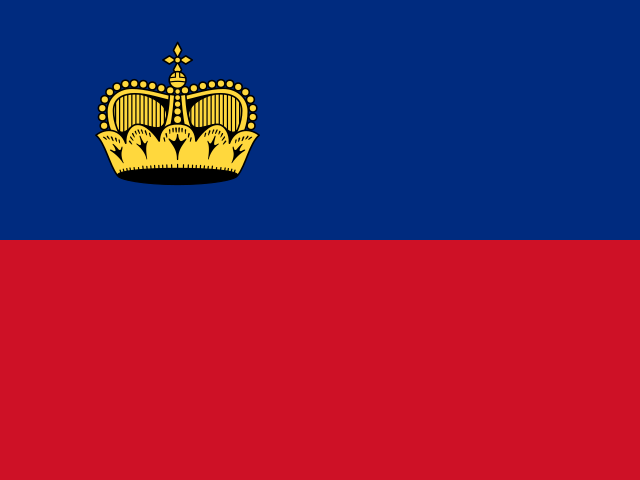
 Liechtenstein
Description of Liechtenstein
Liechtenstein, a small yet economically prosperous country nestled amidst the picturesque Alps, offers a fascinating case study in successful microstate development. Despite its diminutive size and limited resources, Liechtenstein has strategically positioned itself as a global financial hub with a high standard of living. Its unique blend of political stability, business-friendly policies, and innovation has attracted multinational corporations and high-net-worth individuals alike. By delving into the intricacies of Liechtenstein's economy, governance, and cultural fabric, we can uncover the secrets behind its remarkable success story on the world stage.
Population And Age Structure
Population, total: Liechtenstein has a population of 38,756, which is significantly below the average population of 40,097,746. Liechtenstein ranks 189 out of 194 countries in terms of total population.
Population ages 0-14 (% of total population): Liechtenstein's population aged 0-14 accounts for 14.64% of the total population, which is lower than the average of 27.34%. Liechtenstein ranks 177 out of 194 countries in this demographic.
Population ages 0-14, total: The total population aged 0-14 in Liechtenstein is 5,674, much lower than the average of 10,327,379. Liechtenstein ranks 189 out of 194 countries in this category.
Population ages 15-64 (% of total population): Liechtenstein's population aged 15-64 makes up 66.89% of the total population, higher than the average of 63.44%. Liechtenstein ranks 56 out of 194 countries in this age group.
Population ages 15-64, total: Liechtenstein has 25,922 individuals aged 15-64, significantly lower than the average of 26,003,407. Liechtenstein ranks 189 out of 194 countries for this demographic.
Population ages 65 and above (% of total population): The population of individuals aged 65 and above in Liechtenstein represents 18.47% of the total population, higher than the average of 9.22%. Liechtenstein ranks 29 out of 194 countries in this age category.
Population ages 65 and above, total: Liechtenstein has 7,160 individuals aged 65 and above, lower than the average of 3,766,959. Liechtenstein ranks 183 out of 194 countries in this demographic.
Summary
Liechtenstein's population profile indicates a smaller overall population compared to the global average, with a significant percentage of individuals aged 65 and above. The country has a relatively higher proportion of working-age individuals (15-64 years) compared to children and elderly. These demographic statistics are crucial for policymakers to plan for healthcare, social security, and labor force dynamics in Liechtenstein.
Population Miscellaneous
For the attribute "Rural population," Liechtenstein has a value of 33,169, significantly below the average of 18,044,041. Liechtenstein ranks 179 out of 190 countries in this dataset.
Regarding "Rural population (% of total population)," Liechtenstein's value of 85.584 is well above the average of 41.158. Liechtenstein ranks third out of 190 countries in this metric.
Liechtenstein's "Urban population" stands at 5,587, much lower than the average of 22,425,747. The country ranks 194 out of 194 countries in this category.
For "Urban population (% of total population)," Liechtenstein's value of 14.416 is below the average of 59.691. The country ranks 192 out of 194 countries in this regard.
Liechtenstein's "Age dependency ratio (% of working-age population)" is 49.51, below the average of 59.22. The country ranks 139 out of 194 countries in this measure.
In terms of "Birth rate, crude," Liechtenstein's rate of 9.1 is below the average of 19.38. The country ranks 173 out of 192 countries.
Regarding "Death rate, crude," Liechtenstein's rate of 8.2 is very close to the average of 8.21. The country ranks 81 out of 192 countries.
Finally, Liechtenstein's "Fertility rate, total" of 1.46 is below the average of 2.60. The country ranks 161 out of 190 countries in this aspect.
Summary
Liechtenstein stands out with a significantly smaller rural population and a much higher percentage of rural population compared to the global average. Its urban population and urban population percentage are notably lower than average, with the country ranking at the bottom in both categories. The age dependency ratio is also lower than average. These indicators suggest Liechtenstein has a unique demographic profile characterized by a smaller rural population and lower urbanization rates, which can impact its labor force distribution, social welfare programs, and overall economic development strategies.
Natural Resources
Liechtenstein has a forest area of 67 sq. km, well below the average of 211606.11 sq. km. It ranks 179th out of 191 countries in this dataset.
In terms of land area, Liechtenstein has a value of 160 sq. km, significantly lower than the average of 665166.51 sq. km. It ranks 190th out of 194 countries in land area.
Liechtenstein's surface area is also 160 sq. km, far below the average of 689779.56 sq. km. It ranks 190th out of 194 countries in surface area.
Liechtenstein possesses 1730 hectares of arable land, much less than the average of 7329543.16 hectares. It ranks 184th out of 190 countries in arable land area.
Summary
Liechtenstein's limited forest area, land area, surface area, and arable land compared to global averages indicate its small geographical footprint and natural resource constraints. These statistics highlight the challenges Liechtenstein may face in terms of environmental sustainability, agricultural productivity, and economic diversification. Addressing these limitations through efficient land use planning, conservation efforts, and innovative agricultural practices will be crucial for Liechtenstein's long-term development and resilience.
Resource Rents
Liechtenstein's total natural resources rents account for only 0.0015% of its GDP, significantly below the average of 4.63%. This places Liechtenstein at rank 173 out of 175 countries included in the data.
In terms of forest rents, Liechtenstein also falls below the average with 0.0015% of GDP attributed to this sector compared to the average of 1.53%. Liechtenstein ranks 164 out of 174 countries in this category.
Summary
Liechtenstein's low total natural resources rents at 0.0015% of GDP, ranking 173 out of 175 countries, and forest rents at the same percentage, ranking 164 out of 174 countries, indicate a limited contribution of natural resources to its economy compared to global averages. This suggests that Liechtenstein's economic development is less reliant on natural resource exploitation, potentially signaling a focus on other sectors for growth and sustainability.
Intellectual Property
Analysis of key industrial and intellectual property statistics for Liechtenstein:
1. Industrial design applications by nonresidents: Liechtenstein's value of 809 is below the average of 1415.83. It ranks 30 out of 112 countries.
2. Industrial design applications by residents: With 62 applications, Liechtenstein is significantly below the average of 9799.58. It ranks 76 out of 113 countries in this category.
3. Trademark applications by nonresidents: Liechtenstein's 8348 applications are below the average of 15878.93, ranking 46 out of 130 countries.
4. Trademark applications by residents: Liechtenstein's 365 applications are well below the average of 111055.78. It ranks 106 out of 129 countries.
5. Scientific and technical journal articles: Liechtenstein's output of 35.65 articles is significantly below the average of 15103.76, placing it at rank 153 out of 192 countries.
Summary
Liechtenstein falls below the global average in industrial design and trademark applications, both by residents and nonresidents, as well as in scientific and technical journal article output. These statistics indicate a lower level of industrial and intellectual property activity in Liechtenstein compared to other countries. This can impact the country's innovation, economic competitiveness, and attractiveness for foreign investment, highlighting potential areas for growth and development.
Broad Economy Attributes
For GDP (current US$), Liechtenstein has a value of 6.41 billion USD, which is significantly below the average of 442.87 billion USD. Liechtenstein ranks 148th out of 189 countries in this attribute.
Regarding GDP per capita (current US$), Liechtenstein's value is 165,287 USD, notably higher than the average of 15,462 USD. This places Liechtenstein in 2nd rank out of 190 countries.
As for GNI (current US$), Liechtenstein's value stands at 6.87 billion USD, well below the average of 452.04 billion USD. Liechtenstein ranks 146th out of 185 countries in this aspect.
Summary
Liechtenstein's GDP and GNI are notably lower than the global averages, positioning the country in lower ranks compared to other nations. However, Liechtenstein's GDP per capita stands out as significantly higher than the average, placing the country in the 2nd rank globally. These statistics are crucial as they showcase the disparity between the country's overall economic output and the income levels of its population, highlighting potential areas for development and further economic exploration.
Broad Value Added
Gross value added at basic prices (GVA) in Liechtenstein is $6,191,989,706.47, significantly below the attribute average of $360,070,943,595.12. Liechtenstein ranks 141 out of 176 countries in this data set.
Agriculture, forestry, and fishing value added as a percentage of GDP for Liechtenstein is 0.21%, well below the attribute average of 10.86%. Liechtenstein ranks 179 out of 182 countries in this aspect.
Liechtenstein's Agriculture, forestry, and fishing value added in current US dollars is $13,527,302.78, a substantial deviation from the attribute average of $19,924,732,828.07. Liechtenstein holds the 180th position out of 182 countries in this metric.
Services value added as a percentage of GDP in Liechtenstein stands at 56.14%, slightly below the attribute average of 56.72%. Liechtenstein is ranked 93 out of 183 countries in this category.
The Services value added in current US dollars for Liechtenstein is $3,596,345,284.94, notably under the attribute average of $295,837,711,130.69. Liechtenstein ranks 145 out of 183 countries in this criterion.
Industry (including construction) value added in current US dollars for Liechtenstein is $2,581,797,576.16, significantly lower than the attribute average of $118,421,095,413.50. Liechtenstein is ranked 135 out of 183 countries in this field.
Summary
Liechtenstein's economy is characterized by a relatively low Gross Value Added at basic prices (GVA) compared to the global average, positioning it at 141 out of 176 countries. The country also exhibits significantly lower contributions from the Agriculture, forestry, and fishing sectors, ranking 179 out of 182 countries in this aspect. However, Liechtenstein performs relatively better in the Services sector, with a value added of 56.14% of GDP and $3,596,345,284.94 in current US dollars, indicating its strength in the service industry compared to agriculture and industry.
These findings are crucial as they reflect Liechtenstein's economic structure and specialization. With a heavy reliance on the services sector, Liechtenstein may need to focus on diversifying its economy to enhance resilience and sustainable growth. Addressing the relatively low contributions from agriculture and industry could help in creating a more balanced economic landscape and reducing dependency on specific sectors, ultimately fostering long-term economic stability and development.
Manufacturing Value Added
Regarding Manufacturing, value added (current US$), Liechtenstein has a value of 2,199,624,643.98, significantly below the average of 76,207,179,589.66. Liechtenstein ranks 103 out of 173 countries in this attribute.
As for Manufacturing, value added (% of GDP), Liechtenstein's value is 34.34%, well above the average of 11.90%. Liechtenstein ranks 1 out of 173 countries in this attribute.
Summary
In terms of Manufacturing, value added (current US$), Liechtenstein's value is notably lower than the average, positioning it at 103 out of 173 countries. Conversely, Liechtenstein excels in Manufacturing, value added (% of GDP), ranking 1st among the same set of countries. These indicators suggest that even though Liechtenstein's total manufacturing value added is relatively low, its manufacturing sector plays a significant role in contributing to its GDP compared to other nations, showcasing the sector's efficiency and importance to the country's economy.
Information Technology Infrastructure
1. Secure Internet servers: Liechtenstein has 2000 secure internet servers, which is below the average of 458,294. Liechtenstein is ranked 99th out of 193 countries for this attribute.
2. Secure Internet servers (per 1 million people): Liechtenstein has 51,604 secure internet servers per 1 million people, significantly above the average of 14,067. Liechtenstein is ranked 15th out of 193 countries for this attribute.
3. Individuals using the Internet (% of population): Liechtenstein has 94.35% of its population using the internet, which is above the average of 64.77%. Liechtenstein is ranked 17th out of 180 countries for this attribute.
4. Fixed broadband subscriptions: Liechtenstein has 18,050 fixed broadband subscriptions, much below the average of 6,591,956. Liechtenstein is ranked 158th out of 185 countries for this attribute.
5. Mobile cellular subscriptions: Liechtenstein has 48,887 mobile cellular subscriptions, also below the average of 42,526,464. Liechtenstein is ranked 186th out of 193 countries for this attribute.
Summary
Liechtenstein performs exceptionally well in terms of secure internet servers per 1 million people and the percentage of its population using the internet, ranking 15th and 17th respectively on a global scale. However, the country lags behind in fixed broadband and mobile cellular subscriptions, ranking 158th and 186th respectively. These indicators are crucial as they reflect the country's digital infrastructure and connectivity levels, which are vital for economic development, innovation, and competitiveness in today's globalized world.
Energy Consumption
1. Liechtenstein's renewable energy consumption is at 55.21% of total final energy consumption, which is above the global average of 32.18%. The country ranks 43rd out of 191 countries in the dataset.
2. Liechtenstein has CO2 emissions of 141.996 kt, below the average of 171,895.94 kt. In this aspect, Liechtenstein ranks 181st out of 188 countries in the dataset.
Summary
Liechtenstein stands out for its high renewable energy consumption, exceeding the global average by a significant margin and ranking above average globally. Additionally, the country's relatively low CO2 emissions compared to the global average position it favorably in terms of environmental sustainability. These indicators showcase Liechtenstein's commitment to renewable energy sources and environmental stewardship, potentially enhancing its reputation on the international stage and contributing to a cleaner and more sustainable future.
Top Stats
Ranks in Top Decile For:
| Attribute | Rank/Total |
|---|---|
| Rural population (% of total population) | 3/190 |
| GDP per capita (current US$) | 2/190 |
| Manufacturing, value added (% of GDP) | 1/173 |
| Secure Internet servers (per 1 million people) | 15/193 |
| Individuals using the Internet (% of population) | 17/180 |
Ranks in Bottom Decile For:
| Attribute | Rank/Total |
|---|---|
| Population, total | 189/194 |
| Population ages 0-14 (% of total population) | 177/194 |
| Population ages 0-14, total | 189/194 |
| Population ages 15-64, total | 189/194 |
| Population ages 65 and above, total | 183/194 |
| Rural population | 179/190 |
| Urban population | 194/194 |
| Urban population (% of total population) | 192/194 |
| Birth rate, crude (per 1,000 people) | 173/192 |
| Forest area (sq. km) | 179/191 |
| Land area (sq. km) | 190/194 |
| Surface area (sq. km) | 190/194 |
| Arable land (hectares) | 184/190 |
| Total natural resources rents (% of GDP) | 173/175 |
| Forest rents (% of GDP) | 164/174 |
| Agriculture, forestry, and fishing, value added (% of GDP) | 179/182 |
| Agriculture, forestry, and fishing, value added (current US$) | 180/182 |
| Mobile cellular subscriptions | 186/193 |
| CO2 emissions (kt) | 181/188 |