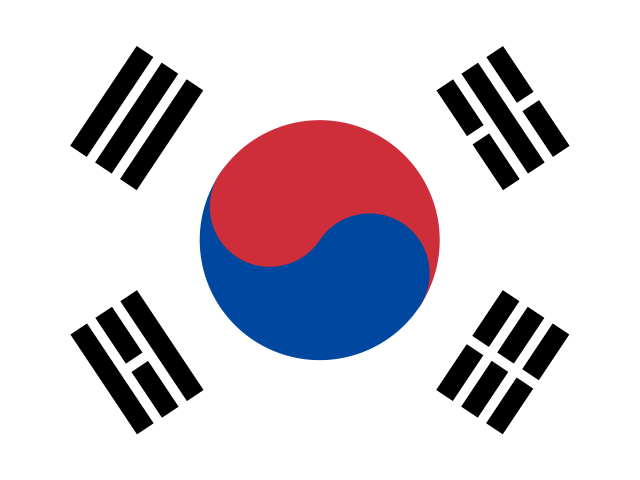
 Korea, Republic of (South)
Description of Korea, Republic of (South)
Welcome to our website dedicated to providing in-depth analysis and insights into the economic and geopolitical landscape of Korea, Republic of (South). As a pivotal player in East Asia, South Korea's remarkable economic growth, technological advancements, and strategic location have positioned it as a key influencer in the region and on the global stage. Through a macroeconomic lens, we explore the various factors shaping South Korea's development, its relations with neighboring countries, and its impact on the broader international community.
Population And Age Structure
For the attribute "Population, total", Korea, Republic of (South) has a population of 51,836,239. This is above the average population of 40,097,746. However, the country ranks 28th out of 194 countries in total population.
In terms of "Population ages 0-14 (% of total population)", South Korea has a percentage of 12.17, which is below the average of 27.34. In this regard, South Korea ranks 192nd out of 194 countries.
When looking at "Population ages 0-14, total", South Korea has 6,306,612 individuals in this age group, which is below the average of 10,327,379. Hence, South Korea ranks 61st out of 194 countries.
"Population ages 15-64 (% of total population)" shows that South Korea's percentage is 72.00, surpassing the average of 63.44. This places South Korea at a rank of 10 out of 194 countries.
For "Population ages 15-64, total", South Korea has 37,324,433 individuals, higher than the average of 26,003,407. South Korea ranks 25th out of 194 countries in this category.
In the attribute "Population ages 65 and above (% of total population)", South Korea has 15.83%, exceeding the average of 9.22. This places South Korea at 40th out of 194 countries.
Lastly, for "Population ages 65 and above, total", South Korea has 8,205,194 individuals, significantly above the average of 3,766,959. South Korea ranks 17th out of 194 countries for this demographic group.
Summary
South Korea stands out in terms of its population distribution with a notably smaller percentage of children aged 0-14 compared to the global average, but a higher percentage in the working-age bracket of 15-64 and the elderly bracket of 65 and above. This demographic composition can have significant implications for the country's workforce structure, healthcare system, and pension provisions. It suggests a potential challenge in terms of a shrinking labor force in the future and an increased demand for elderly care services, signaling the need for strategic planning and policy adjustments to address these demographic shifts.
Population Miscellaneous
Rural population in Korea, Republic of (South) is 9,634,283, which is below the average of 18,044,041. Korea, Republic of (South) ranks 57 out of 190 countries in this attribute.
Rural population (% of total population) is 18.586%, below the average of 41.158%. Korea, Republic of (South) ranks 154 out of 190 countries in this attribute.
Urban population in Korea, Republic of (South) is 42,201,956, higher than the average of 22,425,747. Korea, Republic of (South) ranks 21 out of 194 countries in this attribute.
Urban population (% of total population) is 81.414%, above the average of 59.691%. Korea, Republic of (South) ranks 41 out of 194 countries in this attribute.
Age dependency ratio (% of working-age population) is 38.88%, below the average of 59.219%. Korea, Republic of (South) ranks 185 out of 194 countries in this attribute.
Birth rate, crude (per 1,000 people) is 5.3, well below the average of 19.384. Korea, Republic of (South) ranks 192 out of 192 countries in this attribute.
Death rate, crude (per 1,000 people) is 5.9, lower than the average of 8.214. Korea, Republic of (South) ranks 156 out of 192 countries in this attribute.
Fertility rate, total (births per woman) is 0.837, significantly below the average of 2.603. Korea, Republic of (South) ranks 190 out of 190 countries in this attribute.
Summary
Korea, Republic of (South) stands out in its urbanization trends with a high urban population percentage and ranking above average in urban population size globally. However, the country faces challenges in terms of an aging population as indicated by its low age dependency ratio and fertility rate, which are well below global averages. These demographic indicators are crucial as they signify potential labor force shortages, impacting economic growth, social welfare systems, and the overall sustainability of the population over the long term.
Military
Analysis of key military attributes for Korea, Republic of (South):
- Military expenditure (current USD): South Korea's expenditure is $46,117,096,574.58, significantly higher than the average of $12,904,993,617.17. It ranks 10th out of 149 countries.
- Military expenditure (% of GDP): South Korea's expenditure is 2.80% of its GDP, above the average of 1.90%. It ranks 28th out of 148 countries.
- Arms imports (SIPRI trend indicator values): With imports worth $1,276,000,000, South Korea surpasses the average by $1,070,477,876.11. It ranks 5th out of 113 countries.
- Arms exports (SIPRI trend indicator values): The country's exports are $772,000,000, slightly above the average by $66,294,117.65. It ranks 7th out of 34 countries.
- Armed forces personnel, total: South Korea has 569,000 personnel, well above the average of 165,908.54. It ranks 11th out of 164 countries.
- Armed forces personnel (% of total labor force): With 1.99% of the total labor force in the armed forces, South Korea exceeds the average of 1.28%. It ranks 29th out of 164 countries.
Summary
South Korea demonstrates a strong commitment to its military, with significantly higher than average military expenditure, a substantial number of armed forces personnel, and notable arms imports and exports. These indicators highlight South Korea's prioritization of defense and security, showcasing its preparedness and influence in the global military landscape.
Natural Resources
1. Forest area (sq. km): South Korea has a forest area of 62,870 sq. km. This is below the average forest area of 211,606. South Korea ranks 66 out of 191 countries in this attribute data.
2. Land area (sq. km): The land area of South Korea is 97,600 sq. km, which is below the average of 665,166. South Korea ranks 105 out of 194 countries in land area.
3. Surface area (sq. km): With a surface area of 100,410 sq. km, South Korea is below the average surface area of 689,779. South Korea ranks 108 out of 194 countries in this attribute.
4. Arable land (hectares): South Korea has 1,352,000 hectares of arable land, significantly lower than the average of 7,329,543 hectares. The country ranks 93 out of 190 countries in arable land.
5. Land under cereal production (hectares): South Korea's land under cereal production is 796,102 hectares, below the average of 4,206,011 hectares. South Korea ranks 83 out of 174 countries in this attribute.
6. Average precipitation in depth (mm per year): South Korea receives 1,274 mm of average precipitation annually, slightly above the average of 1,157. South Korea ranks 70 out of 178 countries in this attribute.
7. Renewable internal freshwater resources, total (billion cubic meters): South Korea has 64.85 billion cubic meters of renewable internal freshwater resources, lower than the average of 240.41. South Korea ranks 67 out of 178 countries in this attribute data.
Summary
South Korea's key macroeconomic indicators reveal that the country has limited natural resources compared to the global average. It has relatively small forest, land, and surface areas, as well as lower arable land and freshwater resources. Despite receiving slightly higher precipitation levels, South Korea's rankings in these attributes are below average, indicating constraints on its agricultural and environmental sustainability.
Resource Rents
1. Total natural resources rents (% of GDP): South Korea's value of 0.113% is significantly below the average of 4.63%. This ranks South Korea 146th out of 175 countries in this data set.
2. Coal rents (% of GDP): South Korea's value of 0.0007% is notably lower than the average of 0.40%. This places South Korea 59th out of 65 countries in this dataset.
3. Forest rents (% of GDP): South Korea's value of 0.015% is markedly lower than the average of 1.53%. This ranks South Korea 145th out of 174 countries.
4. Oil rents (% of GDP): South Korea's value of 0.009% is significantly lower than the average of 2.51%. This places South Korea 94th out of 117 countries in this dataset.
5. Natural gas rents (% of GDP): South Korea's value of 0.004% is notably lower than the average of 1.25%. This ranks South Korea 78th out of 96 countries.
6. Mineral rents (% of GDP): South Korea's value of 0.084% is below the average of 1.23%. This places South Korea 56th out of 86 countries in this dataset.
Summary
South Korea's natural resources rents as a percentage of GDP are consistently below global averages across various categories such as coal, forest, oil, natural gas, and minerals. This places South Korea in the lower rankings compared to other countries in the dataset, indicating a lower reliance on natural resource extraction for economic output.
These findings are important as they highlight South Korea's economic resilience and ability to maintain a strong GDP without heavily depending on natural resource rents. This implies that South Korea has diversified its economy and relies more on other sectors for growth and development, reducing vulnerability to fluctuations in global commodity prices and environmental risks associated with resource extraction.
Commodities
For Cereal production, Korea, Republic of (South) has a value of 4,945,343.81 metric tons, below the average of 17,249,945.93 metric tons. It ranks 57th out of 174 countries in the dataset.
Korea, Republic of (South) excels in Aquaculture production with 2,334,232.18 metric tons, surpassing the average of 679,642.92 metric tons. It holds the 6th position out of 180 countries.
In Capture fisheries production, Korea, Republic of (South) achieves 1,376,149.23 metric tons, exceeding the average of 467,453.06 metric tons. It ranks 18th out of 190 countries.
For Total fisheries production, Korea, Republic of (South) records 3,710,381.41 metric tons, well above the average of 1,153,914.85 metric tons. It holds the 12th position out of 182 countries.
Concerning Fertilizer consumption, Korea, Republic of (South) uses 304.81 kilograms per hectare of arable land, higher than the average of 159.04 kilograms. It ranks 22nd out of 187 countries.
Summary
Korea, Republic of (South) stands out in various key macroeconomic indicators such as Aquaculture, Capture fisheries, and Total fisheries production, showcasing its strong performance in the agriculture and fisheries sectors. Additionally, the country's above-average Fertilizer consumption per hectare of arable land indicates a commitment to enhancing agricultural productivity through efficient resource utilization. These indicators are crucial as they not only demonstrate the country's competitiveness in these sectors but also reflect its efforts towards ensuring food security and sustainable economic growth.
Intellectual Property
For Industrial design applications by nonresidents, Korea, Republic of (South) had 6816 applications, significantly above the average of 1415.83 applications, ranking 6th out of 112 countries.
When it comes to Patent applications by residents, South Korea had 64005 applications, well above the average of 9799.58 applications, ranking 2nd out of 113 countries.
In terms of Patent applications by nonresidents, South Korea had 46282 applications, notably higher than the average of 6538.40 applications, ranking 4th out of 129 countries.
For Patent applications by residents, South Korea had 180477 applications, far exceeding the average of 19037.56 applications, ranking 4th out of 117 countries.
Regarding Trademark applications by nonresidents, South Korea had 50627 applications, surpassing the average of 15878.93 applications, ranking 9th out of 130 countries.
For Trademark applications by residents, South Korea had 269318 applications, considerably higher than the average of 111055.78 applications, ranking 9th out of 129 countries.
South Korea produced 72490.44 Scientific and technical journal articles, significantly above the average of 15103.76 articles, ranking 9th out of 192 countries.
Concerning Charges for the use of intellectual property, payments, South Korea made $9.89 billion, well above the average of $3.22 billion, ranking 12th out of 143 countries.
For Charges for the use of intellectual property, receipts, South Korea received $6.9 billion, higher than the average of $3.19 billion, ranking 13th out of 122 countries.
With 8614.63 Researchers in R&D per million people, South Korea far exceeds the average of 2556.45 researchers, ranking 1st out of 72 countries.
Summary
South Korea stands out as a leader in innovation and intellectual property, consistently ranking above average and often within the top 10 globally across various indicators such as industrial design applications, patent applications, trademark applications, scientific journal articles, and researchers in R&D per million people. These statistics highlight South Korea's robust research and development ecosystem, strong intellectual property protections, and emphasis on innovation, all of which are crucial factors in driving economic growth and competitiveness in today's knowledge-based economy.
Broad Economy Attributes
For GDP (current US$), Korea, Republic of (South) has a value of 1644312831906.17. This is above the average GDP for all countries included in the data, ranking 10 out of 189 countries.
Regarding GDP, PPP (current international $), Korea, Republic of (South) has a value of 2340030954018.48, surpassing the average GDP for the dataset. It ranks 14 out of 181 countries in this metric.
For GDP per capita (current US$), South Korea's value is 31721.30, higher than the average GDP per capita among 190 countries. South Korea ranks 30 out of all countries in this category.
In terms of GDP per capita, PPP (current international $), South Korea's value of 45142.76 is above the average, ranking 28 out of 181 countries in the dataset.
Looking at GNI (current US$), South Korea's value is 1658668665990.32, exceeding the average GNI. It ranks 9 out of 185 countries in the data.
For GNI, PPP (current international $), South Korea's value is 2360460823247.64, higher than the average GNI for the dataset. South Korea ranks 14 out of 181 countries in this metric.
Lastly, for GNI per capita, PPP (current international $), South Korea's value of 45540 is above the average, placing it in the 26th position out of 181 countries in the dataset.
Summary
South Korea demonstrates strong economic performance across key macroeconomic indicators such as GDP, GDP per capita, GNI, and GNI per capita both in nominal and PPP terms. With rankings consistently positioned among the top 30 countries globally, South Korea's robust economic indicators signify a prosperous economy with high levels of production, income, and standard of living. These indicators are crucial as they reflect South Korea's economic competitiveness, stability, and potential for sustained growth and development in the global arena.
Broad Value Added
1. Gross value added at basic prices (GVA) (current US$): Korea, Republic of (South) has a focus country value of $1,501,445,098,214.32, ranking 9th out of 176 countries. This is significantly above the attribute average of $360,070,943,595.12.
2. Agriculture, forestry, and fishing, value added (% of GDP): With a value of 1.77%, Korea ranks 155th out of 182 countries, well below the attribute average of 10.86%.
3. Agriculture, forestry, and fishing, value added (current US$): South Korea's value of $29,033,968,450.16 places it 23rd out of 182 countries, above the attribute average of $19,924,732,828.07.
4. Services, value added (% of GDP): South Korea's value of 57.01% is in line with the attribute average of 56.72%, ranking 85th out of 183 countries.
5. Services, value added (current US$): South Korea's value of $937,381,986,328.84 ranks 10th out of 183 countries, significantly above the average of $295,837,711,130.69.
6. Industry (including construction), value added (current US$): South Korea's value of $535,029,143,435.32 is 6th out of 183 countries, notably exceeding the average of $118,421,095,413.50.
Summary
In analyzing key macroeconomic indicators for South Korea, it is evident that the country excels in industrial and services sectors, ranking highly in value added in both categories compared to global averages. However, South Korea lags behind in the agriculture sector, with relatively low contributions to GDP. These findings are crucial as they showcase South Korea's economic diversification and strong focus on industrial and service-oriented activities, indicating a shift away from agriculture towards more value-added sectors for economic growth and stability.
Manufacturing Value Added
For Manufacturing, value added (current US$), Korea, Republic of (South) has a value of 407,465,335,350.73, ranking 5th out of 173 countries. This value is significantly higher than the attribute average of 76,207,179,589.66.
In terms of Manufacturing, value added (% of GDP), South Korea's value of 24.78% places it in 8th position out of 173 countries. This is notably higher than the attribute average of 11.90%.
South Korea excels in Medium and high-tech manufacturing value added (% manufacturing value added) with a value of 63.61%, ranking 3rd out of 149 countries. This value is considerably higher than the attribute average of 24.49%.
Regarding Chemicals (% of value added in manufacturing), South Korea falls slightly below average at 11.01%, placing 36th out of 89 countries. The average for this attribute is 11.56%.
For Food, beverages and tobacco (% of value added in manufacturing), South Korea's value of 6.87% is lower than the average of 24.51%, ranking the country 90th out of 92 countries.
In Machinery and transport equipment (% of value added in manufacturing), South Korea performs exceptionally well with a value of 47.30%, ranking 2nd out of 93 countries. This value is significantly higher than the attribute average of 16.85%.
South Korea's Textiles and clothing (% of value added in manufacturing) stands at 2.91%, below the attribute average of 6.33%. The country ranks 50th out of 93 countries in this aspect.
For Other manufacturing (% of value added in manufacturing), South Korea records 31.91%, which is below the attribute average of 42.13%. This places the country at 75th out of 94 countries in this category.
Summary
South Korea demonstrates a strong manufacturing sector, excelling in medium and high-tech manufacturing but falling behind in the food and textile industries. The country's above-average performance in machinery and transport equipment highlights its industrial prowess. These indicators are crucial as they showcase South Korea's capacity for technological innovation and competitiveness in the global market, while also indicating areas for potential growth and improvement.
Money
1. Inflation, consumer prices (annual %): The consumer price inflation in Korea, Republic of (South) is significantly lower than the global average, with a value of 0.54% compared to the average of 8.26%. This places South Korea at rank 122 out of 165 countries in the dataset.
2. Inflation, GDP deflator (annual %): South Korea also experiences lower GDP deflator inflation at 1.56%, below the average of 6.90%. This ranks South Korea at 110 out of 188 countries in the dataset.
3. Broad money growth (annual %): With a growth rate of 9.82%, South Korea has a lower than average broad money growth rate which stands at 18.03%. The country ranks 98 out of 139 countries for this attribute.
4. Broad money (% of GDP): South Korea has a high percentage of broad money to GDP at 164.88%, well above the average of 71.75%. This places South Korea at rank 4 out of 139 countries in the dataset.
5. Broad money to total reserves ratio: South Korea's broad money to total reserves ratio of 6.11% is slightly higher than the average of 5.17%. The country ranks 18 out of 126 countries in this aspect.
Summary
South Korea demonstrates lower-than-average consumer price inflation, GDP deflator inflation, and broad money growth rate. Despite this, the country has a significantly higher percentage of broad money to GDP compared to the global average. This indicates a stable economic environment with controlled inflation levels but a strong monetary presence within the economy, highlighting South Korea's financial strength and potential for robust economic growth.
Consumption Expenditure
Final consumption expenditure (current US$): Korea, Republic of (South) has a final consumption expenditure of $1,059,435,340,751.21, which is significantly above the average of $381,630,252,515.38. This places South Korea at rank 12 out of 159 countries in this category.
Final consumption expenditure (% of GDP): With a value of 64.43%, South Korea's final consumption expenditure as a percentage of GDP is below the average of 82.37%. This places South Korea at ranking 142 out of 159 countries.
General government final consumption expenditure (current US$): South Korea's expenditure is $296,623,269,097.52, well above the average of $93,676,578,238.03. This places the country at rank 12 out of 158 countries.
General government final consumption expenditure (% of GDP): At 18.04%, South Korea's expenditure is slightly below the average of 18.71%. This ranks South Korea at 75 out of 158 countries.
Household and NPISHs Final consumption expenditure (current US$): South Korea's spending of $762,811,986,927.01 is significantly higher than the average of $290,127,571,157.69. This places South Korea at rank 12 out of 158 countries.
Households and NPISHs final consumption expenditure (% of GDP): With a value of 46.39%, South Korea's expenditure as a percentage of GDP is below the average of 63.68%. This places South Korea at rank 136 out of 158 countries.
Summary
South Korea exhibits strong final consumption expenditure in both absolute terms and as a percentage of GDP, ranking notably high in global comparisons. Notably, the country's household and NPISHs final consumption expenditure significantly surpasses the average, indicating robust domestic consumption levels driving the economy.
These indicators are crucial as they reflect South Korea's economic strength and the resilience of its domestic consumption-driven growth model. High final consumption expenditure signifies a robust domestic market, potentially indicating a stable economy with strong purchasing power among households and the government, which can further drive economic growth and development.
Equities
- Listed domestic companies, total: Korea, Republic of (South) has 2318 listed domestic companies, which is significantly higher than the average of 636.625. The country ranks 6th out of 72 countries in this aspect.
- Stocks traded, total value (current US$): The total value of stocks traded in Korea, Republic of (South) is $5,190,693,110,000, much higher than the average of $1,379,501,951,820.91. This places the country at the 4th rank out of 71 countries.
- Stocks traded, total value (% of GDP): Korea, Republic of (South) has stocks traded totaling 315.68% of its GDP, far exceeding the average of 31.65%. The country leads the ranking at 1st out of 71 countries.
- Market capitalization of listed domestic companies (current US$): The market capitalization of listed domestic companies in Korea, Republic of (South) amounts to $2,176,189,500,000, surpassing the average of $1,196,037,851,618.88. The country ranks 8th out of 73 countries.
- Market capitalization of listed domestic companies (% of GDP): Korea, Republic of (South) has a market capitalization of listed domestic companies equivalent to 132.35% of its GDP, higher than the average of 71.24%. The country ranks 10th out of 73 countries.
- S&P Global Equity Indices (annual % change): The annual change in S&P Global Equity Indices for Korea, Republic of (South) is 44.14%, significantly higher than the average of 2.06%. This places the country at the 2nd rank out of 79 countries.
Summary
In summary, Korea, Republic of (South) stands out in its macroeconomic indicators by having a high number of listed domestic companies, a substantial value of stocks traded, a significant market capitalization of listed domestic companies, and a remarkable annual change in S&P Global Equity Indices. These statistics illustrate a robust and dynamic stock market in the country, reflecting strong investor confidence, liquidity, and potential for economic growth. The high rankings in these indicators signify a stable and attractive investment environment, positioning South Korea as a key player in the global financial market.
Investment
Foreign direct investment, net (BoP, current US$): Korea, Republic of (South) received $26.07 billion in net FDI, ranking 4th out of 169 countries. This amount is significantly above the average of -$1.62 billion.
Foreign direct investment, net inflows (BoP, current US$): South Korea received $8.76 billion in net FDI inflows, ranking 25th out of 182 countries. This value is higher than the average of $5.75 billion.
Foreign direct investment, net inflows (% of GDP): With a value of 0.53%, South Korea's FDI inflows as a percentage of GDP rank 134th out of 178 countries, significantly below the average of 2.61%.
Foreign direct investment, net outflows (BoP, current US$): South Korea recorded $34.83 billion in net FDI outflows, ranking 10th out of 156 countries. This amount is substantially higher than the average of $5.71 billion.
Foreign direct investment, net outflows (% of GDP): The country's net FDI outflows as a percentage of GDP, at 2.12%, position South Korea 19th out of 155 countries, exceeding the average of 1.00%.
Portfolio Investment, net (BoP, current US$): South Korea attracted $41.74 billion in net portfolio investments, ranking 7th out of 159 countries. This value is notably above the average of $0.68 billion.
Portfolio equity, net inflows (BoP, current US$): South Korea experienced a net outflow of $15.74 billion in portfolio equity, ranking 121st out of 125 countries. This figure is below the average of $9.20 billion.
Summary
South Korea stands out as a significant player in attracting foreign direct investment (FDI), ranking 4th globally with $26.07 billion in net FDI. However, the country also displays notable outflows, ranking 10th with $34.83 billion, reflecting a robust presence in the global investment landscape. Furthermore, South Korea's substantial net portfolio investments of $41.74 billion position it as an attractive destination for portfolio equity. These indicators are crucial as they showcase South Korea's ability to both attract and deploy foreign investments, contributing to its economic growth and global standing.
Broad Trade Attributes
Trade (% of GDP): South Korea's trade as a percentage of GDP is below the average of 82.34%, ranking 80th out of 163 countries.
Merchandise trade (% of GDP): The country's merchandise trade as a percentage of GDP is slightly below the average at 59.61%, ranking 64th out of 186 countries.
Trade in services (% of GDP): South Korea's trade in services as a percentage of GDP is significantly below the average of 24.63%, ranking 108th out of 171 countries.
External balance on goods and services (current US$): The country's external balance on goods and services in current US dollars is substantially higher than the average, ranking 9th out of 163 countries.
External balance on goods and services (% of GDP): South Korea's external balance on goods and services as a percentage of GDP is above average at 3.69%, ranking 36th out of 163 countries.
Summary
South Korea's trade as a percentage of GDP is below average, with merchandise trade slightly below the global average and trade in services significantly below. Despite this, the country maintains a strong external balance on goods and services both in absolute terms and as a percentage of GDP.
These indicators are crucial as they reflect South Korea's positioning in the global economy, showing its reliance on trade and the competitiveness of its goods and services. The strong external balance indicates the country's ability to generate revenue from exports, which can contribute to economic growth and stability.
Net Trade
1. The Current account balance (BoP, current US$) for Korea, Republic of (South) is $75,902,200,000. This is significantly higher than the average of $1,443,864,831.49. South Korea ranks 4 out of 170 countries in this attribute.
2. The Current account balance (% of GDP) for South Korea is 4.62%, which is higher than the average of -2.36%. It ranks 25 out of 170 countries in this attribute.
3. The Net trade in goods and services (BoP, current US$) for South Korea is $65,934,700,000, much higher than the average of $2,604,730,003.57. South Korea ranks 8 out of 171 countries in this attribute.
4. The Net primary income (BoP, current US$) for South Korea is $13,486,900,000, above the average of -$903,807,529.74. It ranks 10 out of 170 countries in this attribute.
5. The Net secondary income (BoP, current US$) for South Korea is -$3,519,400,000, lower than the average of -$269,227,340.40. South Korea ranks 148 out of 170 countries in this attribute.
6. The Net trade in goods (BoP, current US$) for South Korea is $80,604,800,000, well above the average of $1,302,831,005.68. South Korea ranks 6 out of 171 countries in this attribute.
7. The Net capital account (BoP, current US$) for South Korea is -$386,300,000, below the average of $136,543,824.05. South Korea ranks 149 out of 159 countries in this attribute.
8. The Net financial account (BoP, current US$) for South Korea is $81,382,700,000, significantly higher than the average of -$469,840,994.63. It ranks 5 out of 170 countries in this attribute.
Summary
In summary, South Korea performs remarkably well in key macroeconomic indicators related to its current account balance, trade in goods and services, primary income, and financial account. The country consistently exceeds global averages and secures high rankings among a significant number of countries in these areas. This indicates a strong economic foundation, robust international trade relationships, and prudent financial management, positioning South Korea as a key player in the global economy.
Broad Export Attributes
- Exports of goods, services and primary income (BoP, current US$): South Korea's value of 645,450,700,000
USD is significantly above the average of 146,238,908,936.30 USD, ranking 10th out of 170 countries.
- Exports of goods and services (BoP, current US$): South Korea's value of 607,505,000,000 USD is notably
higher than the average of 122,938,540,059.78 USD, placing it at the 9th position out of 170 countries.
- Exports of goods and services (current US$): South Korea's value of 597,865,413,028.15 USD is above the
average of 129,596,864,610.19 USD, also ranked 9th out of 163 countries.
- Exports of goods and services (% of GDP): South Korea's percentage of 36.36% is slightly below the
average of 38.19%, ranking 62nd out of 163 countries.
- Goods exports (BoP, current US$): South Korea's value of 517,909,300,000 USD is well above the average
of 93,310,581,697.39 USD, placing it at the 6th position out of 171 countries.
- International tourism, receipts (% of total exports): South Korea's percentage of 1.94% is considerably
below the average of 9.74%, ranking 87th out of 120 countries.
- ICT goods exports (% of total goods exports): South Korea's percentage of 28.89% is significantly higher
than the average of 3.81%, placing it at the 5th position out of 142 countries.
Summary
South Korea excels in various aspects of exports, with high values in exports of goods, services, primary income, and ICT goods exports. These rankings reflect South Korea's strong presence in international trade, particularly for ICT goods. However, the lower percentage of international tourism receipts compared to the average indicates potential room for growth in the tourism sector to further diversify the country's export revenue sources.
Merchandise Exports
For Merchandise exports (current US$), Korea, Republic of (South) has a value of $512,498,000,000, which is significantly higher than the average of $89,542,711,229.95. South Korea ranks 6th out of 187 countries in this attribute.
Agricultural raw materials exports (% of merchandise exports) for South Korea stand at 0.89%, below the average of 2.97%. South Korea ranks 87th out of 151 countries in this category.
Food exports (% of merchandise exports) from South Korea are at 1.63%, well below the average of 24.06%. South Korea ranks 141st out of 152 countries in this aspect.
In terms of Fuel exports (% of merchandise exports), South Korea has a percentage of 4.97%, below the average of 13.70%. The country ranks 61st out of 147 nations in this regard.
Ores and metals exports (% of merchandise exports) for South Korea represent 2.61%, also below the average of 9.10%. The country ranks 86th out of 152 countries in this category.
Regarding Merchandise exports by the reporting economy, residual (% of total merchandise exports), South Korea's percentage is 0.03%, significantly lower than the average of 3.20%. South Korea ranks 121st out of 166 countries in this metric.
Summary
South Korea stands out for its high total merchandise exports, ranking 6th globally in this aspect. However, the country's reliance on agricultural raw materials and food exports is notably below the global average, potentially indicating a need to diversify its export base towards higher-value goods like fuel, ores, and metals. This diversification can help South Korea reduce vulnerability to fluctuations in specific commodity markets and strengthen its overall export competitiveness in the long term.
Technology Exports
- The Manufactures exports (% of merchandise exports) in Korea, Republic of (South) is significantly
higher than the average at 89.56%, ranking 8th out of 152 countries.
- High-technology exports (current US$) for Korea, Republic of (South) amount to $163.94 billion, which is
much higher than the average. South Korea ranks 3rd out of 151 countries in this aspect.
- South Korea's High-technology exports (% of manufactured exports) stand at 35.72%, surpassing the
average by a large margin. The country holds the 6th rank out of 150 countries.
- The Medium and high-tech exports (% manufactured exports) in South Korea are at 77.70%, significantly
above the average. South Korea ranks 4th out of 149 countries in this category.
Summary
South Korea excels in manufacturing exports, high-technology exports, and medium to high-tech exports compared to global averages, ranking within the top 8 in each category. These indicators highlight South Korea's strong industrial and technological capabilities, positioning the country as a major player in global trade and innovation.
Service Exports
- Service exports (BoP, current US$): Korea, Republic of (South) has a service exports value of $89.6
billion, significantly higher than the average of $28.9 billion. It ranks 16th out of 171 countries in the
dataset.
- ICT service exports (BoP, current US$): With $8.16 billion in ICT service exports, South Korea exceeds
the average of $4.58 billion. It ranks 21st out of 166 countries.
- ICT service exports (% of service exports, BoP): South Korea's ICT service exports account for 9.11% of
its total service exports, below the average of 11.75%. It holds the 78th rank out of 166 countries.
- Communications, computer, etc. (% of service exports, BoP): At 56.75%, South Korea surpasses the average
of 45.85% in this category. It ranks 56th out of 169 countries.
- Transport services (% of service exports, BoP): South Korea's 26.71% in transport services is higher
than the 21.80% average. It ranks 57th out of 169 countries.
- Travel services (% of service exports, BoP): South Korea's 11.47% in travel services falls below the
average of 26.40%. It ranks 119th out of 167 countries.
- Insurance and financial services (% of service exports, BoP): At 5.07%, South Korea's insurance and
financial services contribution is below the 6.46% average. It holds the 62nd rank out of 161 countries.
Summary
South Korea stands out in the global market for its robust service exports, particularly in the ICT, communications, and transport sectors. Despite excelling in certain areas like communications and computer services, South Korea lags behind in travel services and ICT service exports as a percentage of total service exports. These indicators are crucial as they showcase South Korea's strengths and areas for improvement in the service sector, which is vital for diversifying the economy and driving sustainable growth.
Commercial Service Exports
Commercial service exports (current US$): Korea, Republic of (South) has a commercial service exports value of $88,844,100,000, which is significantly higher than the average of $28,508,218,402. Korea, Republic of (South) ranks 16th out of 171 countries in this attribute.
Travel services (% of commercial service exports): Korea, Republic of (South) has a value of 11.57%, below the average of 27.89%. This places Korea, Republic of (South) at the 118th position out of 167 countries.
Computer, communications, and other services (% of commercial service exports): Korea, Republic of (South) excels in this attribute with a value of 56.39%, above the average of 42.44%. The country ranks 53rd out of 169 nations.
Insurance and financial services (% of commercial service exports): Korea, Republic of (South) falls below the average at 5.11%, compared to the average of 6.97%. The country ranks 65th out of 161 countries in this category.
Transport services (% of commercial service exports): Korea, Republic of (South) performs well with a value of 26.94%, higher than the average of 23.37%. The country ranks 59th out of 169 nations for this attribute.
Summary
In summary, Korea, Republic of (South) stands out in commercial service exports with a significantly higher value compared to the average, ranking 16th globally. The country excels in computer, communications, and other services, but falls below average in travel services and insurance/financial services. These indicators are crucial as they showcase Korea's strength in certain service sectors and highlight areas where there may be room for improvement to better align with global averages and enhance overall competitiveness.
Broad Import Attributes
Imports of goods and services (current US$): Korea, Republic of (South) has a value of 537,270,248,786.33, which is significantly higher than the average of $126,191,355,599.06. The country ranks 8th out of 163 countries in this category.
Imports of goods and services (% of GDP): With a value of 32.67%, South Korea is below the average of 44.15%. It ranks 101st out of 163 countries for this indicator.
International tourism, expenditures (% of total imports): South Korea's value of 3.08% is below the average of 3.98%. The country holds the 63rd position out of 131 countries in this metric.
ICT goods imports (% total goods imports): South Korea excels in this category with a value of 17.88%, significantly above the average of 6.85%. The country holds the 7th position out of 143 countries.
Goods imports (BoP, current US$): South Korea's value of $437,304,500,000 is well above the average of $92,007,788,027.17. The country ranks 8th out of 171 countries for goods imports.
Imports of goods and services (BoP, current US$): South Korea's value of $541,570,300,000 is notably higher than the average of $120,321,577,988.12. The country ranks 8th out of 170 countries in this category.
Imports of goods, services and primary income (BoP, current US$): With a value of $566,029,100,000, South Korea surpasses the average of $144,514,428,722.28. The country holds the 12th position out of 170 countries for this attribute.
Summary
South Korea stands out in international trade, consistently ranking high in various import categories such as goods and services, ICT goods, and total imports. This signifies the country's strong economic ties with global markets and its significant role in the supply chain. The higher-than-average values in these indicators indicate South Korea's robust demand for foreign goods and services, which in turn drive its domestic consumption and economic growth.
Merchandise Imports
Merchandise imports (current US$): South Korea's merchandise imports amount to $467.6 billion, which is significantly above the average of $89.4 billion, ranking 8th out of 190 countries.
Manufactures imports (% of merchandise imports): South Korea's import of manufactures represents 66.21% of its total imports, just below the average of 66.76%. This places South Korea 88th out of 152 countries.
Agricultural raw materials imports (% of merchandise imports): South Korea's import of agricultural raw materials is 1.13% of its total imports, slightly below the average of 1.27%. With this, South Korea ranks 77th out of 152 countries.
Food imports (% of merchandise imports): South Korea's food imports are 6.74% of its total imports, significantly lower than the average of 15.89%. This places South Korea at 143rd out of 152 countries.
Fuel imports (% of merchandise imports): South Korea's fuel imports make up 18.51% of its total imports, which is above the average of 11.38%. South Korea ranks 18th out of 152 countries in this aspect.
Ores and metals imports (% of merchandise imports): South Korea's import of ores and metals represents 7.19% of its total imports, notably higher than the average of 2.57%. South Korea ranks 10th out of 152 countries in this category.
Merchandise imports by the reporting economy, residual (% of total merchandise imports): South Korea's residual imports account for 0.66% of its total imports, below the average of 2.51%, ranking 74th out of 180 countries.
Summary
South Korea stands out as a significant player in global trade, with merchandise imports amounting to $467.6 billion, ranking 8th out of 190 countries. The country shows a diversified import profile, with above-average imports of fuel and ores/metals, while maintaining lower-than-average imports of food and agricultural raw materials. These findings are crucial as they indicate South Korea's reliance on imported resources to sustain its industrial and energy sectors, highlighting its interconnectedness with the global economy and supply chains.
Service Imports
Service imports in Korea, Republic of (South) amount to $104.27 billion, ranking 14th out of 171 countries. This value is significantly higher than the average service imports of $27.62 billion.
Communications, computer, etc. account for 59.69% of service imports in Korea, Republic of (South), ranking 36th out of 169 countries. This percentage is higher than the average of 44.40%.
Transport services represent 21.90% of service imports in Korea, Republic of (South), placing it at 119th out of 169 countries. This value is below the average of 32.90%.
Travel services contribute 15.43% to service imports in Korea, Republic of (South), ranking 58th out of 169 countries. This percentage is slightly above the average of 14.14%.
Insurance and financial services make up 2.97% of service imports in Korea, Republic of (South), placing it at 140th out of 169 countries. This percentage falls below the average of 8.53%.
Summary
In Korea, Republic of (South), service imports are substantial, particularly in communications, computer, etc. and travel services, which are above the global average. However, the country lags in insurance and financial services imports, which are below the average. These indicators reflect the diversification and strength of South Korea's service sector, highlighting areas of comparative advantage and potential areas for improvement to enhance the country's economic resilience and competitiveness in the global market.
Commercial Service Imports
1. Commercial service imports (current US$): Korea, Republic of (South) has a focus country value of $102.93 billion, which is significantly higher than the attribute average of $27.10 billion. The country ranks 14th out of 171 countries included in the data.
2. Computer, communications and other services (% of commercial service imports): Korea, Republic of (South) has a value of 59.17%, above the attribute average of 41.71%. It ranks 35th out of 169 countries in this category.
3. Insurance and financial services (% of commercial service imports): The focus country value for South Korea is 3.01%, below the attribute average of 8.85%. South Korea ranks 143rd out of 169 countries in this aspect.
4. Transport services (% of commercial service imports): South Korea has a value of 22.18%, below the attribute average of 34.71%. The country ranks 120th out of 169 countries.
5. Travel services (% of commercial service imports): South Korea has a value of 15.63%, slightly above the attribute average of 14.73%. It ranks 58th out of 169 countries in this category.
Summary
The key macroeconomic indicators for South Korea reveal a strong emphasis on computer, communications, and other services, comprising 59.17% of its commercial service imports, above the global average. However, the country allocates a smaller percentage to insurance and financial services compared to the average. While South Korea excels in travel services, its performance in transport services is relatively lower.
These findings are crucial for understanding South Korea's economic structure and trade dynamics. The emphasis on technology-related services indicates a focus on innovation and digital economy, potentially driving future growth. However, the lower allocation to insurance and financial services may require attention to enhance financial sector development. Improving transport services could strengthen trade competitiveness, while maximizing the potential of travel services can boost tourism revenue and enhance cultural exchange.
Infrastructure
Considering the attribute "Railways, goods transported (million ton-km)", Korea, Republic of (South) stands below average with 6652 million ton-km, ranking 31 out of 62 countries in the dataset.
For "Air transport, freight (million ton-km)", Korea, Republic of (South) significantly exceeds the average with 12456.57 million ton-km, securing the 4th rank out of 126 countries.
Regarding "Air transport, registered carrier departures worldwide", Korea, Republic of (South) surpasses the average by a large margin with 254341 departures, ranking 17 out of 149 countries.
In terms of "Air transport, passengers carried", Korea, Republic of (South) carries an impressive 30033310 passengers, which is well above the average, placing it at rank 13 out of 149 countries.
Examining "Container port traffic (TEU: 20 foot equivalent units)", Korea, Republic of (South) handles a substantial 28834192 TEUs, exceeding the average significantly and securing the 4th rank out of 110 countries.
Lastly, in "Rail lines (total route-km)", Korea, Republic of (South) has 4284.7 route-km, below the average, and ranks 25 out of 66 countries.
Summary
South Korea exhibits a mixed performance in key macroeconomic indicators related to transportation infrastructure. While excelling in air transport and container port traffic, it falls below average in railways and rail lines. These indicators are crucial as they highlight South Korea's strength in international trade and connectivity through air and sea routes, while also indicating potential areas of improvement in domestic transportation infrastructure.
Information Technology Infrastructure
For Secure Internet servers, Korea, Republic of (South) has 307,856 servers, which is below the average of 458,294. Korea ranks 30th out of 193 countries for this attribute.
Regarding Secure Internet servers (per 1 million people), Korea has 5,939 servers, significantly below the average of 14,067. Korea ranks 56th out of 193 countries in this category.
Korea, Republic of (South) excels in Individuals using the Internet (% of population) with 96.51% of its population connected, surpassing the average of 64.77%. It ranks 9th out of 180 countries for this metric.
For Fixed broadband subscriptions, South Korea stands out with 22,327,182 subscriptions, well above the average of 6,591,956. Korea ranks 11th out of 185 countries in this aspect.
Lastly, in Mobile cellular subscriptions, Korea boasts 70,513,676 subscriptions, surpassing the average of 42,526,464. The country ranks 24th out of 193 countries for this attribute.
Summary
South Korea demonstrates strong internet infrastructure with a high number of secure internet servers and fixed broadband subscriptions, ranking 30th and 11th respectively globally. Despite lower server density per capita, the country's high percentage of individuals using the internet showcases widespread connectivity, ranking 9th in this aspect. These statistics are crucial as they reflect South Korea's advanced digital economy and high level of internet accessibility, highlighting its competitiveness and potential for innovation in the global marketplace.
Energy Consumption
In terms of Renewable energy consumption (% of total final energy consumption), Korea, Republic of (South) lags significantly behind the global average, with a value of 3.63% compared to an average of 32.18%. This places Korea at a rank of 164 out of 191 countries in the dataset.
For CO2 emissions (kt), Korea, Republic of (South) exhibits a high level of emissions, with 569681.8 kt, notably exceeding the average of 171895.94 kt. This positions Korea at a high rank of 8 out of 188 countries in the dataset.
Summary
Korea, Republic of (South) shows a low utilization of renewable energy, with only 3.63% of total final energy consumption being renewable, significantly below the global average of 32.18%. On the other hand, the country ranks high in CO2 emissions, with 569681.8 kt emitted, far exceeding the average of 171895.94 kt. These statistics are crucial as they indicate Korea's heavy reliance on non-renewable energy sources, contributing significantly to environmental degradation and climate change challenges.
Government Balance Sheet
1. Net acquisition of financial assets (% of GDP): South Korea's value of 4.63% is above the average of 2.45%. It ranks 15 out of 87 countries in the dataset.
2. Central government debt, total (% of GDP): South Korea's debt value of 46.43% is below the average of 74.12%. It ranks 41 out of 61 countries in the dataset.
3. Net incurrence of liabilities, total (% of GDP): South Korea's value of 6.66% is below the average of 7.43%. It ranks 46 out of 92 countries in the dataset.
4. Reserves and related items (BoP, current US$): South Korea's reserve value of $17.39 billion is significantly above the average of $1.92 billion. It ranks 8 out of 171 countries in the dataset.
5. Total reserves minus gold (current US$): South Korea's reserve value of $437.11 billion is significantly above the average of $74.22 billion. It ranks 7 out of 161 countries in the dataset.
6. Total reserves (includes gold, current US$): South Korea's reserve value of $443.46 billion is significantly above the average of $85.71 billion. It ranks 8 out of 161 countries in the dataset.
7. Total reserves in months of imports: South Korea's value of 9.40 months is above the average of 7.10 months. It ranks 34 out of 151 countries in the dataset.
Summary
South Korea demonstrates strong financial indicators compared to global averages and ranking positions amongst countries in the dataset. With above-average net acquisition of financial assets, below-average government debt, and high reserves values, South Korea's economic stability and growth potential are highlighted. The country's prudent financial management is reflected in its high ranking positions for reserves, indicating its ability to withstand external economic shocks and uncertainties.
Government Revenue
1. Revenue, excluding grants (% of GDP): South Korea's value for this attribute is 27.90% of GDP, slightly above the average of 27.02%. South Korea ranks 54th out of 122 countries in this metric.
2. Grants and other revenue (% of revenue): South Korea's value for this attribute is 18.73% of revenue, below the average of 23.54%. South Korea ranks 48th out of 108 countries in this metric.
3. Social contributions (% of revenue): South Korea's value for this attribute is 28.70% of revenue, higher than the average of 22.29%. South Korea ranks 35th out of 81 countries in this metric.
4. Taxes on goods and services (% of revenue): South Korea's value for this attribute is 19.55% of revenue, below the average of 31.82%. South Korea ranks 104th out of 122 countries in this metric.
5. Taxes on international trade (% of revenue): South Korea's value for this attribute is 1.30% of revenue, below the average of 6.24%. South Korea ranks 79th out of 101 countries in this metric.
6. Other taxes (% of revenue): South Korea's value for this attribute is 3.67% of revenue, above the average of 2.12%. South Korea ranks 20th out of 106 countries in this metric.
7. Taxes on income, profits and capital gains (% of revenue): South Korea's value for this attribute is 28.06% of revenue, above the average of 24.66%. South Korea ranks 44th out of 119 countries in this metric.
Summary
South Korea demonstrates a mixed performance in key macroeconomic indicators related to revenue composition. While the country excels in social contributions, it lags behind in taxes on goods and services as well as international trade. This data is crucial as it provides insight into South Korea's fiscal stability, government policies, and economic structure, which can impact its overall economic development and competitiveness on the global stage.
Taxes
1. Tax revenue (% of GDP): South Korea's tax revenue accounts for 14.86% of its GDP, which is below the average of 16.72%. This places South Korea at rank 68 out of 123 countries.
2. Customs and other import duties (% of tax revenue): South Korea's import duties as a percentage of tax revenue stands at 2.47%, significantly lower than the average of 9.01%. With this, South Korea ranks 76 out of 99 countries in this category.
3. Taxes on income, profits and capital gains (% of total taxes): South Korea allocates 53.37% of total taxes to income, profits, and capital gains, surpassing the average of 38.40%. This places South Korea at rank 19 out of 120 countries.
4. Tariff rate, applied, weighted mean, all products (%): South Korea's applied tariff rate is 5.48%, slightly higher than the average of 5.21%. South Korea ranks 61 out of 153 countries in this aspect.
Summary
South Korea's tax revenue as a percentage of GDP is below the global average, ranking 68th out of 123 countries. However, it allocates a higher proportion of total taxes to income, profits, and capital gains compared to the average, ranking 19th globally. Despite having a slightly higher applied tariff rate than average, South Korea still maintains a competitive position at 61st place.
These indicators are crucial as they reflect South Korea's taxation policies, trade dynamics, and its competitive stance in global markets. The higher emphasis on income and profits taxes indicates a focus on individual and corporate contributions to revenue, while the relatively low import duties showcase a strategy that facilitates trade and economic growth.
Government Expenses
Expense (% of GDP): The focus country's expense as a percentage of GDP is 29.73%, which is below the attribute average of 31.69%. South Korea ranks 67th out of 123 countries in this metric.
Compensation of employees (% of expense): South Korea allocates 9.32% of its expenses to employee compensation, significantly below the attribute average of 24.70%. The country ranks 112th out of 123 countries.
Goods and services expense (% of expense): South Korea spends 10.88% of its expenses on goods and services, lower than the attribute average of 14.77%. The country ranks 71st out of 122 countries.
Interest payments (% of expense): South Korea's interest payments account for 3.66% of its expenses, below the attribute average of 6.85%. The country ranks 74th out of 121 countries.
Other expense (% of expense): With 6.15% of expenses allocated to other expenses, South Korea is below the attribute average of 8.29%. The country ranks 58th out of 120 countries.
Subsidies and other transfers (% of expense): South Korea's substantial 69.99% allocation to subsidies and transfers is well above the attribute average of 43.29%. The country ranks 16th out of 121 countries in this category.
Summary
South Korea's macroeconomic indicators reveal a prudent fiscal approach with a below-average expense, particularly in employee compensation and interest payments. However, its substantial allocation to subsidies and transfers indicates a strategic focus on social welfare and economic support programs. These indicators are crucial as they depict the country's priorities in budget allocation, reflecting its economic policy objectives and societal welfare commitments.
Top Stats
Ranks in Top Decile For:
| Attribute | Rank/Total |
|---|---|
| Population ages 15-64 (% of total population) | 10/194 |
| Population ages 65 and above, total | 17/194 |
| Military expenditure (current USD) | 10/149 |
| Arms imports (SIPRI trend indicator values) | 5/113 |
| Armed forces personnel, total | 11/164 |
| Aquaculture production (metric tons) | 6/180 |
| Capture fisheries production (metric tons) | 18/190 |
| Total fisheries production (metric tons) | 12/182 |
| Industrial design applications, nonresident, by count | 6/112 |
| Industrial design applications, resident, by count | 2/113 |
| Patent applications, nonresidents | 4/129 |
| Patent applications, residents | 4/117 |
| Trademark applications, nonresident, by count | 9/130 |
| Trademark applications, resident, by count | 9/129 |
| Scientific and technical journal articles | 9/192 |
| Charges for the use of intellectual property, payments (BoP, current US$) | 12/143 |
| Researchers in R&D (per million people) | 1/72 |
| GDP (current US$) | 10/189 |
| GDP, PPP (current international $) | 14/181 |
| GNI (current US$) | 9/185 |
| GNI, PPP (current international $) | 14/181 |
| Gross value added at basic prices (GVA) (current US$) | 9/176 |
| Services, value added (current US$) | 10/183 |
| Industry (including construction), value added (current US$) | 6/183 |
| Manufacturing, value added (current US$) | 5/173 |
| Manufacturing, value added (% of GDP) | 8/173 |
| Medium and high-tech manufacturing value added (% manufacturing value added) | 3/149 |
| Machinery and transport equipment (% of value added in manufacturing) | 2/93 |
| Broad money (% of GDP) | 4/139 |
| Final consumption expenditure (current US$) | 12/159 |
| General government final consumption expenditure (current US$) | 12/158 |
| Household and NPISHs Final consumption expenditure (current US$) | 12/158 |
| Listed domestic companies, total | 6/72 |
| Stocks traded, total value (current US$) | 4/71 |
| Stocks traded, total value (% of GDP) | 1/71 |
| S&P Global Equity Indices (annual % change) | 2/79 |
| Foreign direct investment, net (BoP, current US$) | 4/169 |
| Foreign direct investment, net outflows (BoP, current US$) | 10/156 |
| Portfolio Investment, net (BoP, current US$) | 7/159 |
| External balance on goods and services (current US$) | 9/163 |
| Current account balance (BoP, current US$) | 4/170 |
| Net trade in goods and services (BoP, current US$) | 8/171 |
| Net primary income (BoP, current US$) | 10/170 |
| Net trade in goods (BoP, current US$) | 6/171 |
| Net financial account (BoP, current US$) | 5/170 |
| Exports of goods, services and primary income (BoP, current US$) | 10/170 |
| Exports of goods and services (BoP, current US$) | 9/170 |
| Exports of goods and services (current US$) | 9/163 |
| Goods exports (BoP, current US$) | 6/171 |
| ICT goods exports (% of total goods exports) | 5/142 |
| Merchandise exports (current US$) | 6/187 |
| Manufactures exports (% of merchandise exports) | 8/152 |
| High-technology exports (current US$) | 3/151 |
| High-technology exports (% of manufactured exports) | 6/150 |
| Medium and high-tech exports (% manufactured exports) | 4/149 |
| Service exports (BoP, current US$) | 16/171 |
| Commercial service exports (current US$) | 16/171 |
| Imports of goods and services (current US$) | 8/163 |
| ICT goods imports (% total goods imports) | 7/143 |
| Goods imports (BoP, current US$) | 8/171 |
| Imports of goods and services (BoP, current US$) | 8/170 |
| Imports of goods, services and primary income (BoP, current US$) | 12/170 |
| Merchandise imports (current US$) | 8/190 |
| Ores and metals imports (% of merchandise imports) | 10/152 |
| Service imports (BoP, current US$) | 14/171 |
| Commercial service imports (current US$) | 14/171 |
| Air transport, freight (million ton-km) | 4/126 |
| Air transport, passengers carried | 13/149 |
| Container port traffic (TEU: 20 foot equivalent units) | 4/110 |
| Individuals using the Internet (% of population) | 9/180 |
| Fixed broadband subscriptions | 11/185 |
| CO2 emissions (kt) | 8/188 |
| Reserves and related items (BoP, current US$) | 8/171 |
| Total reserves minus gold (current US$) | 7/161 |
| Total reserves (includes gold, current US$) | 8/161 |
Ranks in Bottom Decile For:
| Attribute | Rank/Total |
|---|---|
| Population ages 0-14 (% of total population) | 192/194 |
| Age dependency ratio (% of working-age population) | 185/194 |
| Birth rate, crude (per 1,000 people) | 192/192 |
| Fertility rate, total (births per woman) | 190/190 |
| Coal rents (% of GDP) | 59/65 |
| Food, beverages and tobacco (% of value added in manufacturing) | 90/92 |
| Portfolio equity, net inflows (BoP, current US$) | 121/125 |
| Net capital account (BoP, current US$) | 149/159 |
| Food exports (% of merchandise exports) | 141/152 |
| Food imports (% of merchandise imports) | 143/152 |
| Compensation of employees (% of expense) | 112/123 |