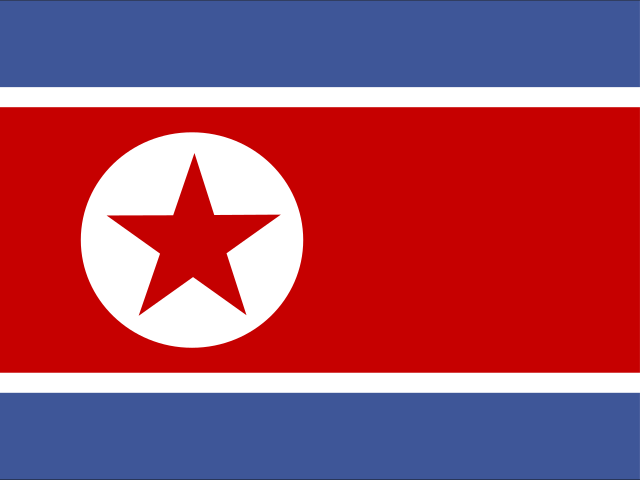
 Korea, Democratic People's Rep. (North)
Description of Korea, Democratic People's Rep. (North)
Welcome to our website dedicated to exploring the macroeconomic landscape of the Democratic People's Republic of Korea, commonly known as North Korea. This reclusive nation is a unique and fascinating case study in global geopolitics and economics. Despite its isolation and often tumultuous relationship with the international community, North Korea's economic data provides valuable insights into the country's internal dynamics and its interactions with the rest of the world. Join us as we delve into the implications of macroeconomic statistics on North Korea's development and its place in the global economic system.
Population And Age Structure
For the attribute "Population, total," the focus country's value is 25,867,467, which is below the average of 40,097,746. The focus country ranks 54 out of 194 countries in total population.
Regarding "Population ages 0-14 (% of total population)," the focus country's value is 19.01%, lower than the average of 27.34%. This places the focus country at the 136th rank out of 194 countries.
As for "Population ages 0-14, total," the focus country's value is 4,918,275, significantly below the average of 10,327,379. The focus country ranks 71 out of 194 countries in this age group.
For "Population ages 15-64 (% of total population)," the focus country's value is 69.89%, above the average of 63.44%. This places the focus country at the 22nd rank out of 194 countries.
Regarding "Population ages 15-64, total," the focus country's value is 18,077,657, notably below the average of 26,003,407. The focus country ranks 49 out of 194 countries in this age group.
Concerning "Population ages 65 and above (% of total population)," the focus country's value is 11.10%, higher than the average of 9.22%. This places the focus country at the 64th rank out of 194 countries.
For "Population ages 65 and above, total," the focus country's value is 2,871,534, below the average of 3,766,959. The focus country ranks 35 out of 194 countries in this age group.
Summary
The focus country has a total population below the global average, with a smaller percentage of young population (ages 0-14) compared to the average. However, it has a higher percentage of working-age population (ages 15-64) and elderly population (ages 65 and above) compared to the global average.
These indicators are crucial for policymakers and investors as they provide insights into the demographic landscape of the country. A younger population can indicate future workforce potential but may also strain resources for education and healthcare, while an aging population may signal increased healthcare and pension costs. Understanding these demographic trends is essential for long-term economic planning and social welfare strategies.
Population Miscellaneous
Rural population in Korea, Democratic People's Rep. (North) is 9,731,082, which is significantly below the average rural population of 18,044,041 in 190 countries (ranked 56 out of 190).
Rural population (% of total population) in Korea, Democratic People's Rep. (North) is 37.619%, below the average of 41.158%. The country is ranked 101 out of 190 countries.
Urban population in Korea, Democratic People's Rep. (North) stands at 16,136,385, lower than the average urban population of 22,425,747 in 194 countries (ranked 46 out of 194).
Urban population (% of total population) in Korea, Democratic People's Rep. (North) is 62.381%, above the average of 59.691%. The country is ranked 94 out of 194 countries.
Age dependency ratio (% of working-age population) in Korea, Democratic People's Rep. (North) is 43.090%, significantly lower than the average of 59.219%. This places the country at rank 173 out of 194 countries.
Birth rate, crude (per 1,000 people) in Korea, Democratic People's Rep. (North) is 13.333, below the average crude birth rate of 19.384. The country is ranked 116 out of 192 countries.
Death rate, crude (per 1,000 people) in Korea, Democratic People's Rep. (North) is 9.078, slightly above the average of 8.214. The country is ranked 60 out of 192 countries.
Fertility rate, total (births per woman) in Korea, Democratic People's Rep. (North) is 1.818, lower than the average fertility rate of 2.603. The country is ranked 115 out of 190 countries.
Summary
Overall, Korea, Democratic People's Rep. (North) has a smaller rural population and urban population compared to global averages. The country also exhibits a lower age dependency ratio and fertility rate, as well as lower crude birth and higher crude death rates compared to global norms. These indicators suggest a demographic profile that may have implications for labor force dynamics, economic development, and healthcare provision within the country.
Military
For the attribute "Armed forces personnel, total," the focus country, Korea, Democratic People's Rep. (North), has a value of 1,469,000. This is significantly higher than the average of 165,908. Korea, Democratic People's Rep. (North) ranks 3rd out of 164 countries in this attribute.
Regarding the attribute "Armed forces personnel (% of total labor force)," Korea, Democratic People's Rep. (North) has a value of 9.59%, which is notably higher than the average of 1.28%. The country ranks 2nd out of 164 countries in this metric.
Summary
North Korea stands out in terms of its military strength, with a total of 1,469,000 armed forces personnel, ranking 3rd globally, far surpassing the average of 165,908. Additionally, North Korea's military personnel as a percentage of its total labor force is 9.59%, ranking the country 2nd globally, well above the global average of 1.28%.
These findings are crucial as they highlight North Korea's significant focus and investment in its military capabilities, indicating a prioritization of defense and potential implications for regional and global security dynamics.
Natural Resources
- Forest area in Korea, Democratic People's Rep. (North) is 60,300.9 sq. km, significantly below the
average of 211,606.1 sq. km and ranks 69th out of 191 countries.
- Land area is 120,410 sq. km, well below the average of 665,166.5 sq. km, placing the country at the 97th
position out of 194 countries.
- Surface area covers 120,540 sq. km, much lower than the average of 689,779.6 sq. km, with a rank of 99
out of 194 countries.
- Arable land spans 2,295,000 hectares, considerably less than the average of 7,329,543.2 hectares,
ranking 77th out of 190 countries.
- Land under cereal production is 1,333,186 hectares, significantly lower than the average of 4,206,011.6
hectares, with a rank of 70 out of 174 countries.
- Average precipitation in depth is 1,054 mm per year, slightly lower than the average of 1,157.8 mm per
year, with a rank of 86 out of 178 countries.
- Renewable internal freshwater resources total 67 billion cubic meters, much less than the average of
240.4 billion cubic meters, ranking 66th out of 178 countries.
Summary
The analysis of key macroeconomic indicators for Korea, Democratic People's Republic (North) reveals that the country has significantly smaller forest area, land area, surface area, arable land, land under cereal production, average precipitation, and renewable internal freshwater resources compared to global averages. These statistics are crucial as they highlight the country's limited natural resources and agricultural potential, which can have implications on food security, economic development, and environmental sustainability.
Commodities
1. Cereal production (metric tons): North Korea's production of 4,665,733.01 metric tons is significantly below the average of 17,249,945.93 metric tons, ranking 59th out of 174 countries in the dataset.
2. Aquaculture production (metric tons): With a production of 680,300 metric tons, North Korea outperforms the average of 679,642.92 metric tons, ranking 15th out of 180 countries.
3. Capture fisheries production (metric tons): North Korea's production of 202,000 metric tons is notably lower than the average of 467,453.06 metric tons, placing it at 56th out of 190 countries.
4. Total fisheries production (metric tons): North Korea's production of 882,300 metric tons falls below the average of 1,153,914.85 metric tons, ranking 28th out of 182 countries.
5. Fertilizer consumption (kilograms per hectare of arable land): North Korea's consumption of 18.94 kilograms per hectare is well below the average of 159.04 kilograms per hectare, ranking 144th out of 187 countries in the dataset.
Summary
North Korea's agricultural sector faces challenges as evidenced by its significantly below-average cereal production, capture fisheries production, and total fisheries production. The country's low fertilizer consumption further indicates potential constraints on agricultural productivity and food security. Improving these indicators is crucial for North Korea's economic development and the well-being of its population.
Intellectual Property
For the attribute "Patent applications, nonresidents," Korea, Democratic People's Rep. (North) has a value of 6, significantly below the average of 6538.40. This places North Korea at a rank of 110 out of 129 countries in the dataset for this attribute.
Looking at "Patent applications, residents," North Korea's value of 6937 is below the average of 19037.56. The country ranks 13 out of 117 countries for this attribute.
Regarding "Scientific and technical journal articles," North Korea's value of 176.64 is much lower than the average of 15103.76. This places North Korea at a rank of 120 out of 192 countries in the dataset.
Summary
North Korea lags behind global averages in key macroeconomic indicators related to innovation and research. The country's low number of patent applications by both residents and nonresidents, as well as its minimal output in scientific and technical journal articles, signify a lack of innovation and technological advancement. This could hinder North Korea's ability to compete on a global scale, attract foreign investment, and foster sustainable economic growth in the long term.
Investment
Foreign direct investment, net inflows in Korea, Democratic People's Rep. (North) is $6,338,705.60. This is significantly below the attribute average of $5,749,270,108.14. The country ranks 148th out of 182 countries in terms of net inflows, indicating it lags behind a majority of nations in attracting foreign direct investment.
Summary
North Korea received a relatively low amount of net foreign direct investment at $6,338,705.60, significantly below the global average of $5,749,270,108.14. Ranking 148th out of 182 countries, North Korea's low FDI inflows suggest a lack of investor confidence and may hinder economic growth and development due to limited access to capital, technology, and expertise that foreign investment can bring.
Merchandise Exports
For the attribute "Merchandise exports (current US$)", Korea, Democratic People's Rep. (North) has a value of $90,000,000. This is significantly below the attribute average of $89,542,711,229.95. The country is ranked 170 out of 187 countries in this dataset.
Regarding "Merchandise exports by the reporting economy, residual (% of total merchandise exports)", Korea, Democratic People's Rep. (North) has a value of 2.03%. This figure is lower than the attribute average of 3.20%. The country is ranked 42 out of 166 countries in this dataset.
Summary
In terms of merchandise exports, Korea, Democratic People's Republic (North) is performing significantly below the global average both in total value and as a percentage of its total merchandise exports. This indicates a potential lack of competitiveness or market access for North Korea in the global trade arena.
These statistics are important as they highlight challenges North Korea may face in terms of generating revenue from exports and participating effectively in global trade. Low export values could also impact the country's economic growth and overall development.
Merchandise Imports
For "Merchandise imports (current US$)", the focus country, Korea, Democratic People's Rep. (North), has a value of $774,000,000. This is significantly below the average of $89,385,605,263. The country ranks 167 out of 190 countries in this dataset.
Regarding "Merchandise imports by the reporting economy, residual (% of total merchandise imports)", Korea, Democratic People's Rep. (North) has a value of 0.0032%, which is considerably lower than the average of 2.51%. The country holds the 158th position out of 180 countries in this metric.
Summary
Korea, Democratic People's Rep. (North) exhibits significantly low values in both "Merchandise imports (current US$)" and "Merchandise imports by the reporting economy, residual (% of total merchandise imports)" compared to the global averages. This indicates a limited participation in international trade activities, possibly due to isolationist policies or economic constraints. These findings highlight the country's relative economic isolation and underscore the potential challenges it may face in terms of access to a diverse range of goods and services, technology transfer, and integration with the global economy.
Infrastructure
- Air transport, freight (million ton-km): North Korea's value of 0.01184 is significantly below the average of 1384.365. Ranking 122 out of 126 countries, North Korea's performance in this aspect is notably low compared to the dataset.
- Air transport, registered carrier departures worldwide: With 44 departures, North Korea falls far below the average of 134365 departures. Ranking 148 out of 149 countries, North Korea's participation in registered carrier departures is minimal within the dataset.
- Air transport, passengers carried: North Korea's figure of 3563 passengers carried is considerably lower than the average of 11848242 passengers. Ranking 145 out of 149 countries, North Korea's volume of passengers carried is notably limited compared to the dataset.
Summary
North Korea's performance in air transport indicators, including freight, registered carrier departures, and passengers carried, is significantly below the global average, ranking poorly compared to other countries in the dataset. These findings suggest a severe lack of connectivity and integration with the global air transport network, potentially pointing towards isolation and limited international trade and tourism opportunities for North Korea.
Information Technology Infrastructure
For Secure Internet servers, Korea, Democratic People's Rep. (North) has 2 servers, significantly lower than the average of 458,294 servers, ranking 193 out of 193 countries.
Looking at Secure Internet servers per 1 million people, the country has 0.077 servers, much lower than the average of 14,067 servers. This places the country at rank 193 out of 193 countries.
In terms of Mobile cellular subscriptions, Korea, Democratic People's Rep. (North) has 6,000,000 subscriptions, below the average of 42,526,464 subscriptions, ranking 115 out of 193 countries.
Summary
North Korea lags significantly behind other countries in terms of secure internet servers and mobile cellular subscriptions, ranking last out of 193 countries in both categories. This lack of digital infrastructure and connectivity can hinder the country's technological development, economic growth, and global competitiveness in an increasingly digital and interconnected world.
Energy Consumption
For Renewable energy consumption (% of total final energy consumption), Korea, Democratic People's Rep. (North) has a value of 12.7%, which is below the attribute average of 32.18%. This places North Korea at rank 129 out of 191 countries included in the data.
As for CO2 emissions (kt), North Korea's emissions stand at 52,437.2 kt, significantly lower than the average of 171,895.94 kt. This positions North Korea at rank 52 out of 188 countries in the dataset.
Summary
North Korea's renewable energy consumption is notably below the global average, ranking at 129 out of 191 countries. Additionally, its CO2 emissions are significantly lower than the average, positioning the country at rank 52 out of 188 nations. These indicators are crucial as they highlight North Korea's environmental sustainability efforts and its impact on global climate goals.
Top Stats
Ranks in Top Decile For:
| Attribute | Rank/Total |
|---|---|
| Armed forces personnel, total | 3/164 |
| Armed forces personnel (% of total labor force) | 2/164 |
| Aquaculture production (metric tons) | 15/180 |
Ranks in Bottom Decile For:
| Attribute | Rank/Total |
|---|---|
| Merchandise exports (current US$) | 170/187 |
| Air transport, freight (million ton-km) | 122/126 |
| Air transport, registered carrier departures worldwide | 148/149 |
| Air transport, passengers carried | 145/149 |
| Secure Internet servers | 193/193 |
| Secure Internet servers (per 1 million people) | 193/193 |