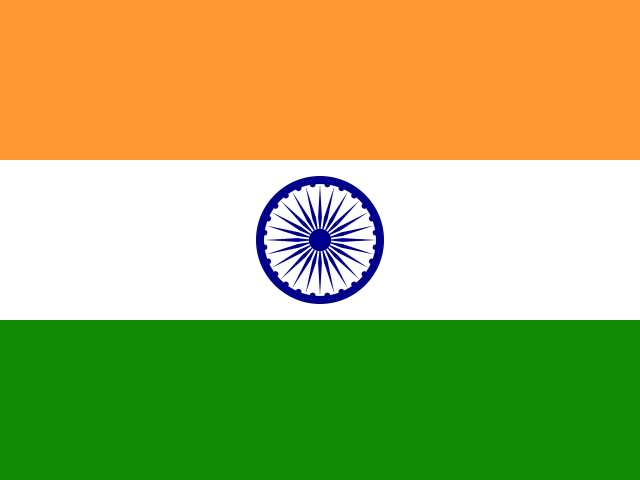
 India
India
Description of India
India, a country known for its rich history, cultural diversity, and rapid economic growth, stands as a prominent player on the global stage. With a population exceeding 1.3 billion people, India boasts a dynamic economy driven by sectors such as technology, agriculture, and manufacturing. As India continues to modernize and urbanize, the country faces unique challenges and opportunities that shape its geopolitical relationships and macroeconomic outlook. Understanding key macroeconomic statistics and their implications is crucial for gaining insight into India's development trajectory and its position within the global community.
Population And Age Structure
Population, total: India's population of 1,396,387,127 is significantly above the average population of 40,097,746. India ranks 2nd out of 194 countries in total population.
Population ages 0-14 (% of total population): India's percentage of population ages 0-14 at 26.11% is slightly below the average of 27.34%. India ranks 97th out of 194 countries in this demographic.
Population ages 0-14, total: India's total population ages 0-14 of 364,629,264 is well above the average of 10,327,379. India ranks 1st out of 194 countries in this age group.
Population ages 15-64 (% of total population): India's percentage of population ages 15-64 at 67.22% is notably above the average of 63.44%. India ranks 51st out of 194 countries in this demographic.
Population ages 15-64, total: India's total population ages 15-64 of 938,586,445 is significantly above the average of 26,003,407. India ranks 2nd out of 194 countries in this age group.
Population ages 65 and above (% of total population): India's percentage of population ages 65 and above at 6.67% is below the average of 9.22%. India ranks 97th out of 194 countries in this demographic.
Population ages 65 and above, total: India's total population ages 65 and above of 93,171,419 is well above the average of 3,766,959. India ranks 2nd out of 194 countries in this age group.
Summary
India has a massive total population, ranking 2nd globally, with a significantly high number of individuals in both the age ranges of 0-14 and 15-64, where it also ranks in the top 2. However, the percentage and total number of individuals aged 65 and above are relatively lower, ranking 97th, indicating a demographic imbalance with fewer elderly citizens.
These demographic indicators are crucial for policymakers and businesses to understand the distribution of age groups within the population. It influences various aspects such as workforce dynamics, healthcare needs, social security requirements, and consumer behavior, impacting policy formulation, healthcare planning, and market strategies.
Population Miscellaneous
Rural population in India is significantly higher than the global average of 18,044,041. India ranks 1st out of 190 countries in terms of rural population, indicating a substantial focus on rural areas compared to other nations.
With a rural population (% of total population) of 65.074%, India surpasses the global average of 41.16%. Despite ranking 33rd out of 190 countries, India shows a strong emphasis on rural living compared to the average.
India's urban population of 487,702,168 is notably higher than the global average of 22,425,747. India ranks 2nd out of 194 countries in urban population, showcasing the country's rapid urbanization compared to its peers.
Although India's urban population (% of total population) stands at 34.926%, below the global average of 59.69%, the country ranks 162nd out of 194 nations in this aspect, indicating a lower urban population percentage compared to many other countries.
India exhibits a lower age dependency ratio (% of working-age population) of 48.78%, compared to the global average of 59.22%. This places India at the 144th rank out of 194 countries, signaling a relatively healthier demographic structure with a lesser dependency burden.
With a crude birth rate of 16.572 per 1,000 people, India falls below the global average of 19.38. Ranking 99th out of 192 countries, India has a lower birth rate compared to many nations included in the dataset.
India's crude death rate of 7.35 per 1,000 people is lower than the global average of 8.21. Ranking 106th out of 192 countries, India's lower death rate signifies comparatively better health outcomes in the country.
The total fertility rate in India is 2.051 births per woman, which is lower than the global average of 2.60. India ranks 100th out of 190 countries, indicating a slightly below-average fertility rate compared to other nations.
Summary
India stands out with a significantly higher rural population and a strong focus on rural living, coupled with rapid urbanization trends. The country exhibits a healthier demographic structure with a lower age dependency ratio, lower birth rate, and lower death rate compared to global averages, indicating potential for sustainable development and economic growth.
Military
India's military expenditure is $72.94 billion, ranking 3rd out of 149 countries in the dataset. It is significantly above the average military expenditure of $12.90 billion.
India's military expenditure as a percentage of GDP is 2.81%, ranking 27th out of 148 countries. This value is higher than the average of 1.90%.
India's arms imports amount to $2.85 billion, ranking 1st out of 113 countries in the dataset. It is substantially higher than the average arms imports of $205.52 million.
India's arms exports total $151 million, positioning it at 18th out of 34 countries. This value is below the average arms exports of $705.71 million.
India has a total of 3,068,000 armed forces personnel, ranking 1st out of 164 countries. This figure is significantly higher than the average of 165,909 personnel.
India's armed forces personnel as a percentage of the total labor force is 0.59%, ranking 102nd out of 164 countries. It is below the average of 1.28%.
Summary
India ranks among the top countries globally in terms of military expenditure, arms imports, and the number of armed forces personnel. Despite having a high military expenditure and number of armed forces personnel, its armed forces personnel as a percentage of the total labor force is relatively low. These indicators are crucial as they reflect India's significant investment in defense capabilities and its military strength compared to other nations, potentially impacting regional security dynamics and defense strategies.
Natural Resources
India has a Forest area of 721,600 sq. km, which is above the average of 211,606. India ranks 10th out of 191 countries in this attribute data.
With a Land area of 2,973,190 sq. km, India exceeds the average of 665,166 sq. km. It holds the 7th position out of 194 countries in this dataset.
India's Surface area of 3,287,260 sq. km is higher than the average of 689,779 sq. km, placing India at 7th out of 194 countries.
India's Arable land of 154,447,948 hectares significantly surpasses the average of 7,329,543 hectares. India ranks 2nd out of 190 countries in this regard.
The Land under cereal production in India is 101,113,610 hectares, well above the average of 4,206,011 hectares. India tops the list at 1st out of 174 countries.
India experiences an Average precipitation in depth of 1,083 mm per year, slightly below the average of 1,157.83 mm. It ranks 84th out of 178 countries in this aspect.
India's Renewable internal freshwater resources total 1,446 billion cubic meters, significantly higher than the average of 240.41 billion cubic meters. India secures the 9th position out of 178 countries based on this attribute.
Summary
India stands out in key macroeconomic indicators relating to its natural resources and land use. With vast forest, land, and arable land areas, as well as abundant freshwater resources, India ranks among the top in the world in these aspects. These statistics are crucial as they reflect India's potential for agriculture, forestry, and environmental sustainability, highlighting the country's natural wealth and capacity for sustainable development.
Resource Rents
India's total natural resources rents account for 1.78% of its GDP, which is below the average of 4.63%. This places India at rank 82 out of 175 countries included in the data.
Coal rents in India contribute 0.70% to its GDP, surpassing the average of 0.40%. India is ranked 5 out of 65 countries in this aspect.
Forest rents in India stand at 0.19% of its GDP, lower than the average of 1.53%. India ranks 100 out of 174 countries in this category.
India's oil rents make up 0.14% of its GDP, falling short of the average of 2.51%. The country is ranked 60 out of 117 nations.
Natural gas rents in India amount to 0.07% of its GDP, below the average of 1.25%. India is ranked 53 out of 96 countries included in this data set.
Mineral rents in India represent 0.69% of its GDP, slightly below the average of 1.23%. India is ranked 30 out of 86 countries in this category.
Summary
India's natural resource rents in various categories such as coal, forest, oil, gas, and minerals, vary significantly from the global averages. While the country performs well in terms of coal rents, it falls below average in forest, oil, gas, and mineral rents. These statistics are crucial as they indicate the relative contribution of different natural resources to India's GDP, reflecting its economic reliance on specific sectors and highlighting areas that may need further development or investment.
Commodities
India's cereal production of 342,108,890 metric tons is significantly higher than the average of 17,249,945. India ranks 3rd out of 174 countries in this attribute.
India's aquaculture production of 8,641,286 metric tons is well above the average of 679,642 metric tons. India also ranks 3rd out of 180 countries in this category.
India's capture fisheries production is 4,658,197.01 metric tons, slightly below the average production of 4,674,53 metric tons. India ranks 5th out of 190 countries in this attribute.
India's total fisheries production of 13,299,483.01 metric tons is significantly higher than the average of 1,153,914.85 metric tons. India also ranks 3rd out of 182 countries in this category.
India's fertilizer consumption stands at 210.66 kilograms per hectare of arable land, which is higher than the average of 159.04 kilograms. However, in this attribute, India ranks 38th out of 187 countries.
Summary
India demonstrates impressive agricultural productivity in cereal and aquaculture production, ranking 3rd globally in both categories. Despite a slightly lower than average capture fisheries production, India excels in total fisheries production, also ranking 3rd globally. However, India's fertilizer consumption, though higher than the global average, lags in ranking at 38th place. These indicators are crucial as they showcase India's significant contributions to global agricultural output and highlight areas for potential improvement in resource usage efficiency.
Intellectual Property
For "Industrial design applications, nonresident, by count," India's value of 3831 is significantly above the average of 1415.83. This places India at rank 12 out of 112 countries.
"Industrial design applications, resident, by count," sees India's value of 8962 below the average of 9799.58. India ranks 12 out of 113 countries in this attribute.
India's patent applications by nonresidents are well above average at 33630, compared to the average of 6538.40. This ranks India at 5 out of 129 countries for this metric.
With 23141 patent applications by residents, India is above the average of 19037.56. India's rank is 7 out of 117 countries.
India's trademark applications by nonresidents at 42254 exceed the average of 15878.93. This places India at rank 12 out of 130 countries.
For trademark applications by residents, India's value of 382294 is significantly higher than the average of 111055.78. India ranks 4 out of 129 countries for this attribute.
India's count of scientific and technical journal articles at 149212.62 is well above the average of 15103.76. India ranks 3 out of 192 countries in this aspect.
Regarding charges for the use of intellectual property payments, India's value of 7241107556.79 is higher than the average of 3218843494.39. India ranks 15 out of 143 countries in this category.
On the other hand, the charges for the use of intellectual property receipts in India amount to 1253654725.41, below the average of 3191687117.58. India ranks 22 out of 122 countries in this attribute.
India's count of researchers in R&D per million people stands at 260.38, below the average of 2556.45. India is ranked 65 out of 72 countries for this metric.
Summary
India performs exceptionally well in terms of industrial design applications, patent applications, trademark applications, and scientific research output compared to global averages. However, there is room for improvement in the number of researchers in R&D per million people and in intellectual property receipt charges. These indicators are crucial as they reflect India's innovation capacity, competitiveness in the global market, and investments in research and development which are essential for long-term economic growth and sustainability.
Broad Economy Attributes
India's GDP (current US$) is $2.67 trillion, significantly above the average of $442.87 billion, ranking 6th out of 189 countries.
India's GDP, PPP (current international $) is $9.10 trillion, well above the average of $734.14 billion, ranking 3rd out of 181 countries.
India's GDP per capita (current US$) is $1913.22, below the average of $15462.11, ranking 145th out of 190 countries.
India's GDP per capita, PPP (current international $) is $6517.76, lower than the average of $21251.89, ranking 122nd out of 181 countries.
India's GNI (current US$) is $2.64 trillion, significantly above the average of $452.04 billion, ranking 7th out of 185 countries.
India's GNI, PPP (current international $) is $8.98 trillion, well above the average of $730.70 billion, ranking 3rd out of 181 countries.
India's GNI per capita, PPP (current international $) is $6430, lower than the average of $20615.75, ranking 126th out of 181 countries.
Summary
India has a strong GDP and GNI, ranking 6th and 7th respectively in terms of current US$. However, when considering GDP per capita and GNI per capita, India ranks lower at 145th and 126th respectively. This indicates a disparity in wealth distribution within the country despite its overall economic size and performance.
These indicators are essential as they provide insights into the overall economic health of a country, its income distribution among the population, and its standing in the global economy. Understanding these figures helps policymakers, investors, and analysts make informed decisions regarding investment, economic policies, and development strategies to address income inequality and foster sustainable economic growth.
Broad Value Added
Gross value added at basic prices (GVA) in current US$ for India is $2,450,491,204,868.09, ranking 4 out
of 176 countries. This is significantly higher than the average of $360,070,943,595.12.
Agriculture, forestry, and fishing value added as a percentage of GDP for India is 18.64%, ranking 43 out
of 182 countries. This figure is notably higher than the average of 10.86%.
Agriculture, forestry, and fishing value added in current US$ for India is $497,865,997,347.15, ranking 2
out of 182 countries. This is substantially above the average of $19,924,732,828.07.
Services value added as a percentage of GDP for India is 48.07%, ranking 148 out of 183 countries. This
falls below the average of 56.72%.
Services value added in current US$ for India is $1,284,185,244,580.14, ranking 7 out of 183 countries.
This surpasses the average of $295,837,711,130.69.
Industry (including construction) value added in current US$ for India is $668,439,962,967.75, which
places India at the 5th position out of 183 countries. This figure is notably higher than the average of
$118,421,095,413.50.
Summary
India demonstrates strong performance in key macroeconomic indicators such as Gross Value Added (GVA), where it ranks 4th globally with a significantly higher value than the average. The country also excels in Agriculture, forestry, and fishing value added and Services value added, ranking 2nd and 7th respectively. These indicators are crucial as they highlight India's robust economic activities across various sectors, indicating a diversified and growing economy with potential for sustained development and prosperity.
Manufacturing Value Added
1. Manufacturing, value added (current US$): India's value added in manufacturing is significantly higher compared to the average, ranking 6th out of 173 countries. This indicates a robust manufacturing sector contributing to the country's GDP.
2. Manufacturing, value added (% of GDP): India's manufacturing value added as a percentage of GDP is above the average, ranking 59th out of 173 countries. This suggests a notable contribution of the manufacturing sector to India's economic output.
3. Medium and high-tech manufacturing value added (% manufacturing value added): India's value added in medium and high-tech manufacturing as a percentage of total manufacturing value added is well above the average, ranking 18th out of 149 countries. This highlights India's strength in advanced manufacturing capabilities.
4. Chemicals (% of value added in manufacturing): India's contribution of the chemicals sector to manufacturing value added is higher than the average, ranking 11th out of 89 countries. This indicates a significant presence of the chemicals industry in India's manufacturing landscape.
5. Food, beverages and tobacco (% of value added in manufacturing): India's contribution from the food, beverages, and tobacco sector to manufacturing value added is below the average, ranking 77th out of 92 countries. This suggests a relatively smaller share of this sector in India's manufacturing activities.
6. Machinery and transport equipment (% of value added in manufacturing): India's contribution from machinery and transport equipment to manufacturing value added is above the average, ranking 32nd out of 93 countries. This indicates a substantial presence of these industries in India's manufacturing sector.
7. Textiles and clothing (% of value added in manufacturing): India's contribution from textiles and clothing to manufacturing value added is higher than the average, ranking 18th out of 93 countries. This highlights the significance of the textile and clothing industry in India's manufacturing sector.
8. Other manufacturing (% of value added in manufacturing): India's contribution from other manufacturing activities to manufacturing value added is below the average, ranking 58th out of 94 countries. This suggests a relatively lower proportion of other manufacturing sectors in India's overall manufacturing output.
Summary
India exhibits strengths in manufacturing, with a robust overall value added that ranks 6th globally. The country's high-tech manufacturing capabilities are particularly notable, ranking 18th worldwide. Despite a below-average contribution from the food and beverages sector, India maintains a significant presence in textiles, machinery, and chemicals industries.
These findings are crucial for India's economic development as they showcase the country's diverse manufacturing landscape. By excelling in high-tech manufacturing and maintaining strong positions in key sectors like textiles and machinery, India can drive economic growth, create employment opportunities, and enhance its global competitiveness in the manufacturing industry.
Money
Inflation, consumer prices (annual %): India has a relatively low consumer price inflation rate of 6.62%, ranking 24th out of 165 countries. This is below the average rate of 8.26%.
Inflation, GDP deflator (annual %): India's GDP deflator inflation rate is 4.75%, ranking 49th out of 188 countries. It is below the average rate of 6.90%.
Broad money growth (annual %): India's broad money growth is strong at 12.48%, ranking 77th out of 139 countries. However, it is below the average growth rate of 18.03%.
Broad money (% of GDP): India's broad money as a percentage of GDP is 87.78%, which is above the average of 71.75%. This places India 42nd out of 139 countries.
Broad money to total reserves ratio: India has a ratio of 3.97, below the average of 5.17, and ranks 39th out of 126 countries in this aspect.
Summary
India's macroeconomic indicators show a mixed picture: while the country maintains relatively low consumer price inflation and solid broad money growth, it lags behind in GDP deflator inflation and broad money to total reserves ratio. These statistics are crucial as they reflect India's economic stability, monetary policy effectiveness, and financial resilience in comparison to global standards, influencing investor confidence, economic growth prospects, and overall competitiveness.
Consumption Expenditure
India's final consumption expenditure in current US dollars is $1,947,172,795,770.17, which is significantly higher than the average of $381,630,252,515.38. India ranks 7th out of 159 countries in this attribute.
The final consumption expenditure as a percentage of GDP in India is 72.88%, below the average of 82.37%. India is ranked 118th out of 159 countries in this metric.
India's general government final consumption expenditure in current US dollars is $310,244,967,184.60, much higher than the average of $93,676,578,238.03. India is ranked 9th out of 158 countries.
General government final consumption expenditure as a percentage of GDP in India is 11.61%, below the average of 18.71%. India holds the 130th rank out of 158 countries in this aspect.
India's household and NPISHs final consumption expenditure in current US dollars amounts to $1,636,927,828,585.56, which is notably above the average of $290,127,571,157.69. India ranks 5th out of 158 countries in this category.
Households and NPISHs final consumption expenditure as a percentage of GDP in India stands at 61.27%, slightly below the average of 63.68%. India is ranked 81st out of 158 countries based on this metric.
Summary
India demonstrates strong final consumption expenditure levels, outperforming the global average in both total and sector-specific expenditures. Despite ranking lower in the percentage of GDP metrics, India's significant absolute expenditure figures reflect a robust domestic demand-driven economy. This highlights India's potential for driving economic growth through increased consumption and investment.
Equities
India's total listed domestic companies stand at 1962, significantly above the average of 636.625, ranking 7th out of 72 countries. The total value of stocks traded in India amounts to 1.945 trillion USD, surpassing the average of approximately 1.379 trillion USD, ranking 6th out of 71 countries. The value of stocks traded as a percentage of GDP in India is 72.815%, notably higher than the average of 31.648%, with a rank of 14 out of 71 countries. India's market capitalization of listed domestic companies reaches 2.595 trillion USD, well above the average of 1.196 trillion USD, positioning India 5th out of 73 countries. Moreover, the market capitalization as a percentage of GDP in India is 97.150%, exceeding the average of 71.240%, and ranking 17th out of 73 countries. Lastly, India's S&P Global Equity Indices show an annual change of 15.771%, significantly higher than the average of 2.060%, placing India 17th out of 79 countries.
Summary
India stands out in the global market with a strong presence of listed domestic companies, high value of stocks traded, impressive market capitalization, and significant annual change in S&P Global Equity Indices. These indicators reveal India's robust and dynamic stock market, indicating investor confidence, economic growth potential, and strong integration into the global financial system.
Investment
- India's net Foreign Direct Investment (FDI) is significantly below the average at -53,239,697,390.82
USD, ranking 165th out of 169 countries.
- Net FDI inflows in India are well above average at 64,362,364,994.38 USD, placing India 7th out of 182
countries.
- Foreign Direct Investment as a percentage of GDP in India is lower than the average, standing at 2.41%,
ranking 76th out of 178 countries.
- India's net outflows of FDI are above the average at 11,122,667,603.55 USD, ranking 16th out of 156
countries.
- Net FDI outflows as a percentage of GDP in India are notably lower than the average, at 0.42%, placing
India 57th out of 155 countries.
- India's Portfolio Investment is significantly below average at -15,111,706,746.66 USD, ranking 154th out
of 159 countries.
- Portfolio investment in bonds is substantially below average for India at -2,457,951,000 USD, placing
India 58th out of 59 countries.
- India's Portfolio Equity net inflows are well above the average at 24,854,054,527.06 USD, with India
ranking 6th out of 125 countries.
Summary
India's performance in terms of Foreign Direct Investment (FDI) and Portfolio Investment indicates mixed results. While the country attracts high levels of net FDI inflows and Portfolio Equity net inflows, its FDI outflows are also considerable. The lower percentage of FDI and Portfolio Investment as a proportion of GDP compared to the global average suggests potential for increased investment to drive economic growth and development in India.
Debt
India has a Total debt service (% of GNI) of 2.90, which is below the average of 5.98. It ranks 76 out of 120 countries in this attribute.
For Public and publicly guaranteed debt service (% of GNI), India's value is 0.99, lower than the average of 2.84. It ranks 94 out of 120 countries.
India's External debt stocks (% of GNI) stand at 21.44, below the average of 65.42. It ranks 107 out of 120 countries in this category.
Regarding Debt service on external debt, total (TDS, current US$), India's value is 76,366,469,390, significantly above the average of 9,811,195,839. India ranks 5 out of 123 countries in this attribute.
Debt service on external debt, public and publicly guaranteed (PPG) (TDS, current US$) for India is 26,000,741,056.4, much higher than the average of 3,310,612,057.6. It ranks 6 out of 123 countries in this category.
India's External debt stocks, public and publicly guaranteed (PPG) (DOD, current US$) amount to 192,805,075,629.9, which is above the average of 28,695,879,144.98. It ranks 6 out of 123 countries.
With External debt stocks, private nonguaranteed (PNG) (DOD, current US$) at 262,911,384,000, India exceeds the average of 33,734,699,285.22. It ranks 3 out of 91 countries in this attribute.
Lastly, India's External debt stocks, total (DOD, current US$) reach 564,979,321,177.1, far above the average of 73,845,530,111.82. India ranks 3 out of 123 countries included in this data.
Summary
India performs below average in terms of Total debt service (% of GNI), Public and publicly guaranteed debt service (% of GNI), and External debt stocks (% of GNI). However, it ranks significantly higher in Debt service on external debt compared to the average, indicating a heavier burden of external debt servicing. India's high rankings in Debt service on external debt and External debt stocks suggest a substantial amount of debt that the country needs to manage efficiently to avoid potential financial strain and ensure sustainable economic growth.
Broad Trade Attributes
India's Trade (% of GDP) is 37.80%, which is below the attribute average of 82.34%. India is ranked 140 out of 163 countries in this category.
Merchandise trade (% of GDP) in India stands at 24.32%, falling below the attribute average of 60.01%. India ranks 175 out of 186 countries for this indicator.
Trade in services (% of GDP) for India is 11.95%, lower than the attribute average of 24.63%. India holds the 105th rank out of 171 countries in this aspect.
India's External balance on goods and services (current US$) is -10516218300.72, significantly below the attribute average of 3405509011.13. India is ranked 149 out of 163 countries in this category.
Furthermore, India's External balance on goods and services (% of GDP) is -0.39%, contrasting with the attribute average of -5.97%. India holds the 68th rank out of 163 countries in this metric.
Summary
India's trade performance, both in terms of total trade and merchandise trade as a percentage of GDP, falls below the attribute averages. However, trade in services as a percentage of GDP in India is even more sluggish compared to the average. India's external balance on goods and services is significantly negative, indicating a trade deficit. This, coupled with a negative percentage in external balance on goods and services in relation to GDP, highlights the challenges India faces in terms of trade sustainability and balance.
These findings are crucial as they indicate that India is heavily reliant on imports relative to its size of the economy, leading to a trade deficit. This could impact the country's foreign exchange reserves, economic stability, and overall growth potential. Addressing these imbalances and boosting exports will be essential for India to strengthen its trade position and improve its overall macroeconomic stability.
Net Trade
- Current account balance (BoP, current US$): India's current account balance is significantly above the
average of $1.44 billion, ranking 9th out of 170 countries.
- Current account balance (% of GDP): India's current account balance as a percentage of GDP is positive
at 1.23%, surpassing the average of -2.36%. It ranks 54th out of 170 countries.
- Net trade in goods and services (BoP, current US$): India's net trade is negative, falling below the
average of $2.60 billion. It holds the 155th rank out of 171 countries.
- Net primary income (BoP, current US$): India's net primary income is below the average, ranking 163rd
out of 170 countries.
- Net secondary income (BoP, current US$): India's net secondary income is well above the average, ranking
1st out of 170 countries.
- Net trade in goods (BoP, current US$): India's net trade in goods is significantly below the average of
$1.30 billion, placing it at 169th out of 171 countries.
- Net capital account (BoP, current US$): India's net capital account is below the average, ranking 152nd
out of 159 countries.
- Net financial account (BoP, current US$): India's net financial account is notably above the average,
placing it at the 11th rank out of 170 countries.
Summary
India's macroeconomic indicators reveal mixed performance: while the country excels in net secondary income and its net financial account, it lags behind in net trade in goods and net primary income. These statistics are crucial as they highlight India's strengths in certain economic sectors while also pointing out areas that require attention and improvement in order to enhance overall economic stability and competitiveness on the global stage.
Broad Export Attributes
India's exports of goods, services, and primary income amount to $507.29 billion, which is significantly higher than the average of $146.24 billion, ranking 14th out of 170 countries. The country's exports of goods and services totaling $484.69 billion also exceed the average of $122.93 billion, ranking 13th out of 170 countries.
India's goods exports stand at $281.55 billion, well above the average of $93.31 billion, ranking 18th out of 171 countries. However, the country's exports of goods and services as a percentage of GDP, at 18.71%, fall below the average of 38.19%, ranking 124th out of 163 countries.
India's international tourism receipts as a percentage of total exports are relatively low at 2.77%, compared to the average of 9.74%, placing the country in the 72nd position out of 120 countries. Furthermore, the country's ICT goods exports as a percentage of total goods exports, at 2.05%, are below the average of 3.81%, ranking 44th out of 142 countries.
Summary
India's significant export performance in goods, services, and primary income highlights its strong presence in the global market, ranking above average in various categories. However, the country's lower exports as a percentage of GDP and lower contribution of international tourism receipts indicate potential areas for further growth and diversification in its economy.
These findings are crucial as they provide insights into India's trade competitiveness, economic diversification, and potential for revenue generation through tourism. Addressing the challenges in increasing exports as a percentage of GDP and boosting international tourism receipts can help India enhance its economic resilience and global market positioning.
Merchandise Exports
India's merchandise exports amount to $276.41 billion, ranking 19th out of 187 countries. This exceeds the average merchandise export value by $186.87 billion.
Regarding agricultural raw materials exports as a percentage of total merchandise exports, India's value of 1.34% is below the average of 2.97%. India is ranked 68th out of 151 countries in this aspect.
Food exports account for 12.77% of India's merchandise exports, which is lower than the average of 24.06%. India is ranked 91st out of 152 countries in this category.
India's fuel exports make up 10.03% of its merchandise exports, below the average of 13.70%. This places India at 47th out of 147 countries for fuel export percentage.
Ores and metals exports contribute 4.70% to India's total merchandise exports, falling short of the average of 9.10%. India is ranked 60th out of 152 countries in this aspect.
In terms of merchandise exports by the reporting economy, residual percentage stands at 0.46% for India, while the average is higher at 3.20%. India holds the 76th rank out of 166 countries for this export component.
Summary
India's merchandise exports are significant at $276.41 billion, exceeding the global average by $186.87 billion. However, the country lags behind in the proportion of agricultural raw materials, food, fuel, ores, and metals exports compared to the global averages, indicating potential areas for diversification and improvement in export composition. Addressing these disparities is crucial for India to enhance its export competitiveness and ensure a more balanced and sustainable trade profile.
Technology Exports
Manufactures exports (% of merchandise exports) in India are 28.40% higher than the average of 42.62%. India ranks 41 out of 152 countries in this attribute.
India's High-technology exports (current US$) are $4,927,262,782.20 above the average of $16,655,934,078.80. India holds the 21st rank out of 151 countries for this data.
High-technology exports (% of manufactured exports) in India are 0.88% higher than the average of 10.15%. India ranks 47 out of 150 countries in this attribute.
Medium and high-tech exports (% manufactured exports) in India are 5.74% above the average of 34.29%. India ranks 60 out of 149 countries in this attribute.
Summary
India performs above average in the export of manufactured goods, high-technology exports, and medium and high-tech exports compared to global averages, positioning the country within the top 60 in these categories. These indicators are crucial as they highlight India's competitive edge in technological advancements and its capacity to diversify its export base beyond traditional sectors, signaling a robust and dynamic economy.
Service Exports
India's Service exports amount to $203.15 billion, ranking 8th out of 171 countries. This is significantly above the average service export value of $28.92 billion.
ICT service exports in India total $99.47 billion, ranking 2nd out of 166 countries. This value is much higher than the average of $4.58 billion for ICT service exports.
ICT service exports as a percentage of total service exports in India stand at 48.97%, ranking 5th out of 166 countries. This is well above the average percentage of 11.75%.
Communications, computer, etc. services in India constitute 75.85% of service exports, ranking 17th out of 169 countries. This is significantly higher than the average of 45.85%.
Transport services in India represent 10.23% of service exports, ranking 119th out of 169 countries. This value is lower than the average of 21.80%.
India's travel services account for 6.42% of service exports, ranking 135th out of 167 countries. This figure is below the average of 26.40%.
Insurance and financial services in India contribute 3.18% to service exports, ranking 87th out of 161 countries. This percentage falls below the average of 6.46%.
Summary
India is a significant player in the global service export market, particularly excelling in ICT services where it ranks 2nd globally. The country also stands out for the high percentage of ICT service exports compared to total service exports. While India's dominance in communications and computer services is notable, there is room for growth in areas like transport and travel services. These indicators are crucial as they showcase India's strengths in key service sectors, highlighting areas where the country can further enhance its competitiveness and economic diversification.
Commercial Service Exports
India's Commercial service exports amount to $202.49 billion, ranking 8th out of 171 countries. This value exceeds the average commercial service exports by $173.98 billion.
Travel services account for 6.44% of India's commercial service exports, ranking 137th out of 167 countries. This percentage is below the average by 21.45%.
Computer, communications, and other services contribute 80.11% to India's commercial service exports, ranking 10th out of 169 countries. This value surpasses the average by 37.67%.
Insurance and financial services represent 3.19% of India's commercial service exports, ranking 93rd out of 161 countries. This percentage falls below the average by 3.78%.
Transport services make up 10.27% of India's commercial service exports, ranking 121st out of 169 countries. This percentage is below the average by 13.10%.
Summary
India's commercial service exports are driven mainly by computer, communications, and other services, which make up a significant 80.11%. However, travel services, insurance, financial services, and transport services lag behind compared to global averages, indicating potential areas for improvement to diversify and strengthen India's service export portfolio.
These findings are crucial as they highlight India's comparative advantage in certain service sectors like technology-related services, while also pointing out areas where there is room for growth and enhancement. By addressing the underperforming sectors, India can potentially boost its overall commercial service export competitiveness and market share globally.
Broad Import Attributes
Imports of goods and services (current US$): India's value of $510.24 billion is significantly above the average of $126.19 billion, ranking 11th out of 163 countries.
Imports of goods and services (% of GDP): India's value of 19.10% is below the average of 44.15%, ranking 148th out of 163 countries.
International tourism, expenditures (% of total imports): India's value of 3.20% is slightly below the average of 3.98%, ranking 62nd out of 131 countries.
ICT goods imports (% total goods imports): India's value of 10.81% is above the average of 6.85%, ranking 20th out of 143 countries.
Goods imports (BoP, current US$): India's value of $376.99 billion is notably above the average of $92.01 billion, ranking 12th out of 171 countries.
Imports of goods and services (BoP, current US$): India's value of $493.03 billion is significantly above the average of $120.32 billion, ranking 11th out of 170 countries.
Imports of goods, services and primary income (BoP, current US$): India's value of $547.68 billion is significantly above the average of $144.51 billion, ranking 13th out of 170 countries.
Summary
India has a notably high value in various import indicators such as Imports of goods and services, Goods imports, and Imports of goods, services, and primary income, ranking 11th, 12th, and 13th respectively out of a large pool of countries. However, when considering the percentage of imports relative to its GDP, India ranks much lower at 148th place, indicating a potential challenge in managing its import dependencies efficiently.
These statistics are important as they highlight India's significant reliance on imports to meet domestic demands and sustain economic activities. The discrepancy in rankings between the total import values and import percentages of GDP signifies the need for India to carefully balance its import expenditures to ensure sustainable economic growth and reduce vulnerability to external shocks.
Merchandise Imports
India's merchandise imports amount to $373.20 billion, which is significantly higher than the average of $89.39 billion, ranking 13th out of 190 countries.
Manufactures imports account for 52.82% of India's total merchandise imports, below the average of 66.76%. This places India at the 138th rank out of 152 countries.
India's agricultural raw materials imports constitute 1.63% of its merchandise imports, slightly higher than the average of 1.27%, ranking 38th out of 152 countries.
Food imports make up 5.49% of India's merchandise imports, lower than the average of 15.89%, placing India at the 150th rank out of 152 countries.
India's fuel imports represent 28.36% of its total merchandise imports, significantly higher than the average of 11.38%, ranking 5th out of 152 countries.
Ores and metals imports contribute 5.23% to India's merchandise imports, higher than the average of 2.57%, ranking 17th out of 152 countries.
Merchandise imports by the reporting economy, residual, account for 0.66% of India's total merchandise imports, below the average of 2.51%, placing India at the 75th rank out of 180 countries.
Summary
India's merchandise imports show a significant dependency on fuel imports, which comprise 28.36% of the total - ranking the country 5th globally. However, India lags behind in food imports, ranking 150th out of 152 countries. These indicators are crucial as they reveal India's vulnerability to fluctuations in global fuel prices and highlight potential challenges in ensuring food security domestically.
Service Imports
India's service imports amount to $116.04 billion, ranking 12th out of 171 countries. This is significantly higher than the average service imports of $27.62 billion.
Communications, computer, etc. account for 63.97% of India's service imports, ranking 24th out of 169 countries. This percentage is notably higher than the average of 44.40%.
Transport services contribute 17.14% to India's service imports, ranking 148th out of 169 countries. This is below the average contribution of 32.90%.
Travel services make up 10.84% of India's service imports, placing it 86th out of 169 countries. This percentage is below the average of 14.14%.
Insurance and financial services represent 5.63% of India's service imports, ranking 94th out of 169 countries. This percentage is lower than the average of 8.53%.
Summary
India's service imports show a significant reliance on communications, computer, and related services, comprising nearly two-thirds of the total imports. However, the country's lower contribution from transport services and insurance/financial services compared to the global average may indicate areas for potential growth and development in diversifying its service imports.
This analysis is crucial as it highlights India's current strengths in certain service sectors while also pointing out potential areas of improvement or expansion. Diversifying service imports can not only enhance India's economic resilience but also foster innovation and competitiveness in emerging sectors, ultimately driving overall economic growth and global market positioning.Commercial Service Imports
India's commercial service imports amounted to $114.97 billion, ranking 12th out of 171 countries with data available, significantly higher than the attribute average of $27.10 billion. The country's Computer, communications, and other services as a percentage of commercial service imports, at 66.09%, are above the average of 41.71%, ranking 18th out of 169 countries. India's Insurance and financial services as a percentage of commercial service imports, at 5.68%, fall below the average of 8.85%, ranking 98th out of 169 countries. Transport services as a percentage of commercial service imports, at 17.29%, are lower than the average of 34.71%, ranking 149th out of 169 countries. Lastly, India's Travel services as a percentage of commercial service imports, at 10.94%, are below the average of 14.73%, placing the country 86th out of 169 countries.
Summary
India's commercial service imports are notably high, with a focus on Computer, communications, and other services. However, the country lags behind in the contribution of Insurance and financial services and Transport services to its overall commercial service imports. This mix of services indicates a strong reliance on technology-related services for economic growth, but also highlights potential areas for improvement in the financial and transportation sectors to enhance overall trade balance and economic diversification.
Infrastructure
India's railways carry an impressive 1050738 million passenger-km, significantly above the average of 32281.9 million passenger-km, ranking 1st out of 64 countries in the dataset.
The country also excels in transporting goods via railways, with 707665 million ton-km, surpassing the average of 119231.2 million ton-km, ranking 3rd out of 62 countries.
Despite ranking 24th out of 126 countries in air transport freight with 875.12 million ton-km, India falls below the average of 1384.4 million ton-km.
For registered carrier departures, India stands at 583142, exceeding the average of 134365.6 departures and ranking 5th out of 149 countries.
India transports a remarkable 68959633 passengers by air, significantly higher than the average of 11848242 passengers, ranking 3rd out of 149 countries.
India's container port traffic of 17576860 TEUs is well above the average of 6907110.3 TEUs, securing the country's 8th rank out of 110 countries.
With a total of 67955.63 rail route-km, India surpasses the average of 12204.7 route-km, ranking 4th out of 66 countries.
Summary
India excels in various transportation indicators such as railway passenger-km, railway ton-km, air passenger volume, and container port traffic, consistently ranking in the top positions globally. These achievements demonstrate India's robust infrastructure and logistical capabilities, crucial for fueling economic growth, facilitating trade, and enhancing connectivity both domestically and internationally.
Information Technology Infrastructure
India's number of Secure Internet servers is 662,298, which is above the global average of 458,294. India ranks 19th out of 193 countries in this attribute.
India has 474.29 Secure Internet servers per 1 million people, significantly below the average of 14,067.17. India ranks 93rd out of 193 countries in this metric.
With 43.41% of its population using the Internet, India falls below the average of 64.77%. India ranks 138th out of 180 countries in this category.
India's 22.95 million Fixed broadband subscriptions far exceed the average of 6.59 million. India ranks 9th out of 185 countries for this attribute.
India's 1.15 billion Mobile cellular subscriptions greatly surpass the average of 42.53 million. India holds the 2nd rank out of 193 countries in this aspect.
Summary
India excels in terms of Secure Internet servers, ranking 19th out of 193 countries globally. However, it lags behind in Internet usage with only 43.41% of its population online, placing it at 138th position. Despite the low internet penetration, India boasts high numbers of Mobile cellular subscriptions and Fixed broadband subscriptions, ranking 2nd and 9th respectively. These indicators are crucial as they highlight India's progress in digital infrastructure development, which is essential for economic growth and competitiveness in the global digital economy.
Energy Consumption
India's renewable energy consumption is 35.82% of total final energy consumption, which is above the global average of 32.18%. India ranks 70th out of 191 countries in this category.
Regarding CO2 emissions, India produces 2,200,836.3 kt, which is significantly higher than the average of 171,895.94 kt. This places India at 3rd out of 188 countries for CO2 emissions.
Summary
India stands out for its high renewable energy consumption, surpassing the global average, and ranking 70th globally. However, the country's CO2 emissions are notably elevated, ranking 3rd among 188 nations. These statistics are crucial as they highlight India's progress in sustainable energy practices but also underline the pressing need to reduce carbon emissions for environmental conservation and climate change mitigation.
Government Balance Sheet
India's total reserves as a percentage of total external debt are at 104.47%, which is above the average of 66.13%. This places India at rank 16 out of 102 countries in the dataset.
For reserves and related items in BoP in current US dollars, India's value is $103,853,279,988.19, significantly higher than the average of $1,924,407,186.58. This places India at rank 2 out of 171 countries.
India's total reserves minus gold amount to $549,086,868,074.87, well above the average of $74,221,588,171.61. This places India at rank 4 out of 161 countries.
India's total reserves, including gold, stand at $590,227,359,928.90, which is notably higher than the average of $85,708,019,773.47. India ranks 6 out of 161 countries in this aspect.
In terms of total reserves in months of imports, India is at 12.93 months, above the average of 7.10 months. This places India at rank 17 out of 151 countries in the dataset.
Summary
India's macroeconomic indicators show that the country has a robust financial position in terms of reserves compared to external debt, BoP in current US dollars, reserves minus gold, reserves including gold, and reserves in months of imports. These indicators indicate a strong buffer against external financial shocks, potential for stabilizing the economy during crises, and increased confidence from international investors and creditors.
Taxes
India's applied weighted mean tariff rate for all products is 6.19%, which is higher than the average rate of 5.21%. India ranks 57th out of 153 countries in this attribute.
Summary
India's applied weighted mean tariff rate for all products is 6.19%, exceeding the global average rate of 5.21%. This places India 57th out of 153 countries in terms of tariff rates. These findings are crucial as they indicate India's trade policies and its stance on protecting domestic industries against international competition.
Top Stats
Ranks in Top Decile For:
| Attribute | Rank/Total |
|---|---|
| Population, total | 2/194 |
| Population ages 0-14, total | 1/194 |
| Population ages 15-64, total | 2/194 |
| Population ages 65 and above, total | 2/194 |
| Rural population | 1/190 |
| Urban population | 2/194 |
| Military expenditure (current USD) | 3/149 |
| Arms imports (SIPRI trend indicator values) | 1/113 |
| Armed forces personnel, total | 1/164 |
| Forest area (sq. km) | 10/191 |
| Land area (sq. km) | 7/194 |
| Surface area (sq. km) | 7/194 |
| Arable land (hectares) | 2/190 |
| Land under cereal production (hectares) | 1/174 |
| Renewable internal freshwater resources, total (billion cubic meters) | 9/178 |
| Coal rents (% of GDP) | 5/65 |
| Cereal production (metric tons) | 3/174 |
| Aquaculture production (metric tons) | 3/180 |
| Capture fisheries production (metric tons) | 5/190 |
| Total fisheries production (metric tons) | 3/182 |
| Patent applications, nonresidents | 5/129 |
| Patent applications, residents | 7/117 |
| Trademark applications, nonresident, by count | 12/130 |
| Trademark applications, resident, by count | 4/129 |
| Scientific and technical journal articles | 3/192 |
| GDP (current US$) | 6/189 |
| GDP, PPP (current international $) | 3/181 |
| GNI (current US$) | 7/185 |
| GNI, PPP (current international $) | 3/181 |
| Gross value added at basic prices (GVA) (current US$) | 4/176 |
| Agriculture, forestry, and fishing, value added (current US$) | 2/182 |
| Services, value added (current US$) | 7/183 |
| Industry (including construction), value added (current US$) | 5/183 |
| Manufacturing, value added (current US$) | 6/173 |
| Final consumption expenditure (current US$) | 7/159 |
| General government final consumption expenditure (current US$) | 9/158 |
| Household and NPISHs Final consumption expenditure (current US$) | 5/158 |
| Listed domestic companies, total | 7/72 |
| Stocks traded, total value (current US$) | 6/71 |
| Market capitalization of listed domestic companies (current US$) | 5/73 |
| Foreign direct investment, net inflows (BoP, current US$) | 7/182 |
| Portfolio equity, net inflows (BoP, current US$) | 6/125 |
| Debt service on external debt, total (TDS, current US$) | 5/123 |
| Debt service on external debt, public and publicly guaranteed (PPG) (TDS, current US$) | 6/123 |
| External debt stocks, public and publicly guaranteed (PPG) (DOD, current US$) | 6/123 |
| External debt stocks, private nonguaranteed (PNG) (DOD, current US$) | 3/91 |
| External debt stocks, total (DOD, current US$) | 3/123 |
| Current account balance (BoP, current US$) | 9/170 |
| Net secondary income (BoP, current US$) | 1/170 |
| Net financial account (BoP, current US$) | 11/170 |
| Exports of goods, services and primary income (BoP, current US$) | 14/170 |
| Exports of goods and services (BoP, current US$) | 13/170 |
| Exports of goods and services (current US$) | 12/163 |
| Service exports (BoP, current US$) | 8/171 |
| ICT service exports (BoP, current US$) | 2/166 |
| ICT service exports (% of service exports, BoP) | 5/166 |
| Commercial service exports (current US$) | 8/171 |
| Computer, communications and other services (% of commercial service exports) | 10/169 |
| Imports of goods and services (current US$) | 11/163 |
| Goods imports (BoP, current US$) | 12/171 |
| Imports of goods and services (BoP, current US$) | 11/170 |
| Imports of goods, services and primary income (BoP, current US$) | 13/170 |
| Merchandise imports (current US$) | 13/190 |
| Fuel imports (% of merchandise imports) | 5/152 |
| Service imports (BoP, current US$) | 12/171 |
| Commercial service imports (current US$) | 12/171 |
| Railways, passengers carried (million passenger-km) | 1/64 |
| Railways, goods transported (million ton-km) | 3/62 |
| Air transport, registered carrier departures worldwide | 5/149 |
| Air transport, passengers carried | 3/149 |
| Container port traffic (TEU: 20 foot equivalent units) | 8/110 |
| Rail lines (total route-km) | 4/66 |
| Secure Internet servers | 19/193 |
| Fixed broadband subscriptions | 9/185 |
| Mobile cellular subscriptions | 2/193 |
| CO2 emissions (kt) | 3/188 |
| Reserves and related items (BoP, current US$) | 2/171 |
| Total reserves minus gold (current US$) | 4/161 |
| Total reserves (includes gold, current US$) | 6/161 |
Ranks in Bottom Decile For:
| Attribute | Rank/Total |
|---|---|
| Researchers in R&D (per million people) | 65/72 |
| Foreign direct investment, net (BoP, current US$) | 165/169 |
| Portfolio Investment, net (BoP, current US$) | 154/159 |
| Portfolio investment, bonds (PPG + PNG) (NFL, current US$) | 58/59 |
| Merchandise trade (% of GDP) | 175/186 |
| External balance on goods and services (current US$) | 149/163 |
| Net trade in goods and services (BoP, current US$) | 155/171 |
| Net primary income (BoP, current US$) | 163/170 |
| Net trade in goods (BoP, current US$) | 169/171 |
| Net capital account (BoP, current US$) | 152/159 |
| Imports of goods and services (% of GDP) | 148/163 |
| Manufactures imports (% of merchandise imports) | 138/152 |
| Food imports (% of merchandise imports) | 150/152 |