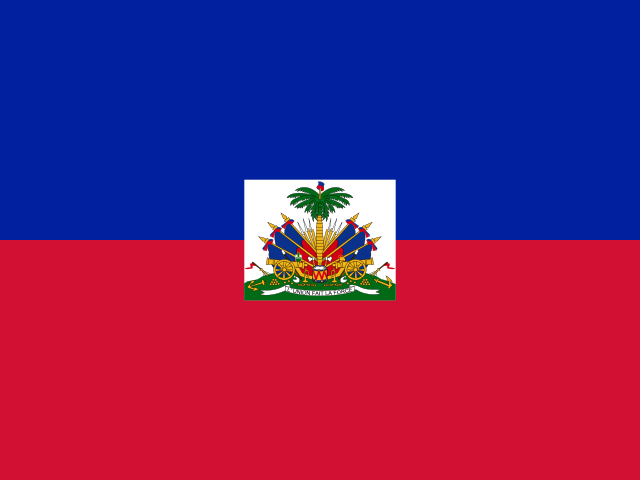
 Haiti
Haiti
Description of Haiti
As a geopolitical and macroeconomic analyst, I have delved into the intricate dynamics shaping the development of nations, with a keen interest in Haiti. Situated on the western third of the island of Hispaniola, Haiti grapples with a complex tapestry of historical legacies, economic challenges, and geopolitical pressures. My analysis of Haiti's macroeconomic indicators, geopolitical positioning, and development trajectory offers unique insights into the opportunities and obstacles facing this Caribbean nation. Join me in exploring the intricate interplay of factors influencing Haiti's journey towards prosperity and stability.
Population And Age Structure
Population, total: Haiti's population of 11,306,801 is significantly below the average population of 40,097,746, ranking 81st out of 194 countries.
Population ages 0-14 (% of total population): With 32.64% of its population in this age group, Haiti exceeds the average of 27.34%, ranking 63rd out of 194 countries.
Population ages 0-14, total: Haiti's total of 3,690,862 in this age group is lower than the average of 10,327,980, ranking 77th out of 194 countries.
Population ages 15-64 (% of total population): Haiti's 62.92% falls slightly below the average of 63.44%, ranking 125th out of 194 countries.
Population ages 15-64, total: Haiti's total of 7,114,696 in this age group is significantly below the average of 26,003,407, ranking 82nd out of 194 countries.
Population ages 65 and above (% of total population): With 4.43% in this age group, Haiti is below the average of 9.22%, ranking 128th out of 194 countries.
Population ages 65 and above, total: Haiti's total of 501,243 in this age group is below the average of 3,766,959, ranking 103rd out of 194 countries.
Summary
Haiti has a lower total population compared to the global average, ranking 81st out of 194 countries. The country has a higher percentage of youths aged 0-14, ranking 63rd, while the percentage of the population aged 15-64 is slightly below average, ranking 125th. The lower percentage of the population aged 65 and above, ranking 128th, signifies a relatively younger population structure for Haiti, which could impact its dependency ratio, healthcare system, and workforce dynamics in the long term.
Population Miscellaneous
- The Rural population of Haiti is 4,851,974, which is below the average of 18,044,041. Haiti ranks 76th out of 190 countries in this statistic.
- Haiti's Rural population (% of total population) is 42.912%, slightly above the average of 41.158%. The country ranks 85th out of 190 in this category.
- In terms of Urban population, Haiti has 6,454,827 people, significantly lower than the average of 22,425,747. Haiti ranks 81st out of 194 countries for Urban population.
- The Urban population (% of total population) in Haiti is 57.088%, below the average of 59.691%. Haiti is ranked 110th out of 194 countries in this aspect.
- Haiti's Age dependency ratio (% of working-age population) is 58.922%, slightly below the average of 59.219%. The country is ranked 70th out of 194 nations for this ratio.
- Haiti's Birth rate is 23.936 per 1,000 people, above the average rate of 19.384. The country is ranked 58th out of 192 countries in terms of Birth rate.
- The Death rate in Haiti is 8.176 per 1,000 people, slightly below the average of 8.214. Haiti ranks 83rd out of 192 countries for Death rate.
- Haiti's Fertility rate, totaling 2.869 births per woman, is higher than the average rate of 2.603. Haiti is ranked 65th out of 190 countries regarding Fertility rate.
Summary
Haiti's demographic profile highlights a significant rural population, low urban population, and a slightly higher than average age dependency ratio. The country also demonstrates a relatively high birth rate and fertility rate compared to global averages. These indicators are crucial as they offer insights into Haiti's population distribution, age structure, and demographic trends, which are pivotal for policymakers in planning healthcare, education, and social welfare programs to cater to the needs of a predominantly rural population with higher birth and fertility rates.
Military
For Military expenditure (current USD), Haiti's value of $26,380,884.78 is significantly below the average of $12,904,993,617.17. Haiti ranks 140th out of 149 countries in this dataset.
In terms of Military expenditure (% of GDP), Haiti's value at 0.17% is well below the average of 1.90%. Haiti holds the 147th position out of 148 countries in this category.
Regarding Armed forces personnel, Haiti's total of 1,000 personnel is substantially lower than the average of 165,908.54. Haiti holds the 163rd position out of 164 countries.
For Armed forces personnel (% of total labor force), Haiti's proportion of 0.02% is significantly below the average of 1.28%. Haiti ranks 164th out of 164 countries in this metric.
Summary
Haiti's military expenditure, both in absolute terms and as a percentage of its GDP, is substantially below global averages, with minimal armed forces personnel compared to other nations. This could indicate limited capacity for defense and security operations, potentially leaving the country vulnerable to internal or external threats. The low allocation towards the military sector may also reflect broader socioeconomic challenges and competing priorities for government spending in Haiti.
Natural Resources
Analysis of key statistics for Haiti:
1. Forest area (sq. km): Haiti's forest area is 3473 sq. km, which is below the average of 211606.11 sq. km. It ranks 144th out of 191 countries.
2. Land area (sq. km): Haiti's land area is 27560 sq. km, well below the average of 665166.51 sq. km. It ranks 141st out of 194 countries.
3. Surface area (sq. km): Haiti's surface area is 27750 sq. km, notably lower than the average of 689779.56 sq. km. It ranks 143rd out of 194 countries.
4. Arable land (hectares): Haiti has 1000000 hectares of arable land, which is significantly below the average of 7329543.16 hectares. It ranks 109th out of 190 countries.
5. Land under cereal production (hectares): Haiti's land under cereal production is 323531 hectares, much lower than the average of 4206011.63 hectares. It ranks 110th out of 174 countries.
6. Average precipitation in depth (mm per year): Haiti receives 1440 mm of average precipitation per year, higher than the average of 1157.83 mm. It ranks 60th out of 178 countries.
7. Renewable internal freshwater resources, total (billion cubic meters): Haiti has 13.007 billion cubic meters of renewable internal freshwater resources, far below the average of 240.41 billion cubic meters. It ranks 113th out of 178 countries.
Summary
In summary, Haiti has limited forest area, land area, and surface area compared to the global average, ranking quite low among countries. Additionally, its arable land and land under cereal production are significantly below average, indicating potential challenges in agricultural productivity. Despite receiving higher than average precipitation, Haiti's renewable internal freshwater resources are notably scarce. These statistics are crucial as they highlight Haiti's environmental limitations, which could impact its food security, economic development, and overall sustainability.
Resource Rents
- Total natural resources rents (% of GDP): Haiti's value for this attribute is 0.578%, which is significantly below the average of 4.630%. This places Haiti at rank 115 out of 175 countries in the dataset.
- Forest rents (% of GDP): Haiti's value for forest rents is also 0.578%, lower than the average of 1.526%. This places Haiti at rank 68 out of 174 countries in the dataset.
Summary
Haiti has a low percentage of natural resources rents and forest rents compared to the global average, ranking 115th and 68th respectively out of the countries analyzed. This indicates a limited reliance on natural resources for economic growth and highlights potential challenges in leveraging these resources for development and sustainability.
Commodities
- Cereal production in Haiti is 300,130 metric tons, significantly below the average of 17,249,945.93
metric tons, ranking 126th out of 174 countries.
- Aquaculture production in Haiti is 1,560 metric tons, far lower than the average of 679,642.92 metric
tons, placing Haiti at the 118th position out of 180 countries.
- Capture fisheries production in Haiti stands at 16,350 metric tons, notably lower than the average of
467,453.06 metric tons, ranking 128th out of 190 countries.
- Total fisheries production in Haiti is 17,910 metric tons, well below the average of 1,153,914.85 metric
tons, placing Haiti at the 131st position out of 182 countries.
- Fertilizer consumption in Haiti is 11.36 kilograms per hectare of arable land, significantly under the
average of 159.04 kilograms, with Haiti ranked 155th out of 187 countries.
Summary
Haiti's agricultural sector is facing significant challenges based on key macroeconomic indicators. The country has low production levels in cereals, aquaculture, and fisheries compared to global averages, resulting in lower rankings internationally. Additionally, Haiti's fertilizer consumption is alarmingly low, indicating potential productivity issues and a need for increased agricultural investment and modernization to improve food security and economic development. These indicators underscore the importance of addressing agricultural productivity and sustainability in Haiti to enhance its overall economic resilience and food self-sufficiency.
Intellectual Property
Scientific and technical journal articles in Haiti account for 40.2, which is significantly below the average of 15,103.76 articles. Haiti is ranked 149 out of 192 countries in this attribute.
Summary
In Haiti, the number of scientific and technical journal articles is notably low at 40.2, ranking the country 149th out of 192 globally. This indicates a significant gap in research output compared to the global average of 15,103.76 articles. This low research output can hinder Haiti's ability to innovate, develop new technologies, and address critical issues, potentially impacting its economic growth and competitiveness on the global stage.
Broad Economy Attributes
GDP (current US$): Haiti's GDP is $14,508,222,518.30, significantly below the average GDP
of $442,870,224,838.68. Haiti is ranked 122 out of 189 countries in this category.
GDP, PPP (current international $): In terms of GDP based on purchasing power parity,
Haiti's value is $35,467,329,94.81, well below the average GDP of $734,141,122,350.78. Haiti is ranked 123
out of 181 countries.
GDP per capita (current US$): Haiti's GDP per capita is $1283.14, significantly lower
than the average of $15,462.11. Haiti is ranked 159 out of 190 countries.
GDP per capita, PPP (current international $): The GDP per capita based on purchasing
power parity for Haiti is $3136.85, significantly below the average of $21,251.89. Haiti is ranked 154 out
of 181 countries.
GNI (current US$): Haiti's GNI is $14,536,821,917.31, considerably lower than the average
GNI of $452,040,815,370.70. Haiti is ranked 119 out of 185 countries.
GNI, PPP (current international $): In terms of GNI based on purchasing power parity,
Haiti's value is $35,537,648,923.30, falling well below the average of $730,698,223,823.47. Haiti is
ranked 120 out of 181 countries.
GNI per capita, PPP (current international $): Haiti's GNI per capita based on purchasing
power parity stands at $3140, far lower than the average of $20,615.75. Haiti is ranked 156 out of 181
countries.
Summary
Haiti's GDP, GDP per capita, and GNI figures are notably below global averages, indicating economic challenges such as lower overall output, individual income, and national income compared to many other countries. These statistics highlight the need for targeted economic development strategies, foreign investment, and assistance to bolster Haiti's economy and improve the standard of living for its citizens.
Broad Value Added
- The Gross value added at basic prices (GVA) for Haiti is $14,161,541,733.88, ranking 112th out of 176
countries. It is significantly below the attribute average of $360,070,943,595.12.
- Haiti's Agriculture, forestry, and fishing value added (% of GDP) is 20.36%, higher than the average of
10.86%, ranking 34th out of 182 countries.
- In terms of Agriculture, forestry, and fishing value added (current US$), Haiti's value is
$2,954,235,900.92, ranking 94th out of 182 countries, significantly below the average of
$19,924,732,828.07.
- Haiti's Services value added (% of GDP) is 53.92%, slightly below the average of 56.72%, ranking 108th
out of 183 countries.
- The Services value added (current US$) for Haiti is $7,822,894,503.06, ranking 119th out of 183
countries, well below the average of $295,837,711,130.69.
- Haiti's Industry (including construction) value added (current US$) is $3,384,411,330.90, ranking 121st
out of 183 countries, significantly below the average of $118,421,095,413.50.
Summary
Haiti exhibits a lower Gross Value Added (GVA) compared to the global average, with a significant focus on Agriculture, forestry, and fishing, which contributes a higher percentage to its GDP than the world average. The country's Services sector, although below the global average, plays a crucial role in its economy, while its Industry sector lags significantly behind. These indicators are vital as they highlight Haiti's economic structure, emphasizing the need for diversification and development to enhance overall economic growth and stability.
Manufacturing Value Added
Regarding Manufacturing, value added (current US$), Haiti's value is $2,558,927,192.11, which is significantly below the average of $76,207,179,589.66. Haiti ranks 102 out of 173 countries included in the data.
For Manufacturing, value added (% of GDP), Haiti's value is 17.64%, which is above the average of 11.90%. This places Haiti at rank 33 out of 173 countries.
In terms of Medium and high-tech manufacturing value added (% manufacturing value added), Haiti's value is 5.26%, well below the average of 24.49%. Haiti is ranked 131 out of 149 countries in this attribute.
Summary
Haiti's manufacturing sector, as indicated by its value added in current US dollars, is significantly below the global average. However, when considering manufacturing value added as a percentage of GDP, Haiti performs relatively better, ranking 33 out of 173 countries. The low percentage of medium and high-tech manufacturing value added highlights Haiti's limited presence in advanced manufacturing industries compared to other nations.
These findings are important as they underscore Haiti's challenges in developing a competitive manufacturing sector that can contribute more significantly to its GDP. Addressing this disparity is crucial for diversifying the economy, creating job opportunities, and improving overall economic resilience in Haiti.
Money
Inflation, consumer prices in Haiti are significantly higher than the global average of 8.26%, standing at 22.80%. Haiti ranks 7th out of 165 countries in this attribute data.
Similarly, Inflation, GDP deflator for Haiti is also above the average of 6.90%, with a rate of 18.69%. The country ranks 8th out of 188 countries in this dataset.
Contrastingly, Haiti's Broad money growth is below the average of 18.03%, at 4.22%. This places Haiti at 123rd out of 139 countries in this metric.
Moreover, Haiti's Broad money (% of GDP) is significantly lower than the average of 71.75%, at 27.19%. The country ranks 126th out of 139 countries for this indicator.
Lastly, Haiti's Broad money to total reserves ratio is also below the average of 5.17%, standing at 1.52%. In this aspect, Haiti is ranked 111th out of 126 countries in the dataset.
Summary
Haiti demonstrates high inflation rates compared to the global average, ranking 7th in consumer price inflation and 8th in GDP deflator inflation globally. However, the country's broad money metrics, including broad money growth, broad money (% of GDP), and broad money to total reserves ratio, are all below world averages, ranking relatively lower in these aspects. These statistics are crucial as they indicate challenges in Haiti's monetary policy effectiveness, economic stability, and potential for sustainable growth.
Consumption Expenditure
Final consumption expenditure (current US$): Haiti's final consumption expenditure is $15,147,858,705.006, which is significantly below the average of $381,630,252,515.3805. Haiti ranks 105 out of 159 countries in this attribute.
Final consumption expenditure (% of GDP): Haiti's final consumption expenditure as a percentage of GDP is 104.41%, which is above the average of 82.37%. Haiti ranks 14 out of 159 countries in this attribute.
General government final consumption expenditure (current US$): Haiti's general government final consumption expenditure is $1,060,849,292.94466, well below the average of $93,676,578,238.03342. Haiti ranks 130 out of 158 countries in this attribute.
General government final consumption expenditure (% of GDP): Haiti's general government final consumption expenditure as a percentage of GDP is 7.31%, significantly lower than the average of 18.71%. Haiti ranks 154 out of 158 countries in this attribute.
Household and NPISHs Final consumption expenditure (current US$): Haiti's household and NPISHs final consumption expenditure is $14,087,009,412.0614, which is notably below the average of $290,127,571,157.693. Haiti ranks 101 out of 158 countries in this attribute.
Households and NPISHs final consumption expenditure (% of GDP): Haiti's households and NPISHs final consumption expenditure as a percentage of GDP is 97.10%, well above the average of 63.68%. Haiti ranks 6 out of 158 countries in this attribute.
Summary
The analysis of key macroeconomic indicators for Haiti reveals a pattern of below-average final consumption expenditure across different categories compared to a global average. Particularly noteworthy is Haiti's low general government final consumption expenditure as a percentage of GDP, ranking significantly lower than the average, reflecting potential challenges in public sector spending and investment in national development. The high percentage of household and NPISHs final consumption expenditure relative to GDP indicates a heavy reliance on private consumption for economic growth, suggesting a need for diversification and strengthening of other sectors to promote sustainable development.
Investment
For the attribute "Foreign direct investment, net (BoP, current US$)", Haiti has a value of -25,000,000 which is significantly below the average of -1,615,235,980.50. Haiti is ranked 47 out of 169 countries for this attribute.
Regarding "Foreign direct investment, net inflows (BoP, current US$)", Haiti's value of $25,000,000 is well below the average of $5,749,271,080.15. Haiti is ranked 140 out of 182 countries for this attribute.
Lastly, for "Foreign direct investment, net inflows (% of GDP)", Haiti's value of 0.17% is lower than the average of 2.61%. Haiti is ranked 150 out of 178 countries considering this metric.
Summary
Haiti performs poorly in attracting foreign direct investment compared to the global average across these three key indicators. The country's negative net foreign direct investment, both in absolute terms and as a percentage of GDP, indicates challenges in attracting capital for economic development. This lack of foreign investment could hinder Haiti's ability to stimulate economic growth, create job opportunities, and improve infrastructure, highlighting the need for targeted investment promotion efforts and economic reforms.
Debt
Among 120 countries, Haiti's Total debt service (% of GNI) is 0.176, significantly lower than the attribute average of 5.984, ranking 117th.
Haiti's Public and publicly guaranteed debt service (% of GNI) stands at 0.067, well below the attribute average of 2.841. This places Haiti at 118th out of 120 countries.
The External debt stocks (% of GNI) for Haiti is 15.944, much lower than the average of 65.418, ranking Haiti at 112th out of 120 countries.
Haiti's Debt service on external debt, total (TDS, current US$) is $25,531,121.40, which is substantially below the average of $9,811,195,839.23, positioning Haiti at 114th out of 123 countries.
With Haiti's Debt service on external debt, public and publicly guaranteed (PPG) at $9,744,000, Haiti is ranked 117th out of 123 countries, below the average of $3,310,612,057.60.
Haiti's External debt stocks, public and publicly guaranteed (PPG) amount to $2,026,545,289.20, a significant deviation from the average of $28,695,879,144.98. This places Haiti at 93rd out of 123 countries.
The External debt stocks, total for Haiti is $2,317,684,493.90, much lower than the average of $73,845,530,111.82, positioning Haiti at the 99th rank out of 123 countries.
Summary
Haiti demonstrates a notably low level of debt burden compared to the global average across various metrics such as total debt service, external debt stocks, and debt service on external debt. These statistics indicate Haiti's relatively manageable debt obligations, which can be crucial for the country's economic stability and development prospects. Maintaining a low debt burden can free up resources for investments in infrastructure, social programs, and economic growth, potentially fostering long-term sustainability and prosperity for Haiti.
Broad Trade Attributes
Concerning "Trade (% of GDP)", Haiti has a value of 34.46% which is below the average of 82.34%. Haiti ranks 146 out of 163 countries in this attribute.
Regarding "Merchandise trade (% of GDP)", Haiti's value is 30.56%, lower than the average of 60.01%. Haiti holds the 161st rank out of 186 countries.
For "Trade in services (% of GDP)", Haiti's value stands at 4.30%, well below the average of 24.63%. Haiti is ranked 167th out of 171 countries in this category.
Looking at "External balance on goods and services (current US$)", Haiti's value is -2,967,001,038.57, below the average of 3,405,509,011.13. Haiti ranks 125th out of 163 countries.
In the attribute of "External balance on goods and services (% of GDP)", Haiti's value is -20.45%, while the average is -5.97%. Haiti is placed 142nd out of 163 countries in this metric.
Summary
Haiti displays concerning figures across key macroeconomic indicators related to trade, merchandise trade, trade in services, and external balance on goods and services. The country's values for these indicators consistently fall below global averages, placing Haiti at relatively low ranks compared to other nations. These statistics are crucial as they highlight Haiti's dependency on external trade, its limited integration in the global economy, and its vulnerability to external shocks and economic fluctuations.
Net Trade
1. Current account balance (BoP, current US$): Haiti's current account balance is $51,548,074.93, which is significantly below the average of $1,443,864,831.49. Haiti ranks 63rd out of 170 countries in this attribute data.
2. Current account balance (% of GDP): Haiti's current account balance as a percentage of GDP is 0.36%, notably higher than the average of -2.36%. Haiti ranks 62nd out of 170 countries in this metric.
3. Net trade in goods and services (BoP, current US$): Haiti's net trade in goods and services is at -$3,159,219,178.16, below the average of $2,604,730,003.57. Haiti ranks 131st out of 171 countries in this category.
4. Net primary income (BoP, current US$): Haiti's net primary income is $28,603,878.80, much higher than the average of -$903,807,529.74. Haiti ranks 41st out of 170 countries for this measure.
5. Net secondary income (BoP, current US$): Haiti's net secondary income is $3,182,163,374.30, significantly above the average of -$269,227,340.40. Haiti ranks 32nd out of 170 countries in this attribute.
6. Net trade in goods (BoP, current US$): Haiti's net trade in goods stands at -$2,800,416,050.79, lower than the average of $1,302,831,005.68. Haiti ranks 127th out of 171 countries in this aspect.
7. Net capital account (BoP, current US$): Haiti's net capital account is $69,890,964.14, below the average of $136,543,824.05. Haiti ranks 78th out of 159 countries in this attribute.
8. Net financial account (BoP, current US$): Haiti's net financial account is $308,650,789.80, surpassing the average of -$469,840,994.63. Haiti ranks 59th out of 170 countries in this metric.
Summary
Haiti has a mixed performance in key macroeconomic indicators. While it has a significantly low current account balance, it performs well in net primary income and net secondary income. These indicators are crucial for understanding Haiti's economic health and its ability to generate income from primary and secondary sources, which can impact its overall economic stability and resilience.
Broad Export Attributes
Analysis:
1. Exports of goods, services and primary income (BoP, current US$): Haiti's value for this attribute is $1,068,525,811.19, which is significantly below the average of $146,238,908,936.30. Haiti is ranked 149th out of 170 countries included in the data.
2. Exports of goods and services (BoP, current US$): Haiti's value for this attribute is $1,018,064,597.63, also notably lower than the average of $122,938,540,059.78. Haiti is ranked 148th out of 170 countries.
3. Exports of goods and services (current US$): Haiti's value for this attribute is $1,016,063,243.93, significantly below the average of $129,596,864,610.19. Haiti is ranked 141st out of 163 countries.
4. Exports of goods and services (% of GDP): Haiti's value for this attribute is 7.00%, well below the average of 38.19%. Haiti is ranked 159th out of 163 countries.
5. Goods exports (BoP, current US$): Haiti's value for this attribute is $885,315,743.61, which is notably lower than the average of $93,310,581,697.39. Haiti is ranked 141st out of 171 countries.
Summary
In analyzing Haiti's key macroeconomic indicators related to exports, it is evident that the country lags significantly behind the global average in terms of export values across various categories. Haiti's rankings are consistently low compared to a large pool of countries, reflecting its limited global market share and economic competitiveness. These findings are crucial as they highlight Haiti's challenges in trade performance, suggesting the need for targeted policies to boost export capabilities and enhance economic growth.
Merchandise Exports
For Merchandise exports (current US$), Haiti's value of 885,000,000 is significantly below the attribute average of 89,542,711,229.95. Haiti ranks 145 out of 187 countries in this category.
Regarding Merchandise exports by the reporting economy, residual (% of total merchandise exports), Haiti's value of 0.00003 is well below the attribute average of 3.20. Haiti is ranked 161 out of 166 countries in this metric.
Summary
Haiti's merchandise exports value of $885,000,000 is markedly lower than the global average of $89,542,711,229.95, positioning it at 145th out of 187 countries. Additionally, Haiti's residual percentage for merchandise exports is significantly below the average at 0.00003 compared to 3.20, placing it at 161st out of 166 countries. These indicators highlight Haiti's limited participation in global trade, which could impact its economic growth and development prospects.
Technology Exports
Medium and high-tech exports (% manufactured exports): Haiti's value is 3.80%, significantly below the average of 34.29%. This places Haiti at rank 139 out of 149 countries in the dataset.
Summary
Haiti's low percentage of medium and high-tech exports compared to the global average indicates a lack of economic diversification and technological advancement. This places Haiti in a less competitive position in the global market, limiting its potential for economic growth and development. Addressing this issue is crucial for Haiti to enhance its competitiveness, attract investment, and foster sustainable economic progress.
Service Exports
Analysis of key statistics for Haiti:
1. Service exports (BoP, current US$): Haiti's value is significantly below the average of $28,917,292,503.82, ranking 149th out of 171 countries.
2. ICT service exports (BoP, current US$): Haiti's value is well below the average of $4,578,501,153.77, ranking 158th out of 166 countries.
3. ICT service exports (% of service exports, BoP): Haiti's percentage is lower than the average of 11.75%, ranking 150th out of 166 countries.
4. Communications, computer, etc. (% of service exports, BoP): Haiti's percentage is significantly lower than the average of 45.85%, ranking 164th out of 169 countries.
5. Transport services (% of service exports, BoP): Haiti's percentage is notably lower than the average of 21.80%, ranking 167th out of 169 countries.
6. Travel services (% of service exports, BoP): Haiti's percentage is significantly higher than the average of 26.40%, ranking 7th out of 167 countries.
7. Insurance and financial services (% of service exports, BoP): Haiti's percentage is above the average of 6.46%, ranking 16th out of 161 countries.
Summary
In analyzing key statistics for Haiti, it is evident that the country lags behind in various economic indicators related to service exports and ICT services compared to global averages. Haiti ranks below average in areas such as ICT service exports, communications, computer services, and transport services, indicating a need for improvement in these sectors. On a positive note, Haiti excels in travel services and insurance/financial services exports, outperforming many other countries globally. These findings are crucial as they highlight Haiti's strengths and weaknesses in the service sector, providing insight into areas for potential growth and development.
Commercial Service Exports
1. Commercial service exports (current US$): Haiti's commercial service exports amount to $124,558,854.02, significantly below the average of $28,508,218,402.80. Haiti ranks 148th out of 171 countries in this category.
2. Travel services (% of commercial service exports): Haiti's travel services account for 81.79% of its commercial service exports, well above the average of 27.89%. Haiti ranks 5th out of 167 countries in this aspect.
3. Computer, communications and other services (% of commercial service exports): Haiti's services in this category represent 1.79% of its commercial service exports, significantly below the average of 42.44%. Haiti ranks 166th out of 169 countries in this segment.
4. Insurance and financial services (% of commercial service exports): Haiti's insurance and financial services amount to 15.81% of its commercial service exports, notably above the average of 6.97%. Haiti ranks 17th out of 161 countries in this field.
5. Transport services (% of commercial service exports): Haiti's transport services comprise 0.60% of its commercial service exports, considerably below the average of 23.37%. Haiti ranks 167th out of 169 countries in this category.
Summary
In summary, Haiti heavily relies on travel services, with it constituting a large portion of its commercial service exports. On the other hand, the country lags behind in computer, communications, and transport services exports compared to the global average. Despite performing well in insurance and financial services, there is significant room for growth in diversifying its service exports beyond travel services.
These findings are crucial as they highlight Haiti's current economic dependence on travel services, which can pose risks in times of global economic uncertainties or disruptions in the travel industry. Diversification of service exports can enhance resilience, reduce vulnerability to external shocks, and foster sustainable economic development in the long run.
Broad Import Attributes
1. Imports of goods and services (current US$): Haiti's value of $3,983,064,282.50 is significantly below the average of $126,191,355,599.06. Haiti ranks 120th out of 163 countries in this attribute data.
2. Imports of goods and services (% of GDP): Haiti's value of 27.45% is below the average of 44.15%. Haiti ranks 121st out of 163 countries in this attribute data.
3. Goods imports (BoP, current US$): Haiti's value of $3,685,731,794.40 is far below the average of $92,007,788,027.17. Haiti ranks 123rd out of 171 countries in this attribute data.
4. Imports of goods and services (BoP, current US$): Haiti's value of $4,177,283,775.79 is substantially below the average of $120,321,577,988.12. Haiti ranks 126th out of 170 countries in this attribute data.
5. Imports of goods, services and primary income (BoP, current US$): Haiti's value of $4,199,141,110.56 is significantly lower than the average of $144,514,428,722.28. Haiti ranks 128th out of 170 countries in this attribute data.
Summary
Haiti's imports of goods and services, both in absolute value and as a percentage of GDP, are well below the global average, ranking 120th and 121st out of 163 countries respectively. This low level of imports indicates limited economic activity and a heavy dependence on domestic production. The disparity between Haiti's import figures and the global average highlights the challenges the country faces in terms of trade openness and economic integration with the global market.
Merchandise Imports
For the attribute "Merchandise imports (current US$)", Haiti has a value of $3,549,000,000. This is significantly below the average of $89,385,605,263. Haiti ranks 133rd out of 190 countries in this attribute.
Regarding "Merchandise imports by the reporting economy, residual (% of total merchandise imports)", Haiti's value of 15.26% is notably higher than the average of 2.51%. This places Haiti at the 6th position out of 180 countries for this specific statistic.
Summary
Haiti has a relatively low value of $3,549,000,000 for merchandise imports (current US$), ranking 133rd globally, well below the average of $89,385,605,263. However, Haiti stands out with a high value of 15.26% for merchandise imports by the reporting economy, residual (% of total merchandise imports), placing 6th out of 180 countries. These indicators are crucial as they highlight Haiti's high reliance on imported goods and the significant role of residual imports in its economy.
Service Imports
Analysis of key service import attributes for Haiti:
1. Service imports (BoP, current US$): Haiti's service imports amount to $491,551,981.40. This is significantly below the average of $27,615,356,170.47, placing Haiti at rank 145 out of 171 countries.
2. Communications, computer, etc. (% of service imports, BoP): Haiti's percentage of service imports allocated to communications, computer, etc. is 39.20%, slightly below the average of 44.40%. Haiti is ranked 102 out of 169 countries.
3. Transport services (% of service imports, BoP): Haiti allocates 56.55% of its service imports to transport services, well above the average of 32.90%. This places Haiti at rank 15 out of 169 countries.
4. Travel services (% of service imports, BoP): Haiti's allocation of service imports to travel services stands at 3.21%, notably lower than the average of 14.14%. Haiti ranks 148 out of 169 countries in this category.
5. Insurance and financial services (% of service imports, BoP): Haiti allocates 1.05% of its service imports to insurance and financial services, significantly below the average of 8.53%. This places Haiti at rank 167 out of 169 countries.
Summary
Haiti's key service import attributes reveal a significant disparity compared to global averages. The country prioritizes transport services with a high allocation percentage, whereas its allocations towards communications, computer, and travel services are notably lower. The low allocation towards insurance and financial services also stands out. These findings are crucial as they highlight Haiti's specific import priorities and emphasize areas where the country may need to focus on diversification and investment to enhance its service import profile and potentially boost its overall economic development.
Commercial Service Imports
Analysis of key statistical attributes for Haiti:
1. Commercial service imports (current US$): Haiti's commercial service imports amount to $463,136,507.24, significantly below the average of $27,102,746,128.60. Haiti ranks 145th out of 171 countries in this attribute.
2. Computer, communications and other services (% of commercial service imports): Haiti's percentage of 35.46% is below the average of 41.71%. This places Haiti at the 104th rank out of 169 countries.
3. Insurance and financial services (% of commercial service imports): With a value of 1.11%, Haiti falls well below the average of 8.85%. The country ranks 167th out of 169 countries in this aspect.
4. Transport services (% of commercial service imports): Haiti's transport services constitute 60.02% of its commercial service imports, which is notably higher than the average of 34.71%. This places Haiti at the 18th rank out of 169 countries.
5. Travel services (% of commercial service imports): Haiti's travel services account for 3.41% of its commercial service imports, below the average of 14.73%. Haiti ranks 146th out of 169 countries in this attribute.
Summary
Haiti's key statistical attributes reveal a significant disparity in its commercial service imports compared to the global average. The country ranks relatively low in terms of computer, communications, and other services as well as insurance and financial services, signaling potential areas for development. However, Haiti performs well above average in transport services, indicating a competitive advantage in this sector. Understanding these statistics is crucial as it can guide policymakers in identifying priority areas for investment and economic growth to improve Haiti's overall economic performance.
Infrastructure
1. Air transport, registered carrier departures worldwide: Haiti has 1563 registered carrier departures, significantly below the average of 134,365. Haiti ranks 128 out of 149 countries in this dataset.
2. Air transport, passengers carried: Haiti carried 23,119 passengers, notably lower than the average of 11,848,242 passengers. Haiti is ranked 138 out of 149 countries for this indicator.
3. Container port traffic (TEU: 20 foot equivalent units): Haiti handled 177,042.75 TEUs, well below the average of 6,907,110. Haiti holds the 99th rank out of 110 countries in this category.
Summary
In analyzing key macroeconomic indicators for Haiti, it is evident that the country lags significantly behind global averages in air transport departures, passengers carried, and container port traffic. This indicates limited connectivity and trade volume compared to the international standards, reflecting potential challenges in economic growth, competitiveness, and global integration for Haiti.
Information Technology Infrastructure
1. Secure Internet servers: Haiti has 87 secure internet servers, which is significantly below the average of 458,294 servers. Haiti ranks 164 out of 193 countries in this attribute.
2. Secure Internet servers (per 1 million people): Haiti has 7.69 secure internet servers per 1 million people, far below the average of 14,067 servers. Haiti ranks 177 out of 193 countries in this attribute.
3. Individuals using the Internet (% of population): Haiti has 36.39% of its population using the internet, much lower than the average of 64.77%. Haiti ranks 143 out of 180 countries in this attribute.
4. Fixed broadband subscriptions: Haiti has 31,000 fixed broadband subscriptions, significantly lower than the average of 6,591,956 subscriptions. Haiti ranks 144 out of 185 countries in this attribute.
5. Mobile cellular subscriptions: Haiti has 7,319,000 mobile cellular subscriptions, below the average of 42,526,464 subscriptions. Haiti ranks 100 out of 193 countries in this attribute.
Summary
Haiti lags behind the global average in key indicators related to internet infrastructure and connectivity. With significantly fewer secure internet servers, low penetration of secure servers per capita, limited internet usage among its population, and fewer fixed broadband subscriptions compared to the average, Haiti faces challenges in advancing its digital connectivity and technology adoption. The lower ranking in these attributes indicates a need for investment in digital infrastructure and policies to bridge the digital divide and enhance connectivity for socio-economic development.
Energy Consumption
Regarding Renewable energy consumption (% of total final energy consumption), Haiti's value of 76.31% is significantly above the attribute average of 32.18%. This places Haiti at rank 23 out of 191 countries in the dataset.
On the other hand, in terms of CO2 emissions (kt), Haiti's value of 3209.04 is notably below the attribute average of 171895.94. This places Haiti at rank 137 out of 188 countries in the dataset.
Summary
Haiti stands out for its high renewable energy consumption, with a percentage well above the global average. This indicates a strong commitment to sustainability and a reduced reliance on non-renewable energy sources. Additionally, Haiti's low CO2 emissions signify environmentally conscious practices, positioning the country favorably in terms of climate impact compared to many other nations. These findings are crucial as they highlight Haiti's potential for environmental leadership and sustainable development amidst global efforts to combat climate change.
Government Balance Sheet
1. Total reserves (% of total external debt): Haiti's total reserves as a percentage of total external debt is 111.76%, significantly above the average of 66.13%. With a rank of 14 out of 102 countries in the dataset, Haiti seems to have a strong financial buffer compared to its debt.
2. Reserves and related items (BoP, current US$): Haiti's reserves and related items are valued at -41,441,075.22 USD, much below the average of 1,924,407,186.58 USD. Ranked 106 out of 171 countries, Haiti appears to have a deficit in this aspect.
3. Total reserves minus gold (current US$): Haiti's total reserves minus gold amount to 2,480,148,340.67 USD, significantly below the average of 74,221,588,171.61 USD. With a rank of 106 out of 161 countries, Haiti seems to have limited reserves excluding gold.
4. Total reserves (includes gold, current US$): Haiti's total reserves including gold total 2,590,258,526.98 USD, considerably lower than the average of 85,708,019,773.47 USD. Ranked 107 out of 161 countries, Haiti appears to have relatively low reserves inclusive of gold.
5. Total reserves in months of imports: Haiti's total reserves in months of imports stand at 7.40, slightly above the average of 7.10 months. Ranked 50 out of 151 countries, Haiti seems to have a reasonably healthy reserve coverage concerning imports.
Summary
Haiti demonstrates a strong buffer against external debt with total reserves surpassing the average by 45.63%. However, the country faces a deficit in reserves and related items, with limited reserves excluding gold. Despite lower total reserves including gold, Haiti maintains a healthy reserve coverage concerning imports. These statistics are crucial as they highlight Haiti's financial stability, resilience against debt, and ability to cover import costs in the short term.
Taxes
For the attribute "Tariff rate, applied, weighted mean, all products (%)" Haiti has a value of 6.76%, which is 1.55% above the average of 5.21%. Haiti ranks 49th out of 153 countries in this dataset.
Summary
Haiti has a higher-than-average tariff rate of 6.76% for all products, surpassing the global average of 5.21%. Despite ranking 49th out of 153 countries in this indicator, the elevated tariff rate might hinder international trade and economic growth for Haiti, making it less competitive compared to countries with lower tariff rates.
Top Stats
Ranks in Top Decile For:
| Attribute | Rank/Total |
|---|---|
| Inflation, consumer prices (annual %) | 7/165 |
| Inflation, GDP deflator (annual %) | 8/188 |
| Final consumption expenditure (% of GDP) | 14/159 |
| Households and NPISHs final consumption expenditure (% of GDP) | 6/158 |
| Travel services (% of service exports, BoP) | 7/167 |
| Insurance and financial services (% of service exports, BoP) | 16/161 |
| Travel services (% of commercial service exports) | 5/167 |
| Merchandise imports by the reporting economy, residual (% of total merchandise imports) | 6/180 |
| Transport services (% of service imports, BoP) | 15/169 |
Ranks in Bottom Decile For:
| Attribute | Rank/Total |
|---|---|
| Military expenditure (current USD) | 140/149 |
| Military expenditure (% of GDP) | 147/148 |
| Armed forces personnel, total | 163/164 |
| Armed forces personnel (% of total labor force) | 164/164 |
| Broad money (% of GDP) | 126/139 |
| General government final consumption expenditure (% of GDP) | 154/158 |
| Total debt service (% of GNI) | 117/120 |
| Public and publicly guaranteed debt service (% of GNI) | 118/120 |
| External debt stocks (% of GNI) | 112/120 |
| Debt service on external debt, total (TDS, current US$) | 114/123 |
| Debt service on external debt, public and publicly guaranteed (PPG) (TDS, current US$) | 117/123 |
| Trade in services (% of GDP) | 167/171 |
| Exports of goods and services (% of GDP) | 159/163 |
| Merchandise exports by the reporting economy, residual (% of total merchandise exports) | 161/166 |
| Medium and high-tech exports (% manufactured exports) | 139/149 |
| ICT service exports (BoP, current US$) | 158/166 |
| ICT service exports (% of service exports, BoP) | 150/166 |
| Communications, computer, etc. (% of service exports, BoP) | 164/169 |
| Transport services (% of service exports, BoP) | 167/169 |
| Computer, communications and other services (% of commercial service exports) | 166/169 |
| Transport services (% of commercial service exports) | 167/169 |
| Insurance and financial services (% of service imports, BoP) | 167/169 |
| Insurance and financial services (% of commercial service imports) | 167/169 |
| Air transport, passengers carried | 138/149 |
| Secure Internet servers (per 1 million people) | 177/193 |