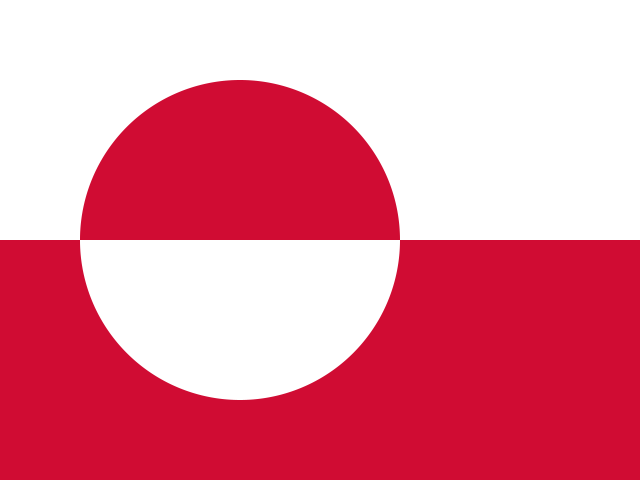
 Greenland
Description of Greenland
Greenland, the world's largest island, is a land of rugged beauty and stark contrasts. Known for its vast ice sheets, stunning fjords, and unique indigenous culture, Greenland holds a strategic geopolitical position at the intersection of the Arctic, North Atlantic, and North American regions. As the effects of climate change reshape the Arctic landscape, Greenland's economy and society face both challenges and opportunities. This website delves into the intricate interplay between macroeconomic factors, geopolitics, and societal dynamics to provide a comprehensive understanding of Greenland's development path and its relationships with neighboring countries and global players.
Population And Age Structure
Population, total: Greenland has a population of 56,367, far below the average population of 40,097,746. Greenland ranks 186 out of 194 countries in terms of population.
Population ages 0-14 (% of total population): With 20.9% of its population aged 0-14, Greenland is below the average of 27.3%. It ranks 121 out of 194 countries in this demographic category.
Population ages 0-14, total: Greenland's total population aged 0-14 is 11,782, significantly lower than the average of 10,327,380. It ranks 187 out of 194 countries in this age group.
Population ages 15-64 (% of total population): Greenland's population aged 15-64 accounts for 70.1% of the total population, above the average of 63.4%. The country ranks 19 out of 194 in this age category.
Population ages 15-64, total: With a population of 39,520 in the 15-64 age group, Greenland falls well below the average of 26,003,407. It ranks 186 out of 194 countries in this demographic segment.
Population ages 65 and above (% of total population): The population aged 65 and above in Greenland represents 8.99% of the total population, slightly below the average of 9.22%. Greenland ranks 75 out of 194 countries in this age bracket.
Population ages 65 and above, total: Greenland's total population aged 65 and above is 5,066, significantly lower than the average of 3,766,959. The country ranks 188 out of 194 countries with respect to this demographic segment.
Summary
Greenland has a relatively small population of 56,367, with a higher percentage of individuals aged 15-64 compared to the global average. However, the country has a lower percentage of children (0-14 years) and elderly individuals (65 and above) compared to the global average. These statistics are crucial as they reveal Greenland's demographic profile, which can impact societal dynamics, healthcare needs, workforce composition, and pension system requirements in the country.
Population Miscellaneous
1. Rural population: Greenland has a relatively low rural population of 7169, significantly below the attribute average of 18,044,041. Greenland is ranked 186th out of 190 countries in terms of rural population.
2. Rural population (% of total population): With a value of 12.718%, Greenland's rural population as a percentage of the total population is well below the average of 41.158%. Greenland is ranked 170th out of 190 countries in this aspect.
3. Urban population: Greenland's urban population stands at 49,198, significantly lower than the average of 22,425,747. Greenland is ranked 179th out of 194 countries for urban population.
4. Urban population (% of total population): The urban population in Greenland represents 87.282% of the total population, which is above the average of 59.691%. Greenland is ranked 25th out of 194 countries in this regard.
5. Age dependency ratio (% of working-age population): Greenland's age dependency ratio is 42.63%, below the average of 59.22%. The country is ranked 176th out of 194 countries for this ratio.
6. Birth rate, crude (per 1,000 people): With a crude birth rate of 14.8 per 1,000 people, Greenland is below the average of 19.38. The country is ranked 109th out of 192 countries in terms of birth rate.
7. Death rate, crude (per 1,000 people): Greenland's crude death rate is 9.2 per 1,000 people, slightly above the average of 8.21. Greenland is ranked 59th out of 192 countries for death rate.
8. Fertility rate, total (births per woman): Greenland's total fertility rate is 2.019, lower than the average of 2.603. The country is ranked 102nd out of 190 countries for fertility rate.
Summary
Greenland demonstrates a unique demographic profile with a low rural population and a high urban population percentage. The country has below-average age dependency and fertility rates, coupled with a lower crude birth rate compared to the global average. These indicators suggest a shift towards urbanization and potentially a declining population growth rate, which could impact future workforce dynamics and economic sustainability in Greenland.
Natural Resources
Greenland has a Forest area of 2.2 sq. km, significantly below the average of 211,606.11 sq. km, ranking at 191 out of 191 countries included in the data.
With a Land area of 410,450 sq. km, Greenland is below the average of 665,166.51 sq. km, ranking at 57 out of 194 countries listed.
The Surface area of Greenland is also 410,450 sq. km, notably lower than the average of 689,779.56 sq. km, placing it at the 59th position out of 194 countries.
Summary
Greenland's small forest area, land area, and surface area compared to global averages position it at the bottom in rankings among the countries included in the data. These indicators are significant as they highlight Greenland's limited natural resources and potential challenges in terms of environmental conservation, agricultural development, and geopolitical influence compared to larger countries with more land and resources.
Commodities
Greenland's Capture fisheries production of 259,209 metric tons is below the attribute average of 467,453. Greenland ranks 48th out of 190 countries in this category.
Summary
Greenland's capture fisheries production of 259,209 metric tons falls below the global average of 467,453 metric tons, positioning Greenland at the 48th rank globally for this category. This indicates that Greenland's fishing industry is performing below the average compared to other countries, suggesting potential challenges or opportunities for growth and sustainability in the sector.
Intellectual Property
Greenland has a low percentage of 27.7 in Scientific and technical journal articles, which is significantly below the average of 15103.76. This places Greenland at rank 158 out of 192 countries in this dataset.
Summary
Greenland's low percentage of 27.7 in Scientific and technical journal articles is strikingly below the global average of 15103.76, positioning the country at 158 out of 192 countries in this particular metric. This disparity underscores a potential gap in research and innovation within Greenland compared to other nations, highlighting the importance of fostering a knowledge-based economy and investing in scientific development to drive future growth and competitiveness.
Broad Economy Attributes
Greenland's GDP (current US$) is 3,082,884,653.25, placing it as the 157th out of 189 countries. The country's GDP is significantly below the average of 442,870,224,838.68.
In terms of GDP per capita (current US$), Greenland has a value of 54,693.08, which is notably higher than the average of 15,462.11. This places Greenland as the 11th out of 190 countries included in the data set.
Summary
Greenland's GDP of 3,082,884,653.25 positions it below the global average, ranking 157th out of 189 countries. However, its GDP per capita of 54,693.08 is substantially higher than the worldwide average, placing it at 11th out of 190 countries. These statistics are crucial as they indicate that while Greenland's overall economic output is modest compared to other nations, the wealth distribution among its population is notably favorable, showcasing a relatively higher standard of living for its residents.
Broad Value Added
- Gross value added at basic prices (GVA) (current US$): Greenland's GVA is $2,966,623,215.11, ranking
150th out of 176 countries. This value is significantly below the average GVA of $360,070,943,595.12.
- Agriculture, forestry, and fishing, value added (% of GDP): Greenland's value added in this sector
accounts for 17.45% of its GDP, ranking 47th out of 182 countries. This percentage is notably higher than
the average of 10.86%.
- Agriculture, forestry, and fishing, value added (current US$): In this category, Greenland's value is
$537,850,542.15, placing it at the 139th position out of 182 countries. However, this value is
considerably lower than the average of $19,924,732,828.07.
- Services, value added (% of GDP): Greenland's service sector contributes to 60.43% of its GDP, ranking
64th out of 183 countries. This percentage is slightly above the average of 56.72%.
- Services, value added (current US$): The value added by Greenland's service sector is $1,863,133,109.72,
securing the 156th position out of 183 countries. It significantly falls below the average of
$295,837,711,130.69.
- Industry (including construction), value added (current US$): Greenland's value added in the industry
sector is $565,593,706.78, ranking 157th out of 183 countries. This value is well below the average of
$118,421,095,413.50.
Summary
Greenland's economy shows a notable reliance on the agriculture, forestry, and fishing sector, with this industry contributing significantly more to GDP compared to the global average. However, in terms of monetary value, Greenland lags behind in both agriculture and industry sectors, reflecting a potential need for increased efficiency and growth strategies in these areas. The country's services sector also falls short in terms of monetary value, indicating room for development and potential opportunities for diversification to drive overall economic growth and competitiveness.
Manufacturing Value Added
Greenland's Manufacturing, value added (current US$) is 104,094,187.97, which is significantly below the attribute average of 76,207,179,589.66. Greenland ranks 156 out of 173 countries in this attribute.
Additionally, Greenland's Manufacturing, value added (% of GDP) is 3.38%, well below the attribute average of 11.90%. This places Greenland at rank 157 out of 173 countries in this category.
Summary
Greenland's Manufacturing, value added and Manufacturing, value added (% of GDP) are both significantly below the global averages, ranking 156 and 157 out of 173 countries, respectively. This indicates a relatively small and underdeveloped manufacturing sector in Greenland, which may impact its overall economic diversification, job creation, and export potential.
Money
Greenland's Inflation rate, GDP deflator (annual %), stands at 0.703%, significantly below the average of 6.898%. This places Greenland at a rank of 131 out of 188 countries in the dataset, highlighting its relatively low inflation compared to other nations.
Summary
Greenland's low inflation rate, with a GDP deflator of 0.703%, is notably below the global average of 6.898%. This indicates a stable price environment within the country and positions Greenland as one of the nations with the lowest inflation levels worldwide. Such low inflation can be crucial for attracting investment, maintaining purchasing power for citizens, and fostering economic stability in the long term.
Consumption Expenditure
Analysis of key economic indicators in Greenland:
1. Final consumption expenditure (current US$): Greenland's value is significantly below the average of $381,630,252,515.38, ranking 142 out of 159 countries in the dataset.
2. Final consumption expenditure (% of GDP): With a value of 79.02%, Greenland is below the average of 82.37%, ranked 88 out of 159 countries.
3. General government final consumption expenditure (current US$): Greenland's value is notably lower than the average of $93,676,578,238.03, placing it at rank 127 out of 158 countries.
4. General government final consumption expenditure (% of GDP): Greenland's value of 43.73% is well above the average of 18.71%, giving it a high rank of 5 out of 158 countries.
5. Household and NPISHs Final consumption expenditure (current US$): Greenland's value is considerably below the average of $290,127,571,157.69, ranking 150 out of 158 countries.
6. Households and NPISHs final consumption expenditure (% of GDP): With a value of 35.28%, Greenland falls below the average of 63.68%, ranking 153 out of 158 countries.
Summary
In analyzing key economic indicators for Greenland, it is evident that the country's final consumption expenditure, both in absolute terms and as a percentage of GDP, is notably below global averages. This indicates potential limitations in domestic demand and economic growth compared to other countries in the dataset. Particularly striking is Greenland's high percentage of general government final consumption expenditure relative to its GDP, which suggests a significant role of the government in driving economic activity.
Broad Trade Attributes
- Trade (% of GDP): Greenland's trade accounts for 82.70% of its GDP, slightly above the average of 82.34%. This places Greenland at the 57th rank out of 163 countries in the dataset.
- Merchandise trade (% of GDP): Greenland's merchandise trade is 57.51% of its GDP, below the average of 60.01%. This positions Greenland at the 73rd rank out of 186 countries.
- External balance on goods and services (current US$): Greenland has a negative balance of -332,841,548.16 USD, significantly below the average of 3,405,509,011.13 USD. This places Greenland at the 86th rank out of 163 countries.
- External balance on goods and services (% of GDP): The external balance in Greenland is -10.80% of its GDP, which is lower than the average of -5.97%. Greenland is ranked 119th out of 163 countries in this metric.
Summary
Greenland's heavy reliance on trade, accounting for 82.70% of its GDP, indicates a high level of openness to international markets. However, its negative external balance on goods and services, both in absolute terms and relative to GDP, raises concerns about sustainability and economic resilience. These indicators are crucial as they highlight Greenland's integration into the global economy and its vulnerability to external shocks, emphasizing the need for prudent economic policies and diversification strategies.
Broad Export Attributes
Greenland's Exports of goods and services (current US$) amount to $1,108,350,891.27. This is significantly below the attribute average of $129,596,864,610.19. Greenland is ranked 140 out of 163 countries in this category.
Regarding Exports of goods and services (% of GDP), Greenland's value is 35.95%, which is slightly below the attribute average of 38.19%. The country is ranked 63 out of 163 countries based on this metric.
Summary
Greenland's exports of goods and services in terms of current US dollars are notably lower than the average for countries globally, ranking 140 out of 163. Additionally, the percentage of exports compared to Greenland's GDP is slightly below the global average, with a ranking of 63 out of 163. These figures indicate that Greenland has room for growth in its export sector, which plays a crucial role in the country's economic development and global competitiveness.
Merchandise Exports
Greenland's Merchandise exports amount to $816,000,000, which is significantly below the average of $89,542,711,229.94. Greenland ranks 149th out of 187 countries in this attribute.
Summary
Greenland's merchandise exports of $816,000,000 are notably lower than the global average of $89,542,711,229.94, positioning the country at 149th out of 187 nations in this aspect. This indicates that Greenland has a relatively limited presence in the global export market, potentially pointing to challenges in diversifying its economy and maximizing revenue generation through international trade.
Broad Import Attributes
Greenland's imports of goods and services amount to $1,441,192,439.43, ranking 142nd out of 163 countries. This value is significantly below the average of $126,191,355,599.06 for this attribute.
Greenland's imports of goods and services as a percentage of GDP is 46.75%, which is above the average of 44.15%. Greenland ranks 56th out of 163 countries in this aspect.
Summary
Greenland's relatively low total imports value puts it significantly below the global average, ranking 142nd out of 163 countries. However, its imports as a percentage of GDP are higher than the average, placing Greenland at the 56th position. This indicates that while Greenland's overall imports are low compared to other countries, they make up a relatively larger portion of its GDP.
These findings are important as they suggest that Greenland may have a more insular economy with limited external dependencies but relies heavily on imported goods and services to drive its economic activity. The higher percentage of imports relative to GDP also highlights the potential vulnerability of Greenland's economy to external shocks that could affect its trade balance and overall economic stability.
Merchandise Imports
Greenland's merchandise imports amount to $957 million, significantly below the average of $89.39 billion. As a result, Greenland ranks 162 out of 190 countries in this category.
Additionally, Greenland's merchandise imports by the reporting economy residual, at 0.09% of total merchandise imports, are notably lower than the average of 2.51%. This places Greenland at the 130th position out of 180 countries included in the data for this attribute.
Summary
Greenland's low merchandise imports significantly deviate from the global average, ranking it among the bottom countries in this category. The low percentage of merchandise imports by the reporting economy residual also indicates a limited role in global trade. These findings suggest that Greenland may have a relatively small and isolated economy, with potentially limited international trade partnerships and economic diversification.
Information Technology Infrastructure
Greenland has 232 secure internet servers, which is significantly below the average of 458,294. With a rank of 147 out of 193 countries, Greenland has a relatively lower presence of secure internet servers.
For secure internet servers per 1 million people, Greenland has 4,115.88 servers, much lower than the average of 14,067.17. This places Greenland at rank 58 out of 193 countries in this aspect.
When it comes to fixed broadband subscriptions, Greenland has 15,657 subscriptions, a stark difference from the average of 6,591,956.35. This places Greenland at rank 160 out of 185 countries with available data.
In terms of mobile cellular subscriptions, Greenland has 65,958 subscriptions, which is well below the average of 42,526,463.87. Greenland ranks 183 out of 193 countries in this category.
Summary
Greenland lags behind global averages in terms of secure internet servers, secure internet servers per 1 million people, fixed broadband subscriptions, and mobile cellular subscriptions. These statistics suggest that Greenland may face challenges in terms of digital infrastructure and connectivity compared to the rest of the world, which could impact its ability to participate fully in the digital economy and access information efficiently.
Energy Consumption
Greenland's renewable energy consumption is 11.46% of total final energy consumption, significantly below the attribute average of 32.18%. With this statistic, Greenland ranks at 134 out of 191 countries in renewable energy consumption.
Summary
Greenland's renewable energy consumption of 11.46% of total final energy consumption falls well below the global average of 32.18%. This places Greenland at 134 out of 191 countries in terms of renewable energy consumption. The low reliance on renewable energy sources indicates a potential opportunity for Greenland to invest in sustainable energy sources and reduce dependence on non-renewable resources, aligning with global environmental initiatives and long-term energy security goals.
Top Stats
Ranks in Top Decile For:
| Attribute | Rank/Total |
|---|---|
| Population ages 15-64 (% of total population) | 19/194 |
| GDP per capita (current US$) | 11/190 |
| General government final consumption expenditure (% of GDP) | 5/158 |
Ranks in Bottom Decile For:
| Attribute | Rank/Total |
|---|---|
| Population, total | 186/194 |
| Population ages 0-14, total | 187/194 |
| Population ages 15-64, total | 186/194 |
| Population ages 65 and above, total | 188/194 |
| Rural population | 186/190 |
| Urban population | 179/194 |
| Age dependency ratio (% of working-age population) | 176/194 |
| Forest area (sq. km) | 191/191 |
| Manufacturing, value added (current US$) | 156/173 |
| Manufacturing, value added (% of GDP) | 157/173 |
| Household and NPISHs Final consumption expenditure (current US$) | 150/158 |
| Households and NPISHs final consumption expenditure (% of GDP) | 153/158 |
| Mobile cellular subscriptions | 183/193 |