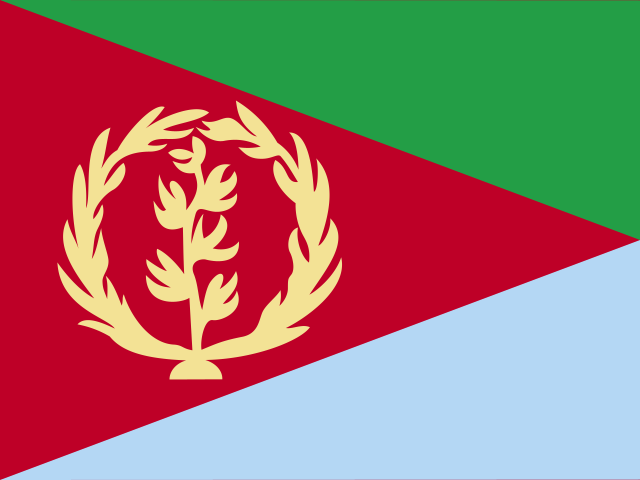
 Eritrea
Description of Eritrea
Welcome to our website dedicated to providing insightful analysis on Eritrea's geopolitical and macroeconomic landscape. As a country located in the Horn of Africa, Eritrea possesses a unique history and strategic positioning that shapes its development trajectory and international relations. By delving into key macroeconomic statistics and their implications, we aim to offer a comprehensive understanding of how Eritrea navigates the global dynamics that impact its growth and stability.
Population And Age Structure
Population, total: Eritrea's population of 3,555,868 is significantly below the average population of 40,097,746. Eritrea ranks 130 out of 194 countries in terms of total population.
Population ages 0-14 (% of total population): Eritrea has a high percentage of 40.42% of its population in the 0-14 age group, which is 13.08% above the average. This places Eritrea at rank 31 out of 194 countries.
Population ages 0-14, total: Eritrea's total population in the 0-14 age group is 1,437,458, significantly below the average of 10,327,380. Eritrea ranks 110 out of 194 countries in this category.
Population ages 15-64 (% of total population): Eritrea has 55.58% of its population in the 15-64 age group, which is 7.86% below the average. This puts Eritrea at rank 166 out of 194 countries.
Population ages 15-64, total: Eritrea has 1,976,297 individuals in the 15-64 age group, significantly below the average of 26,003,407. Eritrea ranks 135 out of 194 countries based on this statistic.
Population ages 65 and above (% of total population): Eritrea has 3.99% of its population aged 65 and above, which is 5.22% below the average. Eritrea ranks 137 out of 194 countries in this category.
Population ages 65 and above, total: The total population of individuals aged 65 and above in Eritrea is 142,113, significantly below the average of 3,766,959. Eritrea ranks 142 out of 194 countries for this metric.
Summary
Eritrea has a relatively small total population compared to the global average, with a significant proportion (40.42%) under the age of 14. This demographic composition indicates a youthful population that will require investments in education and healthcare to support future economic growth and development. The lower percentages of individuals in the working-age group (15-64) and those aged 65 and above compared to the average suggest potential challenges in terms of workforce productivity and elderly care in the country.
Population Miscellaneous
For Rural Population in Eritrea, the value is 2,085,623, which is significantly below the attribute average of 18,044,041. Eritrea is ranked 103 out of 190 countries in this dataset.
Regarding Rural Population (% of Total Population), Eritrea has a value of 58.65%, exceeding the attribute average of 41.16%. In this metric, Eritrea is ranked 48 out of 190 countries.
Urban Population in Eritrea stands at 1,470,245, far below the attribute average of 22,425,747. Eritrea is ranked 140 out of 194 countries for Urban Population.
Eritrea's Urban Population (% of Total Population) is 41.35%, lower than the attribute average of 59.69%. Eritrea is ranked 147 out of 194 countries in this aspect.
With an Age Dependency Ratio of 79.93%, Eritrea surpasses the attribute average of 59.22%. Eritrea holds the 29th rank out of 194 countries for this ratio.
Eritrea's Crude Birth Rate of 28.71 per 1,000 people exceeds the attribute average of 19.38. The country is ranked 41 out of 192 countries in terms of Birth Rate.
The Crude Death Rate in Eritrea is 6.42 per 1,000 people, lower than the global average of 8.21. Eritrea ranks 137 out of 192 countries in Death Rate.
For Total Fertility Rate (Births per Woman), Eritrea has a value of 3.93, higher than the attribute average of 2.60. Eritrea is ranked 36 out of 190 countries based on this metric.
Summary
Eritrea exhibits a rural-focused demographic profile with a high Rural Population (% of Total Population) of 58.65%, placing it above the global average. However, it lags significantly in terms of Urban Population and Urban Population (% of Total Population). The country also shows higher-than-average values in Age Dependancy Ratio, Crude Birth Rate, Crude Death Rate, and Total Fertility Rate. These statistics are crucial as they indicate Eritrea's demographic structure and have implications for its social welfare system, healthcare infrastructure, and economic development strategies.
Military
For the attribute "Armed forces personnel, total", Eritrea has a value of 202,000, which is above the average of 165,908. Eritrea ranks 31 out of 164 countries for this attribute.
As for "Armed forces personnel (% of total labor force)", Eritrea's value of 12.36% is significantly higher than the average of 1.28%. Eritrea is ranked 1st out of the 164 countries included in the data for this attribute.
Summary
Eritrea stands out in terms of its armed forces personnel, with a total of 202,000 individuals - surpassing the global average of 165,908. Furthermore, Eritrea's proportion of armed forces personnel relative to its total labor force is strikingly high at 12.36%, a stark contrast to the average of 1.28%. These statistics underscore Eritrea's significant investment in its military sector, indicating a prioritization of defense and security within the country's economic and strategic framework.
Natural Resources
1. Eritrea's forest area covers 10,552.6 sq. km, well below the average of 211,606.11 sq. km, ranking 122 out of 191 countries in the dataset.
2. The land area of Eritrea is 121,040.829 sq. km, significantly lower than the average of 665,166.51 sq. km, ranking 96 out of 194 countries.
3. Eritrea's surface area spans 121,630.327 sq. km, much less than the average of 689,779.56 sq. km, ranking 98 out of 194 countries.
4. The arable land in Eritrea is 690,000 hectares, far below the average of 7,329,543.16 hectares, ranking 119 out of 190 countries.
5. Eritrea has 476,732 hectares of land under cereal production, significantly below the average of 4,206,011.63 hectares, ranking 99 out of 174 countries.
6. The average precipitation in Eritrea is 384 mm per year, much lower than the average of 1,157.83 mm per year, ranking 149 out of 178 countries.
7. Eritrea's renewable internal freshwater resources total 2.8 billion cubic meters, well below the average of 240.41 billion cubic meters, ranking 144 out of 178 countries.
Summary
Eritrea exhibits significant challenges in its environmental and agricultural sectors based on key macroeconomic indicators. The country's low forest area, land area, arable land, cereal production, precipitation levels, and renewable internal freshwater resources underscore potential issues in environmental sustainability, food security, and water management. Addressing these challenges is crucial for ensuring long-term economic development, resource sustainability, and resilience against climate change impacts in Eritrea.
Commodities
For Cereal production (metric tons), Eritrea's value of 305,332.72 is significantly below the attribute average of 17,249,945.93 metric tons, ranking Eritrea at 125 out of 174 countries in the dataset.
Regarding Aquaculture production (metric tons), with a value of 4 metric tons, Eritrea falls far below the attribute average of 679,642.92 metric tons, placing Eritrea at the bottom rank of 174 out of 180 countries.
In terms of Capture fisheries production (metric tons), Eritrea's production of 5,100 metric tons also lags behind the attribute average of 467,453.06 metric tons, ranking Eritrea at 148 out of 190 countries.
When it comes to Total fisheries production (metric tons), Eritrea's 5,104 metric tons is notably lower than the average of 1,153,914.85 metric tons, positioning Eritrea at 156 out of 182 countries.
Lastly, for Fertilizer consumption (kilograms per hectare of arable land), Eritrea's value of 5.06 kg per hectare is below the attribute average of 159.04 kg per hectare, resulting in Eritrea being ranked 170 out of 187 countries.
Summary
Eritrea has shown significantly lower values in key macroeconomic indicators such as cereal production, aquaculture production, capture fisheries production, total fisheries production, and fertilizer consumption compared to global averages. These statistics indicate that Eritrea faces challenges in achieving substantial agricultural and fisheries output, as well as in utilizing fertilizers effectively to enhance agricultural productivity. Addressing these issues is crucial for Eritrea's economic development and food security, highlighting the importance of improving agricultural practices and fertilizer usage in the country.
Intellectual Property
Scientific and technical journal articles: Eritrea produces 37.51 articles, significantly below the average of 15103.76 articles. This places Eritrea at rank 151 out of 192 countries in the dataset.
Summary
Eritrea's production of scientific and technical journal articles stands at 37.51, notably lower than the global average of 15103.76 articles, positioning the country at 151 out of 192 nations in the dataset. This discrepancy highlights a potential gap in research and innovation within Eritrea, which could impact its technological advancement, knowledge economy, and competitiveness on the global stage.
Manufacturing Value Added
Eritrea has a Medium and high-tech manufacturing value added of 9.72%, which is below the attribute average of 24.49%. This places Eritrea at rank 114 out of 149 countries in this category.
Summary
Eritrea's medium and high-tech manufacturing value added percentage of 9.72% is significantly below the global average of 24.49%, positioning the country at a relatively low rank of 114 out of 149 nations in this sector. This indicates a potential lag in technological advancement and industrial diversification in Eritrea, which are crucial factors for sustainable economic growth and global competitiveness.
Investment
Eritrea's foreign direct investment, net inflows amount to -30349590 (current US$), significantly below the average of 5749271080.15. This places Eritrea at a rank of 158 out of 182 countries in terms of this statistic.
Summary
Eritrea's net inflow of foreign direct investment is notably negative, indicating a lack of foreign capital entering the country compared to the average influx for other nations. This low ranking underscores Eritrea's limited attractiveness to foreign investors, potentially hindering the country's economic growth and development prospects.
Debt
For "Debt service on external debt, total (TDS, current US$)", Eritrea's value is 20284726.4, which is significantly below the attribute average of 9811195839.23. Eritrea ranks 116 out of 123 countries in this dataset.
Regarding "Debt service on external debt, public and publicly guaranteed (PPG) (TDS, current US$)", Eritrea reports a value of 20217859.2, also notably lower than the attribute average of 3310612057.6. Eritrea is ranked 114 out of 123 countries for this metric.
In terms of "External debt stocks, public and publicly guaranteed (PPG) (DOD, current US$)", Eritrea's value stands at 730534216.7, well below the attribute average of 28695879144.98. Eritrea holds the 109th position out of 123 countries in this aspect.
Lastly, for "External debt stocks, total (DOD, current US$)", Eritrea showcases a value of 789671429.3, which is notably under the attribute average of 73845530111.82. Eritrea ranks 112 out of 123 countries for this specific indicator.
Summary
Eritrea exhibits significantly lower values than the attribute averages for key macroeconomic indicators related to debt service on external debt and external debt stocks, both for public and publicly guaranteed debt as well as total external debt. These metrics position Eritrea in lower rankings compared to a dataset of 123 countries. These findings suggest that Eritrea may have a lower debt burden compared to other countries, which could indicate lower financial risk and potentially more favorable creditworthiness in the international financial markets.
Broad Trade Attributes
Eritrea's merchandise trade (% of GDP) stands at 36.12%, below the average of 60.01%. With a rank of 148 out of 186 countries, Eritrea's trade as a percentage of GDP is below average amongst the countries in the dataset.
Summary
Eritrea's merchandise trade as a percentage of GDP is relatively low at 36.12%, well below the average of 60.01% among the countries analyzed. This indicates that Eritrea heavily relies on domestic production and consumption over international trade. The low ranking of 148 out of 186 countries highlights the limited integration of Eritrea's economy with the global market, which may impact its economic growth and resilience to external shocks.
Merchandise Exports
Eritrea's merchandise exports amount to 447 million USD, significantly lower than the average of 89.5 billion USD. This places Eritrea at rank 155 out of 187 countries in terms of merchandise exports.
Moreover, Eritrea's merchandise exports by the reporting economy residual, at 0.025%, are far below the average of 3.2%. In this aspect, Eritrea is ranked 123 out of 166 countries included in the data.
Summary
Eritrea's merchandise exports are notably low compared to the global average, placing the country at a lower ranking among nations. Additionally, Eritrea's merchandise exports by the reporting economy residual are significantly below the average, further highlighting its limited economic engagement on the global stage. These findings are crucial as they indicate Eritrea's challenges in participating effectively in international trade, which can impact its economic growth, development, and ability to generate foreign exchange.
Technology Exports
Eritrea's Medium and high-tech exports (% manufactured exports) account for 14.67% of its total exports, which is below the average of 34.29%. This places Eritrea at a ranking of 108 out of 149 countries in terms of this export category.
Summary
Eritrea's Medium and high-tech exports (% manufactured exports) at 14.67% fall below the global average of 34.29%, positioning the country at 108 out of 149 countries in this metric. This suggests that Eritrea may need to focus on diversifying and boosting its high-tech exports to enhance its economic growth and competitiveness in the global market.
Merchandise Imports
For the attribute Merchandise imports (current US$), Eritrea's value is significantly lower at 483 million compared to the average of approximately 89.39 billion. This places Eritrea at a low rank of 175 out of 190 countries in the dataset.
Regarding Merchandise imports by the reporting economy, residual (% of total merchandise imports), Eritrea's value is 0.92, which is below the average of 2.51. Eritrea ranks 63 out of 180 countries for this attribute.
Summary
Eritrea's merchandise imports are notably low compared to the global average, positioning the country at a ranking of 175 out of 190 nations. Additionally, Eritrea's residual value for merchandise imports by the reporting economy is below the average, placing it at 63 out of 180 countries. These indicators suggest that Eritrea may have limited international trade activities, which can impact its economic growth, development, and integration within the global market.
Infrastructure
Eritrea's registered carrier departures worldwide stand at 494.395, significantly below the attribute average of 134,365.605. This places Eritrea at rank 143 out of 149 countries included in the data.
In terms of passengers carried through air transport, Eritrea recorded 45,104.031, again below the attribute average of 11,848,242.700. Eritrea ranks 132 out of 149 countries for this metric.
Summary
Eritrea's registered carrier departures and the number of passengers carried through air transport are significantly below the global averages, ranking 143rd and 132nd out of 149 countries, respectively. These low rankings indicate a limited air transport infrastructure and connectivity in Eritrea, which could hinder the country's economic development and global integration.
Information Technology Infrastructure
For Secure Internet servers, Eritrea has 3 servers which is significantly below the average of 458,294. Eritrea ranks 191 out of 193 countries in this attribute.
Eritrea's Secure Internet servers (per 1 million people) stands at 0.84, far below the average of 14,067. Eritrea is ranked 192 out of 193 countries in this indicator.
With only 14.18% of its population using the Internet, Eritrea falls well below the average of 64.77%. Eritrea ranks 173 out of 180 countries in this metric.
Eritrea's Fixed broadband subscriptions, at 5000, are significantly lower than the average of 6,591,956. Eritrea ranks 170 out of 185 countries in this aspect.
With 1,801,000 mobile cellular subscriptions, Eritrea is far below the average of 42,526,464. The country ranks 147 out of 193 countries in this category.
Summary
Eritrea lags behind in key technology and internet connectivity indicators, such as secure internet servers, internet usage, fixed broadband subscriptions, and mobile cellular subscriptions, ranking among the lowest globally in each category. These low figures highlight significant gaps in digital infrastructure and accessibility within the country, which could hinder economic development, innovation, and competitiveness on a global scale.
Energy Consumption
Regarding Renewable energy consumption, Eritrea stands out with a value of 80.9%, surpassing the average of 32.18%. This places Eritrea at rank 20 out of 191 countries in the dataset.
On the other hand, in CO2 emissions, Eritrea shows a relatively low value of 706.4 kt, significantly below the average of 171,895.94 kt. This positions Eritrea at rank 161 out of 188 countries included in the data.
Summary
Eritrea demonstrates exceptional performance in renewable energy consumption, exceeding the global average by a significant margin and securing a ranking in the top 20 among 191 countries. Conversely, Eritrea's relatively low CO2 emissions, well below the global average, position it at 161 out of 188 countries. These findings are crucial as they highlight Eritrea's commitment to sustainable practices and environmental conservation, showcasing its potential for long-term economic and environmental stability in a world increasingly focused on green initiatives.
Top Stats
Ranks in Top Decile For:
| Attribute | Rank/Total |
|---|---|
| Armed forces personnel (% of total labor force) | 1/164 |
Ranks in Bottom Decile For:
| Attribute | Rank/Total |
|---|---|
| Aquaculture production (metric tons) | 174/180 |
| Fertilizer consumption (kilograms per hectare of arable land) | 170/187 |
| Debt service on external debt, total (TDS, current US$) | 116/123 |
| Debt service on external debt, public and publicly guaranteed (PPG) (TDS, current US$) | 114/123 |
| External debt stocks, total (DOD, current US$) | 112/123 |
| Merchandise imports (current US$) | 175/190 |
| Air transport, registered carrier departures worldwide | 143/149 |
| Secure Internet servers | 191/193 |
| Secure Internet servers (per 1 million people) | 192/193 |
| Individuals using the Internet (% of population) | 173/180 |
| Fixed broadband subscriptions | 170/185 |