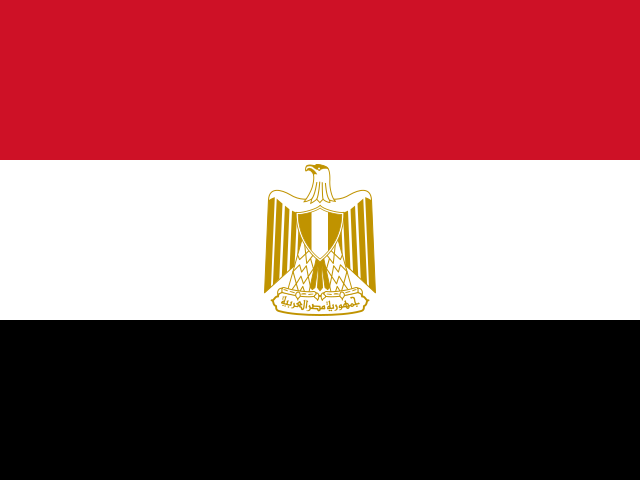
 Egypt
Egypt
Description of Egypt
Welcome to our website dedicated to analyzing the geopolitical and macroeconomic landscape of Egypt. As a pivotal country in the Middle East and North Africa region, Egypt's economic performance and development play a crucial role in shaping the dynamics of the broader region. With a rich historical and cultural heritage, Egypt faces a unique set of challenges and opportunities as it navigates through various macroeconomic statistics and geopolitical relationships. Join us as we delve into the intricate web of factors influencing Egypt's growth and its interactions with the global community.
Population And Age Structure
Population, total: Egypt's total population of 107,465,134 is significantly higher than the average population of 40,097,746. Egypt ranks 14 out of 194 countries in total population.
Population ages 0-14 (% of total population): With 33.21% of the population aged 0-14, Egypt exceeds the average of 27.34%. This places Egypt at rank 60 out of 194 countries.
Population ages 0-14, total: Egypt's total population aged 0-14 is 35,689,370, surpassing the average of 10,327,379. Egypt ranks 11 out of 194 countries in this category.
Population ages 15-64 (% of total population): Egypt's 15-64 age group constitutes 62.08% of the total population, slightly below the average of 63.44%. Egypt ranks 130 out of 194 countries in this regard.
Population ages 15-64, total: The total population aged 15-64 in Egypt is 66,715,543, exceeding the average of 26,003,407. Egypt ranks 13 out of 194 countries in this demographic group.
Population ages 65 and above (% of total population): Egypt's population aged 65 and above accounts for 4.71% of the total population, lower than the average of 9.22%. Egypt ranks 125 out of 194 countries in this category.
Population ages 65 and above, total: With a total population of 5,060,221 aged 65 and above, Egypt surpasses the average of 3,766,959. Egypt ranks 27 out of 194 countries in this age group.
Summary
Egypt has a significantly higher total population than the global average, ranking 14th worldwide. The country also has a higher percentage and total number of young people aged 0-14 compared to the average, ranking 11th in total population in this age group. These demographic indicators are crucial as they provide insights into the country's dependency ratio, workforce composition, and future economic challenges related to education, healthcare, and social welfare for different age groups.
Population Miscellaneous
For Rural population, Egypt's value of 61,488,326 is significantly higher than the average of 18,044,041. Egypt ranks 8th out of 190 countries in this attribute.
Rural population (% of total population) in Egypt is 57.217%, above the average of 41.158%. Egypt ranks 51st out of 190 countries in this category.
Egypt's Urban population of 45,976,808 exceeds the average of 22,425,747. Egypt is ranked 18th out of 194 countries for Urban population.
With an Urban population (% of total population) of 42.783%, Egypt falls below the average of 59.691%. Egypt holds the 144th rank out of 194 countries in this aspect.
The Age dependency ratio in Egypt is 61.08%, slightly higher than the average of 59.22%. Egypt ranks 65th out of 194 countries in this ratio.
Egypt's Birth rate, crude is 23.051 per 1,000 people, higher than the average of 19.384. Egypt holds the 61st rank out of 192 countries in this metric.
For Death rate, crude, Egypt's value of 5.851 per 1,000 people is below the average of 8.214. Egypt ranks 158th out of 192 countries in this category.
The Fertility rate in Egypt is 2.96 births per woman, slightly above the average of 2.603. Egypt ranks 58th out of 190 countries in Fertility rate.
Summary
Egypt demonstrates a significant skew towards rural population, with values well above global averages. Its urban population, while also above average, is comparatively lower. The country has higher birth rates and lower death rates than the global average, signifying a relatively young population with potential for future growth. These demographic indicators are crucial for policymakers and investors to understand Egypt's population dynamics, plan infrastructure development, and anticipate future social and economic needs.
Military
- Egypt's military expenditure is $4,505,374,644.33, ranking 42nd out of 149 countries. This is
significantly below the average expenditure of $12,904,993,617.17 for these countries.
- Egypt's military expenditure as a percentage of GDP is 1.12%, ranking 105th out of 148 countries. This
is below the average of 1.90% for the included countries.
- Egypt's arms imports stand at $1,403,000,000, placing it 4th out of 113 countries in the dataset. This
amount is substantially higher than the average arms import of $205,522,123.89.
- Egypt has a total of 836,000 armed forces personnel, ranking 7th out of 164 countries. This figure is
notably higher than the average total of 165,908 personnel.
- The percentage of armed forces personnel in Egypt's total labor force is 2.80%, placing it in the 18th
position out of 164 countries. This percentage is higher than the average of 1.28% for the dataset.
Summary
Egypt's military expenditure is below average compared to other countries, both in total amount and as a percentage of GDP. However, Egypt ranks considerably high in terms of arms imports and the number of armed forces personnel. These statistics indicate that while Egypt may not spend as much on its military relative to its GDP, it compensates by importing a significant amount of arms and maintaining a large armed forces personnel. This can have implications on Egypt's defense capabilities, geopolitical positioning, and military influence in the region.
Natural Resources
Analysis of Key Geographical Attributes for Egypt:
1. Forest area (sq. km): Egypt's forest area of 449.8 sq. km is significantly below the average of 211,606.11 sq. km, ranking 163 out of 191 countries.
2. Land area (sq. km): With a land area of 995,450 sq. km, Egypt surpasses the average of 665,166.51 sq. km, ranking 29 out of 194 countries.
3. Surface area (sq. km): Egypt's surface area of 1,001,450 sq. km is above the average of 689,779.56 sq. km, ranking 29 out of 194 countries.
4. Arable land (hectares): Egypt's arable land of 3,365,000 hectares is below the average of 7,329,543.16 hectares, ranking 64 out of 190 countries.
5. Land under cereal production (hectares): Egypt's land under cereal production is 3,134,051 hectares, lower than the average of 4,206,011.63 hectares, ranking 40 out of 174 countries.
6. Average precipitation in depth (mm per year): Egypt's average precipitation of 18.1 mm per year is significantly lower than the average of 1,157.83 mm per year, ranking 178 out of 178 countries.
7. Renewable internal freshwater resources, total (billion cubic meters): With 1 billion cubic meters, Egypt falls short of the average of 240.41 billion cubic meters, ranking 154 out of 178 countries.
Summary
Egypt's key geographical attributes paint a clear picture of its natural resources landscape. It has limited forest area, arable land, and freshwater resources compared to global averages, while its surface and land area are relatively larger. The low average precipitation poses a challenge to agriculture and water availability in the country. These indicators are crucial as they highlight Egypt's vulnerability to environmental pressures and emphasize the need for sustainable resource management and innovative solutions to ensure food security and water sustainability.
Resource Rents
Total natural resources rents (% of GDP): Egypt's value for this attribute is 3.26%, lower than the average of 4.63%. Egypt is ranked 66 out of 175 countries in this data set.
Forest rents (% of GDP): Egypt's value for this attribute is 0.13%, significantly below the average of 1.53%. Egypt is ranked 112 out of 174 countries in this data set.
Oil rents (% of GDP): Egypt's value for this attribute is 1.86%, slightly below the average of 2.51%. Egypt is ranked 29 out of 117 countries in this data set.
Natural gas rents (% of GDP): Egypt's value for this attribute is 1.27%, slightly above the average of 1.25%. Egypt is ranked 21 out of 96 countries in this data set.
Summary
Egypt's allocation of natural resources rents as a percentage of its GDP depicts a mixed picture: while it falls below average in forest rents, it surpasses the average in oil and natural gas rents. Despite these variations, the country's rankings suggest that it has been relatively successful in leveraging its oil and natural gas resources compared to its forest resources. These statistics are crucial as they indicate Egypt's reliance and potential for revenue generation from different natural resources, highlighting areas of strength and potential growth for the country's economy.
Commodities
Cereal Production (metric tons): Egypt's cereal production of 22,458,982.11 metric tons is above the average of 17,249,945.93 metric tons. Egypt ranks 25th out of 174 countries in this category.
Aquaculture Production (metric tons): Egypt's aquaculture production of 1,591,896 metric tons surpasses the average of 679,642.92 metric tons. Egypt holds the 8th position out of 180 countries for aquaculture production.
Capture Fisheries Production (metric tons): With a production of 418,684 metric tons, Egypt falls below the average of 467,453.06 metric tons. The country ranks 38th out of 190 nations in capture fisheries production.
Total Fisheries Production (metric tons): Egypt's total fisheries production of 2,010,580 metric tons is significantly higher than the average of 1,153,914.85 metric tons. Egypt holds the 16th rank out of 182 countries for total fisheries production.
Fertilizer Consumption (kilograms per hectare of arable land): Egypt's fertilizer consumption of 496.14 kilograms per hectare exceeds the average of 159.04 kilograms per hectare. The country ranks 10th out of 187 countries in fertilizer consumption.
Summary
Egypt demonstrates strong agricultural and fisheries production, ranking high globally in cereal, aquaculture, capture fisheries, and total fisheries production. Additionally, Egypt's above-average fertilizer consumption indicates a commitment to improving agricultural yields and ensuring food security. These indicators are crucial as they highlight Egypt's potential for economic growth, self-sustainability in food production, and competitiveness in global agricultural markets.
Intellectual Property
Egypt's industrial design applications by nonresidents stand at 844, below the average of 1415.83. With a rank of 29 out of 112 countries, Egypt shows potential for growth in this area.
When it comes to industrial design applications by residents, Egypt's value of 1760 is below the average of 9799.58. The country ranks 23 out of 113 countries, indicating room for improvement.
For patent applications by nonresidents, Egypt's 1229 applications fall short of the average of 6538.40. Egypt ranks 30 out of 129 countries, suggesting a need to boost innovation in this aspect.
In terms of patent applications by residents, Egypt's 978 applications are notably lower than the average of 19037.56. With a rank of 33 out of 117 countries, Egypt lags behind in resident patent applications.
Egypt's trademark applications by nonresidents, at 14057, are below the average of 15878.93. The country ranks 32 out of 130 countries, indicating potential for increased nonresident trademark applications.
Trademark applications by residents in Egypt stand at 29146, falling short of the average of 111055.78. Egypt ranks 30 out of 129 countries, highlighting a gap in resident trademark applications.
Regarding scientific and technical journal articles, Egypt produces 18469.18 articles, surpassing the average of 15103.76. With a rank of 24 out of 192 countries, Egypt demonstrates strong performance in this field.
Egypt's charges for the use of intellectual property amount to $297,000,000, considerably below the average of $3,218,843,494.39. This places Egypt at rank 53 out of 143 countries, indicating potential for increased intellectual property payments.
With 804.91 researchers in R&D per million people, Egypt falls short of the average of 2556.45. The country ranks 47 out of 72 countries, signaling a need to bolster research and development activities.
Summary
Egypt shows great potential for growth in industrial design applications by both residents and nonresidents, while lagging behind in patent and trademark applications. The country performs well in producing scientific and technical journal articles but falls short in intellectual property payments and research and development activities. These indicators are crucial as they reflect Egypt's innovation capabilities, competitiveness in the global market, and investment in research and development, which are essential for long-term economic growth and sustainability.
Broad Economy Attributes
For GDP (current US$), Egypt's value is $383.82 billion, which is below the average of $442.87 billion. Egypt ranks 30th out of 189 countries for this attribute.
Regarding GDP, PPP (current international $), Egypt's value is $1.36 trillion, significantly above the average of $734.14 billion. Egypt holds the 20th rank out of 181 countries in this category.
For GDP per capita (current US$), Egypt's value of $3571.56 is below the average of $15462.11. Egypt is ranked 122nd out of 190 countries for this metric.
In terms of GDP per capita, PPP (current international $), Egypt's value stands at $12661.18, lower than the average of $21251.89. Egypt holds the 95th rank out of 181 countries for this measure.
For GNI (current US$), Egypt's value amounts to $372.46 billion, below the average of $452.04 billion. Egypt is ranked 32nd out of 185 countries in this aspect.
Looking at GNI, PPP (current international $), Egypt's value is $1.32 trillion, surpassing the average of $730.70 billion. Egypt ranks 21st out of 181 countries for this attribute.
For GNI per capita, PPP (current international $), Egypt's value is $12290, below the average of $20615.75. In this regard, Egypt holds the 96th rank out of 181 countries.
Summary
Egypt's macroeconomic indicators show mixed performance compared to global averages and rankings. While Egypt's GDP and GNI values are below average, its GDP per capita metrics are significantly lower than the global average. This implies that while the country has a relatively large economy in absolute terms, the wealth generated is not evenly distributed among its population. Addressing income inequality and improving GDP per capita figures could be crucial for Egypt's long-term economic development and social stability.
Broad Value Added
Egypt's Gross value added at basic prices (GVA) is $366.79 billion, ranking 27th out of 176 countries. This value is above the average GVA of $360.07 billion.
With Agriculture, forestry, and fishing value added accounting for 11.17% of Egypt's GDP, the country is ranked 67th out of 182 countries. This percentage is higher than the average of 10.86%.
Egypt's Agriculture, forestry, and fishing value added in current US dollars is approximately $42.86 billion, placing Egypt at 14th out of 182 countries. This value is significantly higher than the average of $19.92 billion.
Services value added in Egypt represents 52.03% of its GDP, ranking 124th out of 183 countries. The percentage is below the average of 56.72%.
For Services value added in current US dollars, Egypt's value is approximately $199.69 billion, ranking 35th out of 183 countries. This value is below the average of $295.84 billion.
Egypt's Industry (including construction) value added in current US dollars is about $124.24 billion, ranking 26th out of 183 countries. This value is above the average of $118.42 billion.
Summary
Egypt demonstrates a strong agricultural sector with Agriculture, forestry, and fishing contributing significantly to its GDP, surpassing the global average both in percentage and in dollar value. However, the country's service sector, while still a substantial part of the economy, lags behind the global average in both percentage of GDP and dollar value. On the other hand, Egypt's Industry sector performs well, exceeding the global average in terms of value added. These indicators are crucial for Egypt's economic development strategy as they highlight the country's strengths and areas that may require further attention and investment for balanced growth.
Manufacturing Value Added
In Manufacturing, value added (current US$), Egypt's value is $62,871,126,32.56, which is below the attribute average of $76,207,179,589.66. Egypt is ranked 32 out of 173 countries in this category.
In Manufacturing, value added (% of GDP), Egypt's value is 16.38%, higher than the attribute average of 11.90%. Egypt is ranked 38 out of 173 countries in this category.
In Medium and high-tech manufacturing value added (% manufacturing value added), Egypt's value is 22.73%, below the attribute average of 24.49%. Egypt is ranked 75 out of 149 countries in this category.
Summary
In evaluating key macroeconomic indicators for Egypt in the manufacturing sector, it is evident that the country falls below the global average in Manufacturing value added (current US$) but surpasses the average in Manufacturing value added (% of GDP). However, in the subcategory of Medium and high-tech manufacturing value added, Egypt lags behind the attribute average. These findings are crucial as they highlight Egypt's performance and competitiveness in the manufacturing sector compared to other countries, signaling areas for potential improvement and investment to enhance industrial growth and economic development.
Money
Inflation, consumer prices in Egypt is at 5.04%, below the average of 8.26%. Egypt ranks 38th out of 165 countries in this statistic.
Inflation, GDP deflator is 6.18% in Egypt, slightly below the average of 6.90%. Egypt holds the 36th position out of 188 countries in this indicator.
Broad money growth in Egypt is notably high at 19.71%, above the average of 18.03%. Egypt is ranked 27th out of 139 countries in this aspect.
Broad money as a percentage of GDP stands at 79.97% in Egypt, exceeding the average of 71.75%. Egypt holds the 50th position out of 139 countries in this metric.
The ratio of broad money to total reserves is 7.88 in Egypt, surpassing the average of 5.17. Egypt is ranked 13th out of 126 countries for this ratio.
Summary
Egypt's macroeconomic indicators show that while inflation rates are relatively low compared to global averages, broad money growth is high, indicating a flourishing economy. The high ratio of broad money to total reserves also suggests a strong financial position, ranking Egypt competitively on a global scale. These indicators are crucial as they reflect Egypt's economic stability, potential for growth, and ability to manage monetary policies effectively in comparison to other countries.
Consumption Expenditure
Final consumption expenditure (current US$): Egypt's final consumption expenditure is $349.99 billion, which is below the average of $381.63 billion, ranking 25th out of 159 countries.
Final consumption expenditure (% of GDP): Egypt's final consumption expenditure is 91.19% of its GDP, above the average of 82.37%, ranking 39th out of 159 countries.
General government final consumption expenditure (current US$): Egypt's government expenditure is $28.94 billion, significantly below the average of $93.68 billion, ranking 53rd out of 158 countries.
General government final consumption expenditure (% of GDP): Egypt's government expenditure is 7.54% of its GDP, well below the average of 18.71%, ranking 153rd out of 158 countries.
Household and NPISHs Final consumption expenditure (current US$): Egypt's household expenditure is $321.05 billion, above the average of $290.13 billion, ranking 22nd out of 158 countries.
Households and NPISHs final consumption expenditure (% of GDP): Egypt's household expenditure is 83.65% of its GDP, above the average of 63.68%, ranking 16th out of 158 countries.
Summary
Egypt's final consumption expenditure is below the global average in terms of current US dollars, but above average when considering the percentage of GDP it represents. The government's final consumption expenditure is notably lower than the average both in US dollars and as a percentage of GDP. On the other hand, household expenditure in Egypt is above average in both current US dollars and as a percentage of GDP.
These findings are significant as they indicate a high level of household consumption relative to GDP, which may reflect strong domestic demand in the economy. The low government expenditure compared to GDP suggests potential constraints on public sector services and investment. Overall, these indicators provide insights into the composition of Egypt's economy and its balance between public and private sector spending.
Equities
Egypt's total number of listed domestic companies is 240, which is below the average of 636.625. This places Egypt at rank 27 out of 72 countries in the dataset.
The total value of stocks traded in Egypt is $16,081,080,000, significantly lower than the average of $1,379,501,950, which ranks Egypt 32 out of 71 countries.
Stocks traded as a percentage of GDP in Egypt is 4.19%, below the average of 31.65%. Egypt is ranked 34 out of 71 countries in this aspect.
Egypt's market capitalization of listed domestic companies amounts to $41,351,180,000, well below the average of $1,196,037,851, ranking Egypt 40 out of 73 countries.
The market capitalization of listed domestic companies as a percentage of GDP in Egypt is 10.77%, lower than the average of 71.24%. Egypt holds the 66th rank out of 73 countries.
The S&P Global Equity Indices in Egypt experienced a negative annual percentage change of -22.41%, far below the average of 2.06%. This performance ranks Egypt 75 out of 79 countries.
Summary
Egypt's performance in key macroeconomic indicators related to its stock market, such as the number of listed domestic companies, total stock value traded, market capitalization, and S&P Global Equity Indices, lags behind global averages. This suggests a relatively smaller and less developed stock market in Egypt compared to other countries in the dataset. These indicators are crucial as they reflect the depth, breadth, and performance of the country's stock market, which plays a vital role in attracting investment, fostering economic growth, and providing opportunities for capital formation and wealth creation.
Investment
Analysis of key foreign investment statistics for Egypt:
1. Foreign direct investment, net (BoP, current US$): Egypt's focus country value is -5,525,300,000, significantly below the average of -1,615,235,980. The country ranks 148 out of 169 included countries.
2. Foreign direct investment, net inflows (BoP, current US$): With a value of 5,851,800,000, Egypt surpasses the average of 5,749,271,080. It ranks 31 out of 182 countries.
3. Foreign direct investment, net inflows (% of GDP): Egypt's value of 1.52% is below the average of 2.61%. The country ranks 94 out of 178 countries.
4. Foreign direct investment, net outflows (BoP, current US$): Egypt's focus country value of 326,500,000 is significantly lower than the average of 5,707,991,116. The country ranks 58 out of 156 countries.
5. Foreign direct investment, net outflows (% of GDP): Egypt's value of 0.085% is much lower than the average of 1.004%. The country ranks 96 out of 155 countries.
6. Portfolio Investment, net (BoP, current US$): Egypt's value of -1,015,220,000 is below the average of 679,559,169. The country ranks 124 out of 159 countries.
7. Portfolio investment, bonds (PPG + PNG) (NFL, current US$): Egypt's focus country value of 4,681,667,000 is above the average of 4,134,263,915. The country ranks 9 out of 59 countries.
8. Portfolio equity, net inflows (BoP, current US$): Egypt's value of -1,996,900,000 is below the average of 9,197,145,995. The country ranks 108 out of 125 countries.
Summary
Egypt has mixed results in terms of foreign direct investment, with net inflows exceeding the average but net outflows falling below par. The country also shows lower portfolio investment compared to the average, particularly in terms of portfolio equity net inflows. These statistics are important as they reflect Egypt's attractiveness to foreign investors, its ability to retain investment within the country, and its financial market stability.
Debt
Egypt's Total debt service (% of GNI) is 3.34%, lower than the average of 5.98%. This places Egypt at rank 69 out of 120 countries in the dataset.
For Public and publicly guaranteed debt service (% of GNI), Egypt's value of 3.07% is slightly above the average of 2.84%. Egypt is ranked 46 out of 120 countries.
Egypt's External debt stocks (% of GNI) stand at 35.59%, significantly lower than the average of 65.42%. This places Egypt at rank 89 out of 120 countries.
Regarding Debt service on external debt, total (TDS, current US$), Egypt's value of $12,447,314,109 is higher than the average of $9,811,195,839. Egypt holds the 17th rank out of 123 countries.
For Debt service on external debt, public and publicly guaranteed (PPG) (TDS, current US$), Egypt's value of $11,444,597,049.3 is notably higher than the average of $3,310,612,057.6. Egypt ranks 8 out of 123 countries.
Egypt's External debt stocks, public and publicly guaranteed (PPG) (DOD, current US$) is $99,849,195,841.1, significantly exceeding the average of $28,695,879,145. Egypt is ranked 9 out of 123 countries.
With External debt stocks, private nonguaranteed (PNG) (DOD, current US$) at $402,342,000, Egypt is below the average of $33,734,699,285.2, placing it at rank 74 out of 91 countries.
In terms of External debt stocks, total (DOD, current US$), Egypt's value of $132,572,383,019.4 is notably above the average of $73,845,530,111.8. Egypt holds the 15th rank out of 123 countries.
Summary
Egypt generally shows a favorable position when it comes to its total debt service compared to the average of countries in the dataset. However, its external debt stocks as a percentage of GNI are notably lower than the average, indicating a relatively lower external debt burden. This suggests that Egypt has managed its debt levels in a more sustainable manner compared to many other countries, potentially signaling a healthier financial position for future growth and development.
Broad Trade Attributes
Trade (% of GDP): Egypt's trade value accounts for 32.13% of its GDP, which is below the average of 82.34%. Egypt is ranked 152 out of 163 countries in this statistic.
Merchandise trade (% of GDP): Egypt's merchandise trade is 22.67% of its GDP, below the average of 60.01%. Egypt ranks 177 out of 186 countries for this metric.
Trade in services (% of GDP): Egypt's trade in services represents 8.66% of its GDP, lower than the average of 24.63%. Egypt is ranked 132 out of 171 countries in this aspect.
External balance on goods and services (current US$): Egypt has an external balance of -$27.56 billion, significantly below the average of $3.41 billion. Egypt ranks 159 out of 163 countries in this measurement.
External balance on goods and services (% of GDP): Egypt's external balance is -7.18% of its GDP, below the average of -5.97%. Egypt ranks 102 out of 163 countries based on this indicator.
Summary
Egypt exhibits a trade deficit with its trade value, merchandise trade, and trade in services all below global averages. The country also faces a negative external balance on goods and services, both in absolute terms and as a percentage of GDP, ranking below the global average. These indicators suggest that Egypt may be overly reliant on imports, which could impact its economic stability and foreign exchange reserves.
Net Trade
1. Current account balance (BoP, current US$): Egypt's current account balance is -14235956908.69 which is significantly below the average of 1443864831.49. Egypt ranks 160 out of 170 countries in this attribute.
2. Current account balance (% of GDP): Egypt's current account balance as a percentage of GDP is -3.71, lower than the average of -2.36. Egypt ranks 112 out of 170 countries in this attribute.
3. Net trade in goods and services (BoP, current US$): Egypt's net trade value is -32380693000, well below the average of 2604730003.57. Egypt ranks 168 out of 171 countries in this attribute.
4. Net primary income (BoP, current US$): Egypt's net primary income is -11015463908.69, below the average of -903807529.74. Egypt ranks 152 out of 170 countries in this attribute.
5. Net secondary income (BoP, current US$): Egypt's net secondary income is 29160200000, much higher than the average of -269227340.40. Egypt ranks 3 out of 170 countries in this attribute.
6. Net trade in goods (BoP, current US$): Egypt's net trade in goods is -29233930500, significantly below the average of 1302831005.68. Egypt ranks 164 out of 171 countries in this attribute.
7. Net capital account (BoP, current US$): Egypt's net capital account is -232600000, lower than the average of 136543824.05. Egypt ranks 146 out of 159 countries in this attribute.
8. Net financial account (BoP, current US$): Egypt's net financial account is -17086856167.78, much lower than the average of -469840994.63. Egypt ranks 162 out of 170 countries in this attribute.
Summary
Egypt's macroeconomic indicators show significant weaknesses in its current account balance, net trade values, and net financial account. These statistics indicate that Egypt is facing challenges in balancing its international trade and financial transactions, which could potentially impact its overall economic stability and growth. Addressing these imbalances and improving these indicators is crucial for Egypt to enhance its economic resilience and competitiveness in the global market.
Broad Export Attributes
1. Exports of goods, services and primary income (BoP, current US$): Egypt's value of $40,646,263,091.31 is below the average of $146,238,908,936.30. Egypt is ranked 58 out of 170 countries in this dataset.
2. Exports of goods and services (BoP, current US$): Egypt's value of $40,101,707,000 is below the average of $122,938,540,059.78. Egypt is ranked 54 out of 170 countries in this dataset.
3. Exports of goods and services (current US$): Egypt's value of $47,872,738,615.10 is below the average of $129,596,864,610.19. Egypt is ranked 50 out of 163 countries in this dataset.
4. Exports of goods and services (% of GDP): Egypt's value of 12.47% is below the average of 38.19%. Egypt is ranked 148 out of 163 countries in this dataset.
5. Goods exports (BoP, current US$): Egypt's value of $25,049,007,000 is below the average of $93,310,581,697.39. Egypt is ranked 59 out of 171 countries in this dataset.
6. International tourism, receipts (% of total exports): Egypt's value of 12.15% is above the average of 9.74%. Egypt is ranked 25 out of 120 countries in this dataset.
7. ICT goods exports (% of total goods exports): Egypt's value of 2.95% is below the average of 3.81%. Egypt is ranked 37 out of 142 countries in this dataset.
Summary
Egypt's export performance across various indicators places it below the global averages in terms of value and percentage of GDP. Despite being ranked below average in most categories, Egypt stands out positively in international tourism receipts as a percentage of total exports. These findings are important as they highlight Egypt's relative position in the global market, signaling areas of strength and weakness that the country can focus on for economic growth and diversification.
Merchandise Exports
Analysis of key statistics for Egypt:
1. Merchandise exports (current US$): Egypt's merchandise exports amount to $27,078,000,000, ranking 62 out of 187 countries. This is below the average of $89,542,711,229.95.
2. Agricultural raw materials exports (% of merchandise exports): Egypt's agricultural raw materials exports account for 1.74% of total exports, ranking 58 out of 151 countries. This is below the average of 2.97%.
3. Food exports (% of merchandise exports): Egypt's food exports represent 18.07% of total exports, ranking 71 out of 152 countries. This is below the average of 24.06%.
4. Fuel exports (% of merchandise exports): Egypt's fuel exports make up 17.62% of total exports, ranking 35 out of 147 countries. This is above the average of 13.70%.
5. Ores and metals exports (% of merchandise exports): Egypt's ores and metals exports constitute 3.82% of total exports, ranking 69 out of 152 countries. This is below the average of 9.10%.
6. Merchandise exports by the reporting economy, residual (% of total merchandise exports): Egypt's residual exports account for 0.67% of total exports, ranking 64 out of 166 countries. This is below the average of 3.20%.
Summary
Egypt's key statistics indicate a reliance on food and fuel exports, while lagging behind in ores and metals exports. The country's total merchandise exports value is significantly lower than the global average. These findings highlight Egypt's vulnerability to price fluctuations in food and fuel markets, signaling a need to diversify its export base to enhance economic resilience and sustainability.
Technology Exports
1. Egypt's manufactures exports account for 47.85% of its merchandise exports, slightly above the average of 42.62%. This places Egypt at rank 65 out of 152 countries.
2. Egypt's high-technology exports amount to $343,563,046, well below the average of $16,655,934,078.80. Egypt is ranked 64 out of 151 countries in this aspect.
3. The percentage of high-technology exports in Egypt's manufactured exports is 2.68%, significantly lower than the average of 10.15%. Egypt ranks 107 out of 150 countries in this category.
4. Egypt's medium and high-tech exports as a percentage of manufactured exports stand at 34.17%, just below the average of 34.29%. Egypt is ranked 72 out of 149 countries based on this metric.
Summary
Egypt's manufacturing sector heavily relies on exports, with manufactures exports constituting a significant portion of its merchandise exports. However, the country lags behind in high-technology exports, both in absolute value and relative contribution to manufactured exports. This indicates a potential need for technological advancement and diversification to enhance Egypt's competitiveness and economic growth in the global market.
Service Exports
Service exports (BoP, current US$): Egypt's value of $15,052,700,000 is below the average of $28,917,292,503.82. Egypt ranks 42 out of 171 countries in this data set.
ICT service exports (BoP, current US$): Egypt's value of $1,073,100,000 is significantly below the average of $4,578,501,153.77. Egypt ranks 53 out of 166 countries in this data set.
ICT service exports (% of service exports, BoP): Egypt's value of 7.13% is below the average of 11.75%. Egypt ranks 97 out of 166 countries in this data set.
Communications, computer, etc. (% of service exports, BoP): Egypt's value of 20.29% is below the average of 45.85%. Egypt ranks 137 out of 169 countries in this data set.
Transport services (% of service exports, BoP): Egypt's value of 47.38% is above the average of 21.80%. Egypt ranks 18 out of 169 countries in this data set.
Travel services (% of service exports, BoP): Egypt's value of 29.21% is above the average of 26.40%. Egypt ranks 59 out of 167 countries in this data set.
Insurance and financial services (% of service exports, BoP): Egypt's value of 3.12% is below the average of 6.46%. Egypt ranks 89 out of 161 countries in this data set.
Summary
Egypt's service exports, ICT service exports, and various service components as a percentage of total service exports all fall below global averages. This indicates potential underutilization of these sectors in Egypt's economy, leading to missed opportunities for economic growth and diversification. Improving and promoting these service sectors could enhance Egypt's competitiveness in the global market and drive sustainable economic development.
Commercial Service Exports
1. Commercial service exports (current US$): Egypt's commercial service exports amount to $14,376,300,000, which is below the average of $28,508,218,402. The country ranks 42nd out of 171 countries in this category.
2. Travel services (% of commercial service exports): Egypt's travel services account for 30.59% of its commercial service exports, slightly above the average of 27.89%. The country holds the 59th rank out of 167 countries in this aspect.
3. Computer, communications and other services (% of commercial service exports): Egypt's percentage of these services in its commercial exports is 16.54%, significantly lower than the average of 42.44%. This places Egypt at the 138th rank out of 169 countries.
4. Insurance and financial services (% of commercial service exports): Egypt's insurance and financial services constitute 3.27% of its commercial service exports, below the average of 6.97%. The country holds the 91st rank out of 161 countries for this attribute.
5. Transport services (% of commercial service exports): Egypt's transport services represent 49.61% of its commercial service exports, significantly higher than the average of 23.37%. Egypt ranks 19th out of 169 countries in this category.
Summary
Egypt's commercial service exports are below the global average, with a notable reliance on travel and transport services, while lagging in computer, communications, and other services as well as insurance and financial services. This data suggests that Egypt may have a comparative advantage in tourism and transportation sectors, but may need to develop and diversify its offerings in technology and finance to enhance its overall export competitiveness and resilience in the global market.
Broad Import Attributes
Imports of goods and services (current US$): Egypt's value of $75,433,562,071.12 is below the average of $126,191,355,599.06. Egypt ranks 43 out of 163 countries in this attribute.
Imports of goods and services (% of GDP): Egypt's value of 19.65% is below the average of 44.15%. Egypt ranks 146 out of 163 countries in this attribute.
International tourism, expenditures (% of total imports): Egypt's value of 3.56% is below the average of 3.98%. Egypt ranks 50 out of 131 countries in this attribute.
ICT goods imports (% total goods imports): Egypt's value of 3.99% is below the average of 6.85%. Egypt ranks 97 out of 143 countries in this attribute.
Goods imports (BoP, current US$): Egypt's value of $54,282,937,500 is below the average of $92,007,788,027.17. Egypt ranks 42 out of 171 countries in this attribute.
Imports of goods and services (BoP, current US$): Egypt's value of $72,482,400,000 is below the average of $120,321,577,988.12. Egypt ranks 42 out of 170 countries in this attribute.
Imports of goods, services and primary income (BoP, current US$): Egypt's value of $84,042,420,000 is below the average of $144,514,428,722.28. Egypt ranks 43 out of 170 countries in this attribute.
Summary
Egypt's import indicators across various categories consistently show values below the global averages, with the country ranking relatively low among a significant number of countries in each attribute. This suggests that Egypt may have limited integration with the global market and may face challenges in diversifying its imports, potentially impacting its economic growth and competitiveness in the international market.
Merchandise Imports
Merchandise imports in Egypt amount to $59,949,000,000, which is below the average of $89,385,605,263. The country is ranked 42nd out of 190 countries in this attribute.
Manufactures imports account for 57.88% of merchandise imports in Egypt, below the average of 66.76%. Egypt is ranked 124th out of 152 countries in this category.
Egypt's imports of agricultural raw materials as a percentage of merchandise imports stand at 2.62%, higher than the average of 1.27%. The country ranks 11th out of 152 countries for this attribute.
Food imports represent 22.83% of merchandise imports in Egypt, exceeding the average of 15.89%. Egypt is ranked 23rd out of 152 countries in this aspect.
Fuel imports constitute 11.53% of merchandise imports in Egypt, slightly above the average of 11.38%. The country is placed 69th out of 152 countries in this category.
Ores and metals imports account for 4.90% of merchandise imports in Egypt, higher than the average of 2.57%. Egypt ranks 21st out of 152 countries in this attribute.
Merchandise imports by the reporting economy, residual, make up 0.93% of total merchandise imports in Egypt, below the average of 2.51%. Egypt is ranked 62nd out of 180 countries for this attribute.
Summary
Egypt's import profile reveals a mixed picture compared to global averages and rankings. While the country imports less in total merchandise than the average, it relies more heavily on agricultural raw materials and food imports, indicating potential vulnerabilities in food security. On the other hand, Egypt's higher-than-average imports of ores and metals suggest a possible focus on industrial development. These statistics are crucial as they provide insights into Egypt's economic structure, trade dependencies, and areas that may require strategic planning for sustainability and growth.
Service Imports
Service imports in Egypt amount to $18,199,462,500. This is below the average service imports of $27,615,356,170.47. Egypt ranks 38th out of 171 countries in this category.
Communications, computer, etc. account for 30.38% of Egypt's service imports, lower than the average of 44.40%. Egypt ranks 128th out of 169 countries in this aspect.
Transport services constitute 44.14% of Egypt's service imports, surpassing the average of 32.90%. Egypt ranks 37th out of 169 countries in this domain.
Travel services make up 13.79% of Egypt's service imports, slightly below the average of 14.14%. Egypt ranks 68th out of 169 countries for this metric.
Insurance and financial services contribute 11.70% to Egypt's service imports, higher than the average of 8.53%. Egypt ranks 37th out of 169 countries in this sector.
Summary
Egypt's service imports total $18,199,462,500, ranking 38th globally. The composition of these imports shows a higher reliance on transport services and insurance/financial services compared to the global average, while lower shares in communications/technology and travel services. This data is significant as it highlights Egypt's key areas of expenditure in the service sector, providing insights into the country's priorities, trade patterns, and economic dependencies.
Commercial Service Imports
Egypt's commercial service imports amount to $17,126,962,500. This is below the average of $27,102,746,128.60, ranking Egypt 42nd out of 171 countries.
Computer, communications, and other services account for 26.02% of Egypt's commercial service imports, lower than the average of 41.71%. This places Egypt at the 127th rank out of 169 countries.
Insurance and financial services make up 12.43% of Egypt's commercial service imports, exceeding the average of 8.85%. Egypt ranks 34th out of 169 countries in this aspect.
Egypt allocates 46.90% of its commercial service imports to transport services, which is above the average of 34.71%. This places Egypt at the 37th rank out of 169 countries.
Travel services represent 14.65% of Egypt's commercial service imports, slightly below the average of 14.73%. Egypt is ranked 65th out of 169 countries regarding this parameter.
Summary
Egypt's commercial service imports are lower than the global average, ranking the country 42nd out of 171 countries. However, Egypt allocates a higher percentage of its commercial service imports to transport services and insurance/financial services compared to the average, which demonstrates a strategic focus on these sectors for economic development. The lower allocation to computer, communications, and other services indicates potential areas for growth and investment to enhance Egypt's competitive position in the global market.
Infrastructure
1. Air transport, freight (million ton-km): Egypt's value of 438.91 million ton-km is below the attribute average of 1384.37 million ton-km. Egypt ranks 36th out of 126 countries in this data.
2. Air transport, registered carrier departures worldwide: Egypt's 45340.34 departures is below the attribute average of 134365.61 departures. Egypt ranks 46th out of 149 countries in this data.
3. Air transport, passengers carried: Egypt's 4638192.26 passengers carried is below the attribute average of 11848242.70 passengers. Egypt ranks 42nd out of 149 countries in this data.
4. Container port traffic (TEU: 20 foot equivalent units): Egypt's 6810285 TEUs is below the attribute average of 6907110.27 TEUs. Egypt ranks 26th out of 110 countries in this data.
Summary
Egypt falls below the attribute average in key macroeconomic indicators related to air transport, freight, registered carrier departures, passengers carried, and container port traffic. While ranking in the middle or lower half among the countries assessed, these statistics suggest that Egypt's transportation infrastructure may require further development to enhance its connectivity and efficiency for both domestic and international trade. Improving these indicators can bolster Egypt's trade competitiveness, facilitate economic growth, and strengthen its position in the global economy.
Information Technology Infrastructure
For Secure Internet servers, Egypt has 4,503 servers, which is below the average of 458,294. Egypt ranks 84 out of 193 countries in this attribute.
Regarding Secure Internet servers per 1 million people, Egypt has 41.90 servers, significantly lower than the average of 14,067. Egypt ranks 153 out of 193 countries for this metric.
Individuals using the Internet in Egypt constitute 71.91% of the population, slightly above the average figure of 64.77%. Egypt ranks 93 out of 180 countries in this aspect.
Egypt boasts 9,335,108 fixed broadband subscriptions, surpassing the average of 6,591,956. The country ranks 22 out of 185 nations for this attribute.
In terms of mobile cellular subscriptions, Egypt has 95,357,427 subscriptions, which exceeds the average of 42,526,463. Egypt ranks 18 out of 193 countries for mobile cellular subscriptions.
Summary
Egypt shows a mixed performance in key macroeconomic indicators related to internet infrastructure and connectivity. While the country has a relatively low number of secure internet servers compared to the global average, it has a higher percentage of individuals using the internet and boasts a significant number of fixed broadband subscriptions and mobile cellular subscriptions. These indicators are crucial as they reflect Egypt's capacity for digital transformation, economic competitiveness, and potential for technological advancement in the digital age.
Energy Consumption
1. Egypt's renewable energy consumption accounts for 6.51% of its total final energy consumption, which is significantly below the average of 32.18%. This places Egypt at rank 157 out of 191 countries in the dataset.
2. Egypt's CO2 emissions amount to 210,752.3 kt, which is higher than the average of 171,895.94 kt. Egypt ranks 25th out of 188 countries in terms of CO2 emissions.
Summary
Egypt's low renewable energy consumption at 6.51% of total final energy consumption positions it below the global average of 32.18%, ranking 157th out of 191 countries. Additionally, Egypt's CO2 emissions of 210,752.3 kt surpass the average of 171,895.94 kt, ranking 25th out of 188 countries. These indicators suggest that Egypt has significant room for improvement in transitioning towards sustainable energy sources to reduce its carbon footprint and align with global environmental goals.
Government Balance Sheet
For "Total reserves (% of total external debt)", Egypt's value is 29.40%, which is below the average of
66.13%. Egypt ranks 61 out of 102 countries in this dataset.
For "Reserves and related items (BoP, current US$)", Egypt's value is -14060319362.12, significantly below
the average of 1924407186.58. Egypt ranks 165 out of 171 countries in this dataset.
For "Total reserves minus gold (current US$)", Egypt's value is 34094946983.72, below the average of
74221588171.61. Egypt ranks 48 out of 161 countries in this dataset.
For "Total reserves (includes gold, current US$)", Egypt's value is 38972812936.67, which is below the
average of 85708019773.47. Egypt ranks 47 out of 161 countries in this dataset.
For "Total reserves in months of imports", Egypt's value is 5.56, below the average of 7.10. Egypt ranks
76 out of 151 countries in this dataset.
Summary
Egypt's total reserves as a percentage of total external debt are lower than the global average, placing it at 61st out of 102 countries. Additionally, its reserves and related items, total reserves minus gold, total reserves including gold, and total reserves in months of imports are all below average, positioning Egypt relatively lower in global rankings. These indicators are crucial as they reflect Egypt's capacity to meet its external financial obligations, maintain stability in its balance of payments, and sustain its import levels. The lower rankings suggest potential vulnerabilities in Egypt's financial resilience and international economic standing.
Top Stats
Ranks in Top Decile For:
| Attribute | Rank/Total |
|---|---|
| Population, total | 14/194 |
| Population ages 0-14, total | 11/194 |
| Population ages 15-64, total | 13/194 |
| Rural population | 8/190 |
| Urban population | 18/194 |
| Arms imports (SIPRI trend indicator values) | 4/113 |
| Armed forces personnel, total | 7/164 |
| Aquaculture production (metric tons) | 8/180 |
| Total fisheries production (metric tons) | 16/182 |
| Fertilizer consumption (kilograms per hectare of arable land) | 10/187 |
| Agriculture, forestry, and fishing, value added (current US$) | 14/182 |
| Debt service on external debt, public and publicly guaranteed (PPG) (TDS, current US$) | 8/123 |
| External debt stocks, public and publicly guaranteed (PPG) (DOD, current US$) | 9/123 |
| Net secondary income (BoP, current US$) | 3/170 |
| Agricultural raw materials imports (% of merchandise imports) | 11/152 |
| Mobile cellular subscriptions | 18/193 |
Ranks in Bottom Decile For:
| Attribute | Rank/Total |
|---|---|
| Average precipitation in depth (mm per year) | 178/178 |
| General government final consumption expenditure (% of GDP) | 153/158 |
| Market capitalization of listed domestic companies (% of GDP) | 66/73 |
| S&P Global Equity Indices (annual % change) | 75/79 |
| Trade (% of GDP) | 152/163 |
| Merchandise trade (% of GDP) | 177/186 |
| External balance on goods and services (current US$) | 159/163 |
| Current account balance (BoP, current US$) | 160/170 |
| Net trade in goods and services (BoP, current US$) | 168/171 |
| Net trade in goods (BoP, current US$) | 164/171 |
| Net capital account (BoP, current US$) | 146/159 |
| Net financial account (BoP, current US$) | 162/170 |
| Exports of goods and services (% of GDP) | 148/163 |
| Reserves and related items (BoP, current US$) | 165/171 |