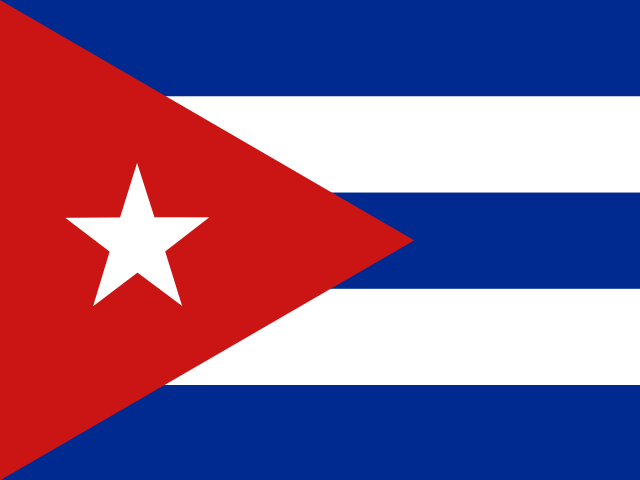
 Cuba
Cuba
Description of Cuba
Cuba, a nation rich in history and culture, stands out as a unique and intriguing country in the Caribbean region. From its revolutionary past led by Fidel Castro to its resilient population, Cuba has navigated through decades of political and economic challenges. As an analyst, delving into the macroeconomic landscape of Cuba offers a fascinating glimpse into the country's development, its relations with other nations, and the potential impact of global trends on its future trajectory. Join me in exploring the intricate interplay between macroeconomic statistics and Cuba's journey towards prosperity.
Population And Age Structure
Population, total: Cuba's population of 11,300,698 is significantly below the average population of 40,097,746, ranking 82nd out of 194 countries.
Population ages 0-14 (% of total population): With 15.86% of the total population falling in this age group, Cuba is below the average of 27.34%, ranking 164th out of 194 countries.
Population ages 0-14, total: Cuba's total population in this age group is 1,792,351, considerably lower than the average of 10,327,380, ranking 104th out of 194 countries.
Population ages 15-64 (% of total population): The 15-64 age group accounts for 68.59% of Cuba's population, which is above the average of 63.44%, ranking 37th out of 194 countries.
Population ages 15-64, total: Cuba's total population in the 15-64 age group is 7,750,885, below the average of 26,003,407, ranking 75th out of 194 countries.
Population ages 65 and above (% of total population): 15.55% of Cuba's population is aged 65 and above, higher than the average of 9.22%, ranking 43rd out of 194 countries.
Population ages 65 and above, total: Cuba has 1,757,463 individuals aged 65 and above, below the average of 3,766,959, ranking 52nd out of 194 countries.
Summary
Cuba has a relatively small total population compared to the global average, with a significant percentage falling in the 15-64 age group. This demographic distribution may impact labor force participation, healthcare needs, and overall economic productivity in the country. Understanding these population dynamics is crucial for policymakers to plan and implement targeted social and economic development programs to support different age groups effectively.
Population Miscellaneous
For Rural population, Cuba has a value of 2,577,237 which is below the average of 18,044,041. Cuba ranks 96 out of 190 countries in this attribute.
Looking at Rural population (% of total population), Cuba's value of 22.806 is below the average of 41.158%. The country ranks 140 out of 190 countries.
With Urban population, Cuba has 8,723,461 residents, which is below the average of 22,425,747. Cuba ranks 67 out of 194 countries in this category.
In terms of Urban population (% of total population), Cuba's 77.194% is above the average of 59.691%. The country ranks 55 out of 194 countries.
The Age dependency ratio (% of working-age population) in Cuba is 45.799%, which is below the average of 59.219%. Cuba ranks 158 out of 194 countries.
Cuba has a crude Birth rate of 9.344 per 1,000 people, which is below the average of 19.384. The country ranks 168 out of 192 countries in this aspect.
For crude Death rate, Cuba has a rate of 10.23 per 1,000 people, above the average of 8.214. The country ranks 39 out of 192 countries in this attribute.
Regarding Fertility rate, Cuba's value of 1.5 births per woman is below the average of 2.603. Cuba ranks 154 out of 190 countries in this indicator.
Summary
Cuba demonstrates a unique demographic profile compared to global averages, with lower rural population figures, higher urban population percentages, and lower birth rates. The country stands out with a relatively low age dependency ratio and fertility rate, indicating potential challenges in sustaining population growth and maintaining a balanced workforce. These indicators are crucial as they reflect Cuba's social and economic development, influencing areas such as healthcare, labor force dynamics, and future population trends.
Military
For "Armed forces personnel, total", Cuba has 76,000 personnel, which is below the average of 165,908.537. The country ranks 57th out of 164 countries for this attribute.
In terms of "Armed forces personnel (% of total labor force)", Cuba's percentage is 1.52%, above the average of 1.28%. Cuba ranks 39th out of 164 countries evaluated for this parameter.
Summary
Cuba has a total of 76,000 armed forces personnel, below the global average of 165,908.537, ranking 57th out of 164 countries. However, with a percentage of 1.52% of total labor force being in the armed forces, Cuba exceeds the average of 1.28%, ranking 39th globally.
These findings are crucial as they provide insights into Cuba's military capacity relative to other nations. The high percentage of armed forces personnel compared to the labor force may indicate a significant allocation of resources towards military activities, potentially impacting the country's economic development and resource distribution.
Natural Resources
Regarding Forest area (sq. km), Cuba's value of 32,420 falls significantly below the average of 211,606.11 sq. km. This places Cuba at rank 87 out of 191 countries.
For Land area (sq. km), Cuba's 103,800 sq. km is notably lower than the average of 665,166.51 sq. km, ranking Cuba at 103 out of 194 countries.
With a Surface area (sq. km) of 109,880, Cuba is below the average of 689,779.56 sq. km, ranking 105 out of 194 countries.
In terms of Arable land (hectares), Cuba's 2,908,600 is significantly below the average of 7,329,543.16 hectares, placing Cuba at rank 67 out of 190 countries.
For Land under cereal production (hectares), Cuba's 204,385 is notably lower than the average of 4,206,011.63 hectares, ranking at 121 out of 174 countries.
Cuba's Average precipitation in depth (mm per year) of 1,335 is higher than the average of 1,157.83 mm per year, ranking at 66 out of 178 countries.
When it comes to Renewable internal freshwater resources (total billion cubic meters), Cuba's 38.12 is significantly below the average of 240.41 billion cubic meters, putting Cuba at rank 86 out of 178 countries.
Summary
Cuba's geographical indicators such as forest area, land area, arable land, and land under cereal production are notably below global averages, impacting its agricultural potential and environmental sustainability. Additionally, Cuba faces challenges due to lower renewable internal freshwater resources compared to the average, affecting water security. These indicators highlight the need for Cuba to focus on sustainable land use practices, water management, and agricultural development to ensure long-term resilience and food security.
Resource Rents
- Total natural resources rents (% of GDP) in Cuba are at 0.5654, which is below the average of 4.6300.
Cuba ranks 116 out of 175 countries in this metric.
- Cuba's Forest rents (% of GDP) stand at 0.0741, well below the average of 1.5258. The country ranks 123
out of 174 nations in this category.
- Oil rents (% of GDP) in Cuba are at 0.2225, also below the average of 2.5051. Cuba holds the 52nd
position out of 117 countries in this aspect.
- Natural gas rents (% of GDP) in Cuba are relatively low at 0.0244, compared to the average of 1.2527.
The country ranks 61 out of 96 nations in this sector.
- Mineral rents (% of GDP) in Cuba are at 0.2443, below the average of 1.2286. Cuba holds the 43rd
position out of 86 countries in this specific field.
Summary
Cuba's key macroeconomic indicators for natural resources rents, including forest, oil, natural gas, and mineral rents, all show values below the global averages across different categories. This indicates a lower utilization or exploitation of natural resources in the country compared to the global average. These findings are crucial as they suggest that Cuba may not be fully capitalizing on its natural resource potential to drive economic growth and development. Addressing this underutilization could present opportunities for boosting economic productivity and diversification in Cuba's economy.
Commodities
Analysis of key agricultural production and consumption statistics in Cuba:
- Cereal production (metric tons): Cuba's cereal production is 52,731.5 metric tons, ranking 120th out of 174 countries. This value is significantly below the attribute average of approximately 17,249,946 metric tons.
- Aquaculture production (metric tons): Cuba's aquaculture production is 25,910 metric tons, ranking 55th out of 180 countries. It is notably lower than the attribute average of approximately 679,643 metric tons.
- Capture fisheries production (metric tons): With a production of 20,186.2 metric tons, Cuba ranks 122nd out of 190 countries, falling short of the attribute average of about 467,453 metric tons.
- Total fisheries production (metric tons): The total fisheries production in Cuba is 46,096.2 metric tons, placing Cuba at 106th out of 182 countries. This value is notably lower than the attribute average of around 1,153,915 metric tons.
- Fertilizer consumption (kilograms per hectare of arable land): Cuba's fertilizer consumption is 25.57 kilograms per hectare, ranking 135th out of 187 countries. It is below the attribute average of approximately 159.04 kilograms per hectare.
Summary
In analyzing key agricultural production and consumption statistics in Cuba, it is evident that the country faces challenges in achieving high levels of production compared to global averages. Cuba's low levels of cereal, aquaculture, and fisheries production, coupled with below-average fertilizer consumption per hectare of arable land, indicate limitations in agricultural output and potential for further development. These findings are crucial as they highlight areas where Cuba can focus on improving efficiency and productivity in the agricultural sector to enhance food security, economic growth, and sustainability.
Intellectual Property
1. Industrial design applications, nonresident, by count: Cuba's value of 4 is significantly below the average of 1415.83. The country ranks 106th out of 112 countries in this dataset.
2. Industrial design applications, resident, by count: With a value of 19, Cuba is well below the average of 9799.58. The country holds the 91st position out of 113 countries included.
3. Patent applications, nonresidents: Cuba's value of 76 falls below the average of 6538.40. The country ranks 76th out of 129 countries in the dataset.
4. Patent applications, residents: Cuba's value of 33 is notably lower than the average of 19037.56. The country is ranked 85th out of 117 countries in this attribute.
5. Trademark applications, nonresident, by count: Cuba's value of 3445 is significantly below the average of 15878.93. The country ranks 84th out of 130 countries in the dataset.
6. Trademark applications, resident, by count: With a value of 2859, Cuba is well below the average of 111055.78. The country holds the 77th position out of 129 countries included.
7. Scientific and technical journal articles: Cuba's value of 1287.89 is notably lower than the average of 15103.76. The country ranks 78th out of 192 countries in this attribute.
Summary
Cuba lags behind global averages in key macroeconomic indicators such as industrial design applications, patent applications, trademark applications, and scientific and technical journal articles. These lower values indicate a potential lack of innovation, research and development, and intellectual property creation within the country's economy. Addressing these shortcomings is crucial for Cuba's economic growth and competitiveness on the international stage.
Broad Economy Attributes
For GDP (current US$), Cuba's GDP value is 107,351,800,000, placing it at the 59th rank out of 189 countries. This figure is significantly below the attribute average of 442,870,224,838.68.
Regarding GDP per capita (current US$), Cuba's value is 9,499.57, positioning it at the 68th rank out of 190 countries. This falls below the attribute average of 15,462.11 per capita.
Summary
Cuba's GDP of 107.35 billion USD ranks it 59th out of 189 countries, well below the global average of 442.87 billion USD. In terms of GDP per capita, Cuba ranks 68th out of 190 countries with 9,499.57 USD per capita, lower than the global average of 15,462.11 USD per capita. The low GDP and GDP per capita figures suggest that Cuba may face challenges in economic development, infrastructure, and standard of living compared to the global average, indicating the need for potential reforms and strategies to improve its economic situation.
Broad Value Added
- Gross value added at basic prices (GVA) (current US$): Cuba's GVA is $106.59 billion, significantly below the average of $360.07 billion, ranking 55th out of 176 countries in the dataset. - Agriculture, forestry, and fishing, value added (% of GDP): With a value of 2.76%, Cuba's contribution to GDP from this sector is well below the average of 10.86%, placing it at 135th out of 182 countries. - Agriculture, forestry, and fishing, value added (current US$): Cuba's value added in this sector is $2.96 billion, much lower than the average of $19.92 billion, ranking 93rd out of 182 countries. - Services, value added (% of GDP): Cuba's service sector contribution is high at 73.51%, above the average of 56.72%, placing it at 12th out of 183 countries. - Services, value added (current US$): With a value of $78.91 billion, Cuba's service sector value added is significantly lower than the average of $295.84 billion, ranking 55th out of 183 countries. - Industry (including construction), value added (current US$): Cuba's industry value added stands at $24.71 billion, below the average of $118.42 billion, ranking 64th out of 183 countries.
Summary
Cuba's economy shows a significant imbalance in its sectoral contributions. While its service sector is robust, with a high contribution to GDP and value added, the agriculture, forestry, and fishing sectors lag significantly behind global averages. This imbalance is crucial as it indicates a heavy reliance on services, which may pose risks in terms of economic resilience and diversity, highlighting the need for Cuba to focus on developing its agricultural sector to create a more sustainable and balanced economy.
Manufacturing Value Added
In terms of Manufacturing, value added (current US$), Cuba's value of $12,020,100,000 is significantly below the average of $76,207,179,589.66. Cuba ranks 61st out of 173 countries in this attribute category.
For Manufacturing, value added (% of GDP), Cuba's percentage of 11.20% is slightly below the average of 11.90%. With a rank of 86 out of 173 countries, Cuba falls below the midpoint in this category.
Regarding Medium and high-tech manufacturing value added (% manufacturing value added), Cuba's value of 16.22% is noticeably lower than the average of 24.49%. The country is ranked 93rd out of 149 countries in this attribute.
Summary
Cuba lags behind the global average in Manufacturing, value added (current US$) with a value of $12,020,100,000, ranking 61st out of 173 countries. Additionally, its Manufacturing value added (% of GDP) is slightly below average at 11.20% and it ranks 86th globally. Furthermore, Cuba's Medium and high-tech manufacturing value added (% manufacturing value added) is 16.22%, significantly lower than the average of 24.49%, placing the country at 93rd position out of 149 countries.
These findings are crucial as they indicate that Cuba's manufacturing sector is underperforming compared to the global benchmarks. The lower manufacturing value added figures suggest a potential lack of technological advancement and efficiency in production processes, which could impact the country's overall economic competitiveness and growth prospects in the long run.
Money
- Inflation, GDP deflator (annual %): Cuba's inflation rate, measured by the GDP deflator, is 16.56%, significantly higher than the attribute average of 6.90%. This places Cuba at rank 10 out of 188 countries in terms of inflation rate.
Summary
Cuba's inflation rate, as measured by the GDP deflator, stands at 16.56%, notably surpassing the global average of 6.90%. This places Cuba in the top 10 countries worldwide in terms of inflation rate. Such a high inflation rate can have significant implications on the country's economy, leading to decreased purchasing power for consumers, increased production costs for businesses, and potentially impacting overall economic stability.
Consumption Expenditure
Final consumption expenditure (current US$): Cuba's final consumption expenditure is $96,049,000,000, which is significantly below the attribute average of $381,630,252,515.38. Cuba ranks 55 out of 159 countries in this data set.
Final consumption expenditure (% of GDP): Cuba's final consumption expenditure as a percentage of GDP is 89.47%, above the attribute average of 82.37%. The country ranks 47 out of 159 countries in this metric.
General government final consumption expenditure (current US$): Cuba's general government final consumption expenditure is $41,704,000,000, which is notably lower than the attribute average of $93,676,578,238.03. Cuba ranks 43 out of 158 countries in this aspect.
General government final consumption expenditure (% of GDP): Cuba's general government final consumption expenditure as a percentage of GDP is 38.85%, well above the attribute average of 18.71%. Cuba ranks 6 out of 158 countries for this indicator.
Household and NPISHs Final consumption expenditure (current US$): Cuba's household and NPISHs final consumption expenditure stands at $54,345,000,000, much lower than the attribute average of $290,127,571,157.69. The country ranks 62 out of 158 in this category.
Households and NPISHs final consumption expenditure (% of GDP): Cuba's household and NPISHs final consumption expenditure as a percentage of GDP is 50.62%, below the attribute average of 63.68%. Cuba ranks 124 out of 158 countries in this metric.
Summary
Cuba exhibits a pattern where its final consumption expenditure metrics, both in absolute terms and as a percentage of GDP, are below the attribute averages when compared to a group of 159 countries. Specifically, the country ranks lower in general government final consumption expenditure and household/NPISHs final consumption expenditure, highlighting potential areas for growth and development in public and private spending. These statistics are crucial as they indicate the level of economic activity driven by consumption within Cuba and provide insights into the government's role in spending as well as the contribution of households and non-profit institutions serving households to the country's GDP.
Broad Trade Attributes
Trade (% of GDP): Cuba's trade as a percentage of GDP stands at 15.68%, significantly below the average of 82.34%. This places Cuba at rank 162 out of 163 countries in the dataset.
Merchandise trade (% of GDP): Cuba's merchandise trade as a percentage of GDP is 8.32%, well below the average of 60.01%. This places Cuba at rank 186 out of 186 countries in the dataset.
External balance on goods and services (current US$): Cuba's external balance in goods and services is $702 million, much lower than the average of $3.41 billion. This places Cuba at rank 51 out of 163 countries in the dataset.
External balance on goods and services (% of GDP): Cuba's external balance on goods and services as a percentage of GDP is 0.65%, above the average of -5.97%. This places Cuba at rank 59 out of 163 countries in the dataset.
Summary
Cuba exhibits a low level of trade and merchandise trade as a percentage of its GDP, ranking near the bottom in both indicators globally. However, Cuba's external balance on goods and services, both in absolute terms and as a percentage of GDP, is relatively stable compared to the average. These indicators are important as they reflect Cuba's reliance on domestic production and the sustainability of its external trade relationships.
Broad Export Attributes
Regarding Exports of goods and services (current US$), Cuba's value amounts to $8,769,000,000. This value is below the attribute average of $129,596,864,610.19. Cuba is ranked 88 out of 163 countries in this category.
As for Exports of goods and services (% of GDP), Cuba's value is 8.17%, which is below the attribute average of 38.19%. Cuba's ranking in this aspect is 157 out of 163 countries analyzed.
Summary
Cuba's exports of goods and services in terms of value and as a percentage of GDP are significantly below the global average and are ranked relatively low compared to other countries. This indicates that Cuba may have challenges in effectively leveraging its export sector to drive economic growth and competitiveness in the international market.
These findings are important as they highlight Cuba's limited capacity to generate revenue from exports, which could impact its ability to earn foreign exchange, attract investments, and strengthen its overall economic resilience in the face of external shocks or global economic fluctuations.
Merchandise Exports
For "Merchandise exports (current US$)", Cuba's value of $1,703,000,000 is significantly below the attribute average of $89,542,711,229.95. Cuba is ranked 139 out of 187 countries in this category.
As for "Merchandise exports by the reporting economy, residual (% of total merchandise exports)", Cuba's value of 20.35% is well above the attribute average of 3.20%. Cuba holds the 7th rank out of 166 countries in this metric.
Summary
Cuba's merchandise exports in terms of value are quite low compared to the global average, placing the country at a relatively lower rank. However, when considering the proportion of merchandise exports that come from the reporting economy itself, Cuba stands out with a significantly high percentage, ranking 7th globally. These indicators are crucial in understanding Cuba's economic dependency on external markets and the domestic contribution to its export sector.
Technology Exports
For Medium and high-tech exports (% manufactured exports), Cuba's value is 63.43%, which is above the average of 34.29%. Cuba ranks 23rd out of 149 countries in this indicator.
Summary
Cuba's high percentage of medium and high-tech exports compared to manufactured exports indicates a strong emphasis on advanced technology industries within its economy. This could signify a shift towards higher value-added production and increased competitiveness in the global market. Ranking 23rd out of 149 countries demonstrates Cuba's relative strength in this sector compared to its peers, highlighting its potential for future economic growth and development.
Broad Import Attributes
Imports of goods and services (current US$): Cuba's imports of goods and services amount to $8,067 million, which is significantly below the average of $126,191 million for 163 countries. Cuba ranks 101 out of 163 countries in this attribute.
Imports of goods and services (% of GDP): Cuba's imports of goods and services account for 7.51% of its GDP, much lower than the average of 44.15% for 163 countries. Cuba ranks 162 out of 163 countries in this attribute.
Summary
Cuba has significantly lower imports of goods and services both in absolute terms and as a percentage of its GDP compared to the global average. This indicates that Cuba is more self-reliant and less dependent on foreign goods and services for its economic activities. However, this could also suggest limited access to international markets and potential challenges in diversifying its economy.
Merchandise Imports
Regarding Merchandise imports (current US$), Cuba's imports amount to $7.23 billion. This is significantly below the average of $89.39 billion, ranking Cuba 103rd out of 190 countries in the dataset for this attribute.
On the other hand, in terms of Merchandise imports by the reporting economy, residual (% of total merchandise imports), Cuba's value stands at 3.05%, which is above the average of 2.51%. This places Cuba at the 32nd position out of 180 countries considered for this statistic.
Summary
Cuba's merchandise imports in terms of value are notably lower than the global average, positioning the country at a relatively lower rank globally. However, when considering the proportion of imports attributed to the reporting economy, Cuba surpasses the average, indicating a higher reliance on its own production capabilities compared to global trade norms. These findings are crucial as they shed light on Cuba's trade dynamics, showcasing both its limited external dependency in imports and its relatively stronger reliance on domestic production.
Infrastructure
Analysis of Air Transport Statistics in Cuba:
1. Air transport, freight (million ton-km): Cuba's value of 13.42 million ton-km is significantly below the average of 1384.37 million ton-km, ranking 74th out of 126 countries.
2. Air transport, registered carrier departures worldwide: With 2123 departures, Cuba falls far below the average of 134365.61 departures, placing 123rd out of 149 countries.
3. Air transport, passengers carried: Cuba carried 99838 passengers, much lower than the average of 11848242.70 passengers, ranking 123rd out of 149 countries.
Summary
Cuba's air transport statistics indicate a significant underperformance compared to global averages. The country ranks low in air freight, registered carrier departures, and passengers carried, highlighting limited connectivity and accessibility. These factors are crucial as they can impact tourism, trade, and overall economic development by hampering efficient transport of goods and people, potentially hindering economic growth and global integration.
Information Technology Infrastructure
For Secure Internet servers, Cuba has 775 servers, which is significantly below the average of 458,294. Cuba ranks 119 out of 193 countries in this attribute data.
Regarding Secure Internet servers (per 1 million people), Cuba has 68.58 servers, well below the average of 14,067. Cuba ranks 142 out of 193 countries for this metric.
With Individuals using the Internet (% of population), Cuba performs slightly better with 71.12%, just above the average of 64.77%. The country ranks 95 out of 180 in this category.
In terms of Fixed broadband subscriptions, Cuba has 231,654 subscriptions, significantly lower than the average of 6,591,956. Cuba ranks 111 out of 185 countries in this metric.
For Mobile cellular subscriptions, Cuba has 6,661,763 subscriptions, below the average of 42,526,464. Cuba ranks 108 out of 193 countries for this attribute.
Summary
Cuba lags behind global averages in key internet and communication technology metrics such as secure internet servers, fixed broadband subscriptions, and mobile cellular subscriptions. Despite performing slightly better in terms of individuals using the internet, the country still faces significant challenges in closing the digital divide. These indicators are crucial for assessing Cuba's connectivity, technological infrastructure, and potential for economic growth and development in the digital age.
Energy Consumption
1. Cuba's renewable energy consumption accounts for 23.93% of its total final energy consumption, which is below the global average of 32.18%. With a rank of 92 out of 191 countries, Cuba is below average in this aspect.
2. In terms of CO2 emissions, Cuba emits 24,327.8 kt of CO2, significantly below the average of 171,895.94 kt. Ranking 75th out of 188 countries, Cuba performs better than many others in terms of carbon emissions.
Summary
Cuba's renewable energy consumption percentage and CO2 emissions level indicate a below-average environmental footprint compared to global averages. The country's focus on renewable energy and lower carbon emissions suggests a relatively more sustainable energy policy. This not only positions Cuba favorably in terms of environmental conservation but also signifies a potential advantage in transitioning towards a greener and more energy-efficient economy.
Taxes
Tariff rate, applied, weighted mean, all products (%): Cuba's tariff rate stands at 8.83%, which is above the attribute average of 5.21%. This places Cuba at rank 36 out of 153 countries in the dataset.
Summary
Cuba's weighted mean applied tariff rate of 8.83% exceeds the global average of 5.21%, positioning the country at 36th out of 153 nations analyzed. This suggests that Cuba imposes higher tariffs on imported goods compared to many countries, potentially impacting its trade relations, economic competitiveness, and overall market integration.
Top Stats
Ranks in Top Decile For:
| Attribute | Rank/Total |
|---|---|
| Services, value added (% of GDP) | 12/183 |
| Inflation, GDP deflator (annual %) | 10/188 |
| General government final consumption expenditure (% of GDP) | 6/158 |
| Merchandise exports by the reporting economy, residual (% of total merchandise exports) | 7/166 |
Ranks in Bottom Decile For:
| Attribute | Rank/Total |
|---|---|
| Industrial design applications, nonresident, by count | 106/112 |
| Trade (% of GDP) | 162/163 |
| Merchandise trade (% of GDP) | 186/186 |
| Exports of goods and services (% of GDP) | 157/163 |
| Imports of goods and services (% of GDP) | 162/163 |