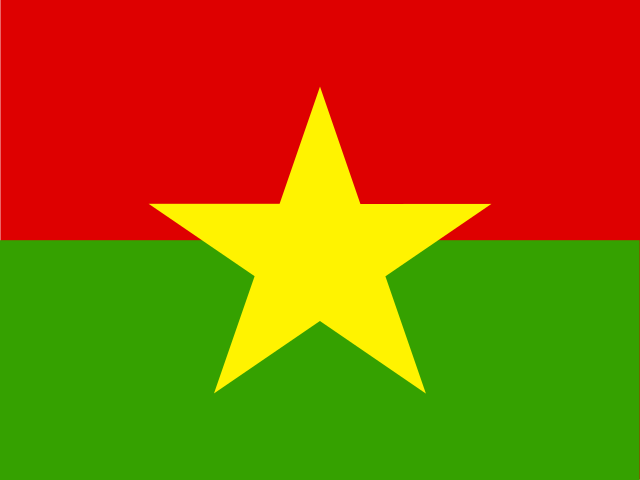
 Burkina Faso
Description of Burkina Faso
As a landlocked country in West Africa, Burkina Faso holds a strategic position in the region, sharing borders with six countries. With a rich cultural heritage and a diverse ethnic makeup, Burkina Faso faces unique geopolitical challenges and opportunities. This country has made significant strides in economic development and governance, yet continues to grapple with issues such as poverty, food insecurity, and political instability. By delving into the macroeconomic indicators and geopolitical dynamics of Burkina Faso, we can gain valuable insights into its position in the global arena and its potential for future growth and stability.
Population And Age Structure
Population, total: Burkina Faso's population is 21,522,626, which is below the average population of 40,097,746. Burkina Faso is ranked 58th out of 194 countries in terms of population.
Population ages 0-14 (% of total population): Burkina Faso's population in this age group is 44.44%, higher than the average of 27.34%. Burkina Faso is ranked 11th out of 194 countries in this category.
Population ages 0-14, total: With a total of 9,564,122 children in this age group, Burkina Faso is below the average of 10,327,380 children. Burkina Faso is ranked 45th out of 194 countries.
Population ages 15-64 (% of total population): Burkina Faso's working-age population makes up 53.00% of the total population, below the average of 63.44%. The country is ranked 182nd out of 194 countries in this aspect.
Population ages 15-64, total: Burkina Faso has 11,407,221 people in this age group, lower than the average of 26,003,407. Burkina Faso is ranked 63rd out of 194 countries in this category.
Population ages 65 and above (% of total population): The elderly population in Burkina Faso constitutes 2.56% of the total population, significantly lower than the average of 9.22%. Burkina Faso is ranked 180th out of 194 countries in this demographic.
Population ages 65 and above, total: Burkina Faso has 551,283 elderly individuals, below the average of 3,766,959. The country is ranked 93rd out of 194 countries in this aspect.
Summary
Burkina Faso has a relatively small total population compared to the global average, with a higher percentage of children aged 0-14 and a lower percentage of working-age individuals (15-64). The country also has a significantly smaller elderly population compared to the average. These demographics are important as they impact factors such as workforce composition, dependency ratio, healthcare needs, and pension requirements, which are crucial for social welfare planning, economic development strategies, and overall societal well-being.
Population Miscellaneous
For Burkina Faso, the rural population stands at 14,935,196, which is below the average rural population of 18,044,041. Burkina Faso ranks 37th out of 190 countries in this category.
The rural population (% of total population) in Burkina Faso is 69.393%, significantly higher than the average of 41.16%. Burkina Faso ranks 28th out of 190 countries for this metric.
Urban population in Burkina Faso is 6,587,430, well below the average urban population of 22,425,747. Burkina Faso ranks 80th out of 194 countries in urban population.
The urban population (% of total population) for Burkina Faso is 30.607%, much lower than the average of 59.69%. Burkina Faso ranks 167th out of 194 countries in this regard.
The age dependency ratio (% of working-age population) in Burkina Faso is 88.68%, higher than the average of 59.22%. Burkina Faso ranks 13th out of 194 countries in this aspect.
Burkina Faso has a crude birth rate of 36.085 per 1,000 people, surpassing the average of 19.38. The country ranks 13th out of 192 countries in this category.
With a crude death rate of 8.813 per 1,000 people, Burkina Faso exceeds the average of 8.21. The country ranks 67th out of 192 countries for this metric.
The total fertility rate in Burkina Faso is 4.869 births per woman, higher than the average rate of 2.60. Burkina Faso ranks 11th out of 190 countries in fertility rate.
Summary
Burkina Faso stands out in key macroeconomic indicators related to population demographics. It has a significantly higher rural population percentage, a lower urban population percentage, and a higher age dependency ratio compared to global averages. Additionally, Burkina Faso has high crude birth and death rates, as well as a total fertility rate above the global average. These indicators are crucial for policymakers and analysts to understand the country's population dynamics, economic development, and future sustainability.
Military
Analysis of Military Expenditure (current USD): Burkina Faso has a military expenditure of 382,464,677.36, which is significantly below the average of $12,904,993,617.17. Burkina Faso ranks 93 out of 149 countries in this data set.
Analysis of Military Expenditure (% of GDP): Burkina Faso's military expenditure as a percentage of GDP is 2.20%, above the average of 1.90%. Burkina Faso ranks 38 out of 148 countries in this data set.
Analysis of Arms Imports: Burkina Faso has arms imports of $2,000,000, a value considerably lower than the average of $205,522,123.89. Burkina Faso ranks 103 out of 113 countries in this data set.
Analysis of Armed Forces Personnel, Total: Burkina Faso has a total of 11,000 armed forces personnel, well below the average of 165,908.54. Burkina Faso ranks 128 out of 164 countries in this data set.
Analysis of Armed Forces Personnel (% of total labor force): Burkina Faso's proportion of armed forces personnel in the total labor force is 0.14%, significantly lower than the average of 1.28%. Burkina Faso ranks 156 out of 164 countries in this data set.
Summary
Burkina Faso demonstrates a unique profile in key military indicators. Despite having a relatively low military expenditure in absolute terms and a smaller armed forces personnel count compared to the global average, the country allocates a higher percentage of its GDP to military expenses. This could indicate a prioritization of defense spending relative to its economic output, potentially reflecting regional security concerns or internal stability considerations.
Natural Resources
Forest area in Burkina Faso is 62,164 sq. km, significantly below the average of 211,606 sq. km, ranking 67 out of 191 countries.
Land area in Burkina Faso is 273,600 sq. km, well below the average of 665,166 sq. km, putting the country at rank 73 out of 194 countries.
Surface area in Burkina Faso covers 274,220 sq. km, notably lower than the average of 689,780 sq. km, ranking the country 73 out of 194 nations.
Arable land in Burkina Faso spans 6,004,000 hectares, below the average of 7,329,543 hectares, positioning the country at rank 39 out of 190 countries.
Land under cereal production in Burkina Faso is 4,104,826 hectares, slightly lower than the average of 4,206,012 hectares, placing the country at rank 34 out of 174 nations.
The average precipitation in Burkina Faso is 748 mm per year, under the average of 1,157.83 mm per year, ranking the country 108 out of 178 countries.
Renewable internal freshwater resources in Burkina Faso total 12.5 billion cubic meters, significantly below the average of 240.41 billion cubic meters, ranking the country 116 out of 178 nations.
Summary
Burkina Faso's key macroeconomic indicators reveal significant challenges in its natural resource distribution and agricultural potential. With below-average forest, land, and arable land areas, as well as lower-than-average precipitation levels and renewable internal freshwater resources, the country faces constraints in its agricultural productivity and water availability. These indicators indicate a potential vulnerability to environmental risks, highlighting the importance of sustainable resource management and strategic planning to ensure food security and economic resilience in Burkina Faso.
Resource Rents
- Total natural resources rents (% of GDP): Burkina Faso's value of 9.18% is above the average of 4.63%. This places Burkina Faso at rank 35 out of 175 countries.
- Forest rents (% of GDP): Burkina Faso's value of 4.82% is significantly higher than the average of 1.53%. This places Burkina Faso at rank 16 out of 174 countries.
- Mineral rents (% of GDP): Burkina Faso's value of 4.36% is notably above the average of 1.23%. This places Burkina Faso at rank 9 out of 86 countries.
Summary
Burkina Faso stands out in terms of natural resources rents, with values above the global averages for total natural resources rents, forest rents, and mineral rents. These statistics indicate that Burkina Faso has significant natural resource wealth relative to its GDP compared to many other countries globally. This suggests the country may have opportunities for economic growth through the sustainable exploitation and management of its natural resources, which could potentially boost its overall economic development and resilience.
Commodities
- In the field of Cereal production, Burkina Faso's production of 5,179,104 metric tons is well below the average of 17,249,945.93 metric tons. The country ranks 56th out of 174 countries in this dataset. - Burkina Faso's Aquaculture production of 647 metric tons is significantly lower than the average of 679,642.92 metric tons. The country is ranked 133rd out of 180 countries for this attribute. - Capture fisheries production in Burkina Faso is 29,104 metric tons, far below the average of 467,453.06 metric tons. Burkina Faso ranks 114th out of 190 countries in this category. - Burkina Faso's Total fisheries production is 29,751 metric tons, well below the average of 1,153,914.85 metric tons. The country holds the 117th rank out of 182 countries. - Fertilizer consumption in Burkina Faso stands at 17.17 kilograms per hectare of arable land, which is below the average consumption of 159.04 kilograms per hectare. The country ranks 149th out of 187 countries for this indicator.
Summary
Burkina Faso exhibits notable underperformance in key agricultural indicators such as cereal production, aquaculture, capture fisheries, and total fisheries production, placing below global averages and rankings in these sectors. Particularly concerning is the low fertilizer consumption per hectare of arable land, significantly lagging behind the international average. These indicators highlight the challenges Burkina Faso faces in achieving agricultural productivity and food security, signaling a need for targeted interventions and investment in agricultural practices and technologies to enhance efficiency and output in the sector.
Intellectual Property
Burkina Faso has a relatively low number of scientific and technical journal articles compared to the average of 15103.76, ranking 113 out of 192 countries in the dataset.
The charges for the use of intellectual property payments in Burkina Faso are significantly below the average of $3,218,843,494.39, placing the country at a rank of 131 out of 143 countries.
In terms of charges for the use of intellectual property receipts, Burkina Faso also falls below the average of $3,191,687,117.58, ranking 91 out of 122 countries in the dataset.
Summary
Burkina Faso is positioned lower than the global average in terms of scientific and technical journal articles, intellectual property payments, and intellectual property receipts. This indicates a weaker presence in research and development activities as well as limited participation in the global intellectual property market. These findings highlight the need for Burkina Faso to prioritize investments in innovation, technology, and intellectual property protection to enhance its competitiveness and participation in the knowledge economy.
Broad Economy Attributes
- Burkina Faso's GDP (current US$) is significantly below the average of $442,870,224,838.68, ranking 113
out of 189 countries.
- The GDP, PPP (current international $) for Burkina Faso is also notably below the average of
$734,141,122,350.78, with a rank of 108 out of 181 countries.
- Burkina Faso's GDP per capita (current US$) of $823.55 is well below the average of $15,462.11, ranking
171 out of 190 countries.
- Similarly, the GDP per capita, PPP (current international $) for Burkina Faso is significantly lower
than the average of $21,251.89, with a rank of 163 out of 181 countries.
- Burkina Faso's GNI (current US$) falls below the average of $452,040,815,370.70, ranking 113 out of 185
countries.
- The GNI, PPP (current international $) for Burkina Faso is notably below the average of
$730,698,223,823.47, with a rank of 107 out of 181 countries.
- Lastly, Burkina Faso's GNI per capita, PPP (current international $) of $2,130 is significantly lower
than the average of $20,615.75, with a rank of 165 out of 181 countries.
Summary
Burkina Faso's key macroeconomic indicators, including GDP, GDP per capita, and GNI, both in current US dollars and PPP, consistently rank below global averages across the board. This indicates a relatively lower level of economic development and prosperity compared to a significant number of countries worldwide. These indicators are crucial as they provide insight into Burkina Faso's economic performance, standard of living, and overall position in the global economy, highlighting areas that may require attention for improvement and development.
Broad Value Added
Burkina Faso's Gross value added at basic prices (GVA) is $16,366,930,255.71, ranking 107 out of 176 countries with data available. This is below the attribute average of $360,070,943,595.12.
The country's Agriculture, forestry, and fishing, value added (% of GDP) is 17.85%, which is above the average of 10.86%. Burkina Faso ranks 44 out of 182 countries in this category.
For Agriculture, forestry, and fishing, value added in current US dollars, Burkina Faso's value is $3,164,496,676.74, ranking 91 out of 182 countries. It falls below the attribute average of $19,924,732,828.07.
Services value added (% of GDP) in Burkina Faso is 44.83%, lower than the average of 56.72%. The country ranks 155 out of 183 nations.
Similarly, the Services value added in current US dollars for Burkina Faso is $7,946,742,902.48, ranking 117 out of 183 countries. It is below the attribute average of $295,837,711,130.69.
Lastly, Burkina Faso's Industry (including construction) value added in current US dollars is $5,255,690,676.50, putting it at rank 108 out of 183 countries. This value is notably lower than the average of $118,421,095,413.50.
Summary
Burkina Faso exhibits a strong reliance on the agriculture, forestry, and fishing sectors, with above-average contributions to its GDP compared to other countries. However, the country lags behind in services and industry value added, both in terms of percentage of GDP and current US dollar value. This indicates a potential imbalance in Burkina Faso's economic structure, with disproportionate emphasis on traditional sectors and room for diversification and growth in services and industry. Addressing this imbalance is crucial for achieving sustainable economic development, reducing dependency on volatile agricultural activities, and fostering overall economic resilience and competitiveness.
Manufacturing Value Added
For the attribute "Manufacturing, value added (current US$)", Burkina Faso's value is $1,793,646,806.96, which is significantly below the average of $76,207,179,589.66. Burkina Faso ranks 106th out of 173 countries in this attribute.
Regarding "Manufacturing, value added (% of GDP)", Burkina Faso's rate is 10.12%, slightly lower than the average of 11.90%. The country holds the 101st rank out of 173 countries for this metric.
Summary
Burkina Faso's manufacturing sector, as indicated by the value added in current US dollars, is considerably below the global average, positioning the country at 106th place out of 173 countries. Similarly, the percentage contribution of manufacturing to Burkina Faso's GDP is slightly below the average, ranking the country at 101st place. These statistics suggest that Burkina Faso's manufacturing sector may be underdeveloped compared to its peers, potentially affecting its overall economic growth and competitiveness on a global scale.
Money
1. Inflation, consumer prices (annual %): Burkina Faso has a consumer price inflation rate of 1.88%, which is below the average rate of 8.26%. This places Burkina Faso at rank 87 out of 165 countries in the dataset.
2. Inflation, GDP deflator (annual %): Burkina Faso's GDP deflator inflation rate is 6.56%, slightly below the average of 6.90%. The country is ranked 31 out of 188 countries for this indicator.
3. Broad money growth (annual %): Burkina Faso shows a robust broad money growth rate of 17.82%, just slightly lower than the average of 18.03%. This places Burkina Faso at rank 38 out of 139 countries.
4. Broad money (% of GDP): Burkina Faso's broad money as a percentage of GDP is 46.84%, significantly lower than the average of 71.75%. The country is ranked 92 out of 139 countries in this metric.
Summary
Burkina Faso exhibits relatively low consumer price inflation and GDP deflator inflation rates compared to global averages. However, it demonstrates strong broad money growth despite a lower proportion of broad money to GDP. These indicators are crucial as they reflect the country's price stability, economic growth, and the efficiency of its monetary system, which are essential factors for assessing overall economic health and development.
Consumption Expenditure
Final consumption expenditure (current US$): Burkina Faso's final consumption expenditure is $14,250,304,782.86, significantly below the attribute average of $381,630,252,515.38. The country ranks 107 out of 159 countries in this category.
Final consumption expenditure (% of GDP): Burkina Faso's final consumption expenditure as a percentage of GDP is 80.40%, slightly below the average of 82.37%. The country ranks 78 out of 159 countries in this aspect.
General government final consumption expenditure (current US$): With a value of $3,506,740,925.71, Burkina Faso's expenditure is well below the average of $93,676,578,238.03. The country is ranked 100 out of 158 countries.
General government final consumption expenditure (% of GDP): Burkina Faso's government expenditure as a percentage of GDP is 19.78%, slightly above the average of 18.71%. The country ranks 60 out of 158 countries in this parameter.
Household and NPISHs Final consumption expenditure (current US$): Burkina Faso's expenditure in this category is $10,743,563,857.15, significantly lower than the average of $290,127,571,157.69. The country ranks 109 out of 158 countries.
Households and NPISHs final consumption expenditure (% of GDP): Burkina Faso's household and NPISHs expenditure as a percentage of GDP is 60.61%, slightly below the average of 63.68%. The country ranks 87 out of 158 countries in this aspect.
Summary
Burkina Faso's final consumption expenditure, both in absolute terms and as a percentage of GDP, is notably lower than the global average across various categories such as general government, households, and NPISHs. This indicates a relatively constrained level of domestic consumption within the country's economy. The low consumption levels could signify a potential lack of economic development, limited purchasing power, or inefficient resource allocation within Burkina Faso, impacting overall economic growth and development prospects.
Investment
Foreign direct investment, net (BoP, current US$): Burkina Faso's value of 91,638,973.26 is above the average of -1,615,235,980.51. The country ranks 32 out of 169 countries.
Foreign direct investment, net inflows (BoP, current US$): Burkina Faso's value of -98,777,856.01 is below the average of 5,749,271,080.15. The country ranks 160 out of 182 countries.
Foreign direct investment, net inflows (% of GDP): Burkina Faso's value of -0.56 is below the average of 2.61. The country ranks 158 out of 178 countries.
Foreign direct investment, net outflows (BoP, current US$): Burkina Faso's value of -7,138,882.75 is below the average of 5,707,991,116.07. The country ranks 124 out of 156 countries.
Foreign direct investment, net outflows (% of GDP): Burkina Faso's value of -0.04 is below the average of 1.00. The country ranks 120 out of 155 countries.
Portfolio Investment, net (BoP, current US$): Burkina Faso's value of 518,135,049.81 is below the average of 679,559,169.57. The country ranks 48 out of 159 countries.
Portfolio equity, net inflows (BoP, current US$): Burkina Faso's value of 31,338,154.71 is below the average of 9,197,145,994.70. The country ranks 38 out of 125 countries.
Summary
Burkina Faso's foreign direct investment (FDI) shows a mixed performance compared to global averages, with net FDI inflows lagging behind. The country also has lower-than-average net outflows in both absolute terms and as a percentage of GDP. In terms of portfolio investment, Burkina Faso receives less net inflows than the average, indicating potential opportunities for growth in attracting investment. These indicators are crucial as they reflect the country's attractiveness to foreign investors and its ability to engage in international financial markets, which are essential for economic growth and development.
Debt
Total debt service (% of GNI) for Burkina Faso is 12.67%, which is above the average of 5.98%. Burkina
Faso ranks 12th out of 120 countries in this attribute.
Public and publicly guaranteed debt service (% of GNI) is 0.79% for Burkina Faso, below the average of
2.84%. Burkina Faso ranks 99th out of 120 countries.
External debt stocks (% of GNI) in Burkina Faso stand at 57.03%, lower than the average of 65.42%. The
country ranks 54th out of 120 nations.
Burkina Faso's debt service on external debt is $2,166,761,439.40, significantly lower than the average of
$9,811,195,839.23. The country ranks 45th out of 123 nations.
Debt service on external debt, public and publicly guaranteed, amounts to $135,913,486.80 for Burkina
Faso, below the average of $3,310,612,057.60. The country ranks 86th out of 123 nations.
External debt stocks, public and publicly guaranteed, reach $4,018,501,222.30 in Burkina Faso, below the
average of $28,695,879,144.98. Burkina Faso is ranked 79th out of 123 nations.
External debt stocks, private nonguaranteed, amount to $5,271,094,000 for Burkina Faso, below the average
of $33,734,699,285.22. The country ranks 45th out of 91 nations.
Total external debt stocks are $9,755,974,315.30 for Burkina Faso, below the average of
$73,845,530,111.82. Burkina Faso is ranked 69th out of 123 nations.
Summary
Burkina Faso's total debt service as a percentage of its Gross National Income (GNI) is above the global average, indicating a higher financial burden on the country. However, its debt service on external debt is significantly lower than the global average, demonstrating a more manageable level of external debt repayment. These indicators are crucial as they reflect Burkina Faso's financial stability, ability to manage its debt obligations, and its standing relative to other nations in the global economy.
Broad Trade Attributes
Trade (% of GDP): Burkina Faso's Trade as a percentage of GDP is 60.71%, below the average of 82.34%. This places Burkina Faso at rank 96 out of 163 countries.
Merchandise trade (% of GDP): Burkina Faso's Merchandise Trade as a percentage of GDP is 47.94%, below the average of 60.01%. This places Burkina Faso at rank 105 out of 186 countries.
Trade in services (% of GDP): Burkina Faso's Trade in Services as a percentage of GDP is 9.99%, significantly below the average of 24.63%. This places Burkina Faso at rank 121 out of 171 countries.
External balance on goods and services (current US$): Burkina Faso's External Balance on Goods and Services is $504,894,138.28, lower than the average of $3,405,509,011.13. This places Burkina Faso at rank 55 out of 163 countries.
External balance on goods and services (% of GDP): Burkina Faso's External Balance on Goods and Services as a percentage of GDP is 2.85%, above the average of -5.97%. This places Burkina Faso at rank 43 out of 163 countries.
Summary
Burkina Faso's trade indicators, including Trade (% of GDP), Merchandise Trade (% of GDP), and Trade in Services (% of GDP), show that the country's level of international trade is below the global average. This places Burkina Faso at lower ranks among countries in terms of trade performance. Additionally, Burkina Faso's External Balance on Goods and Services, both in absolute value and as a percentage of GDP, is significantly below the global average, indicating a trade deficit. These findings are important as they highlight Burkina Faso's dependency on international trade and the need for strategies to improve trade competitiveness and strengthen the external balance to support economic growth and stability.
Net Trade
1. Current account balance (BoP, current US$): Burkina Faso's current account balance is $743,231,869.87, ranking 45th out of 170 countries. This value is below the attribute average of $1,443,864,831.49.
2. Current account balance (% of GDP): With a value of 4.19%, Burkina Faso ranks 29th out of 170 countries in this metric. The country performs better than the attribute average of -2.36%.
3. Net trade in goods and services (BoP, current US$): Burkina Faso's net trade in goods and services is $576,815,704.72. This places Burkina Faso 57th out of 171 countries, below the attribute average.
4. Net primary income (BoP, current US$): The country's net primary income stands at -$555,697,773.53, ranking 91st out of 170 countries. Burkina Faso lags behind the attribute average in this aspect.
5. Net secondary income (BoP, current US$): Burkina Faso's net secondary income is $722,113,938.67, ranking 64th out of 170 countries. This value is notably above the attribute average.
6. Net trade in goods (BoP, current US$): Burkina Faso's net trade in goods is $1,329,958,724.16, placing the country 52nd out of 171 countries. Burkina Faso slightly outperforms the attribute average.
7. Net capital account (BoP, current US$): Burkina Faso's net capital account balance is $367,657,516.93, ranking 30th out of 159 countries. This value is significantly higher than the attribute average.
8. Net financial account (BoP, current US$): Burkina Faso's net financial account amounts to $1,103,456,302.45, positioning the country 42nd out of 170 countries. Burkina Faso surpasses the attribute average in this regard.
Summary
Burkina Faso exhibits a mix of economic performance in key macroeconomic indicators. While the country performs well in metrics like current account balance (% of GDP) and net secondary income, it lags behind in areas such as net primary income. The data highlights Burkina Faso's position relative to other nations and provides insights into its economic stability, trade dynamics, and financial flows, which are crucial for assessing the country's overall economic health and development prospects.
Broad Export Attributes
Analysis of key statistics for Burkina Faso:
1. Exports of goods, services and primary income (BoP, current US$): Burkina Faso's value of $5,603,943,479.57 is significantly below the average of $146,238,908,936.30. Burkina Faso ranks 110 out of 170 countries in this attribute.
2. Exports of goods and services (BoP, current US$): Burkina Faso's value of $5,355,646,932.99 is notably lower than the average of $122,938,540,059.78. The country ranks 109 out of 170 countries.
3. Exports of goods and services (current US$): Burkina Faso's value of $5,632,452,790.44 is below the average of $129,596,864,610.19. Burkina Faso ranks 105 out of 163 countries in this category.
4. Exports of goods and services (% of GDP): Burkina Faso's percentage of 31.78% is lower than the average of 38.19%. The country ranks 74 out of 163 countries for this statistic.
5. Goods exports (BoP, current US$): Burkina Faso's value of $4,846,982,739.90 is below the average of $93,310,581,697.39. The country ranks 100 out of 171 countries.
6. ICT goods exports (% of total goods exports): Burkina Faso's percentage of 0.019% is significantly below the average of 3.81%. The country ranks 138 out of 142 countries in this category.
Summary
Burkina Faso's key export statistics show that the country lags behind global averages in terms of export values across different categories such as goods, services, and ICT goods. These lower export figures indicate potential challenges in diversifying the economy and expanding trade opportunities, which are crucial for sustainable economic growth and development in Burkina Faso.
Merchandise Exports
1. Burkina Faso's merchandise exports amount to $4.37 billion, significantly below the average of $89.54 billion. It ranks 112 out of 187 countries in this aspect.
2. Agricultural raw materials exports account for 6.03% of Burkina Faso's merchandise exports, higher than the average of 2.97%. Burkina Faso is ranked 20 out of 151 countries.
3. Food exports make up 6.79% of Burkina Faso's merchandise exports, below the average of 24.06%. Burkina Faso ranks 119 out of 152 countries.
4. Burkina Faso's fuel exports constitute 0.29% of its merchandise exports, well below the average of 13.70%. It holds the 125th rank out of 147 countries.
5. Ores and metals exports represent 2.69% of Burkina Faso's merchandise exports, falling short of the average of 9.10%. In this category, Burkina Faso ranks 85 out of 152 countries.
6. The residual merchandise exports, which are unclassified, make up 0.50% of Burkina Faso's total merchandise exports, below the average of 3.20%. Burkina Faso is ranked 74 out of 166 countries.
Summary
Burkina Faso's merchandise exports are below the global average, with significant variations in the composition of its exports compared to other countries. The country relies more on agricultural raw materials for its exports, while lagging in food and fuel exports. These indicators highlight Burkina Faso's economic structure, dependency on specific export sectors, and potential vulnerabilities to fluctuations in commodity prices and market demands.
Technology Exports
1. Burkina Faso's Manufactures exports (% of merchandise exports) are significantly below the average of 42.62%, with a value of 2.75%. This places Burkina Faso at rank 146 out of 152 countries included in the data.
2. In terms of High-technology exports (current US$), Burkina Faso's value is notably lower than the average of $16,655,934,078.80, standing at $4,097,239. This places Burkina Faso at rank 123 out of 151 countries in the dataset.
3. Burkina Faso's High-technology exports (% of manufactured exports) at 3.40% is below the average of 10.15%. This places Burkina Faso at rank 97 out of 150 countries in the dataset.
Summary
Burkina Faso lags behind significantly in key macroeconomic indicators such as Manufactures exports, High-technology exports (in USD), and High-technology exports as a percentage of total manufactured exports. These low values and rankings indicate a lack of diversification in Burkina Faso's economy, heavy reliance on traditional sectors, and limited integration into high-value global trade networks. Addressing these challenges is crucial for Burkina Faso to boost economic growth, create job opportunities, and improve overall competitiveness in the international market.
Service Exports
Service exports (BoP, current US$): Burkina Faso's service exports amount to $508,664,193.09, well below the average of $28,917,292,503.82. Burkina Faso is ranked 125th out of 171 countries in this category.
ICT service exports (BoP, current US$): With $56,231,101.08 in ICT service exports, Burkina Faso falls significantly below the average of $4,578,501,153.77. The country is ranked 107th out of 166 countries.
ICT service exports (% of service exports, BoP): Burkina Faso's ICT service exports account for 11.05% of its total service exports, slightly below the average of 11.75%. The country holds the 58th rank out of 166 countries.
Communications, computer, etc. (% of service exports, BoP): Burkina Faso's percentage of service exports attributed to communications, computer, etc. stands at 50.53%, higher than the average of 45.85%. Burkina Faso ranks 77th out of 169 countries.
Transport services (% of service exports, BoP): At 15.45%, Burkina Faso's transport services contribution to service exports is below the average of 21.80%. The country is ranked 93rd out of 169 nations.
Travel services (% of service exports, BoP): Burkina Faso's travel services account for 14.72% of its service exports, well below the average of 26.40%. The country holds the 100th rank out of 167 countries.
Insurance and financial services (% of service exports, BoP): Burkina Faso's insurance and financial services contribute 19.30% to its service exports, significantly above the average of 6.46%. The country is ranked 13th out of 161 countries.
Summary
Burkina Faso's macroeconomic indicators in service exports highlight a mixed performance. While the country excels in the contribution of insurance and financial services to its total service exports, ranking 13th globally, it falls short in ICT service exports and travel services, with rankings of 107th and 100th, respectively. This data is crucial as it showcases Burkina Faso's strengths and weaknesses in diversifying its service exports portfolio, which is essential for economic growth and stability in an increasingly globalized world.
Commercial Service Exports
Analysis of Commercial Service Exports (current US$): Burkina Faso's value of $450,485,109.19 is significantly below the average of $28,508,218,402.80, placing Burkina Faso at rank 123 out of 171 countries in the dataset.
Analysis of Travel Services (% of Commercial Service Exports): Burkina Faso's value of 16.62% is below the average of 27.89%, placing Burkina Faso at rank 98 out of 167 countries in the dataset.
Analysis of Computer, Communications and Other Services (% of Commercial Service Exports): Burkina Faso's value of 44.14% is above the average of 42.44%, placing Burkina Faso at rank 87 out of 169 countries in the dataset.
Analysis of Insurance and Financial Services (% of Commercial Service Exports): Burkina Faso's value of 21.79% is significantly above the average of 6.97%, placing Burkina Faso at rank 12 out of 161 countries in the dataset.
Analysis of Transport Services (% of Commercial Service Exports): Burkina Faso's value of 17.45% is below the average of 23.37%, placing Burkina Faso at rank 91 out of 169 countries in the dataset.
Summary
Burkina Faso's commercial service exports value is notably lower than the average of countries in the dataset, ranking 123rd out of 171. However, the country performs relatively better in Computer, Communications, and Other Services as well as Insurance and Financial Services, ranking 87th and 12th respectively. It lags behind in Travel and Transport Services.
These findings are crucial as they indicate Burkina Faso's strengths and weaknesses in different service sectors, highlighting areas where the country can focus on improving its competitiveness and potentially increasing its export earnings. Understanding these dynamics can aid policymakers in formulating targeted strategies to boost economic growth and enhance global trade relations.
Broad Import Attributes
1. Burkina Faso's Imports of goods and services (current US$) amount to $5,127 million. This is below the average of $126,191 million, ranking 117th out of 163 countries.
2. Imports of goods and services (% of GDP) in Burkina Faso is 28.93%, lower than the average of 44.15%. Burkina Faso ranks 114th out of 163 countries in this aspect.
3. Burkina Faso's ICT goods imports (% total goods imports) stand at 2.65%, falling below the average of 6.85%. The country ranks 124th out of 143 countries in this category.
4. Goods imports (BoP, current US$) for Burkina Faso amount to $3,517 million, significantly lower than the average of $92,008 million, placing the country at 125th out of 171 countries.
5. Burkina Faso's Imports of goods and services (BoP, current US$) are $4,779 million, below the average of $120,322 million. The country ranks 124th out of 170 countries in this metric.
6. Imports of goods, services and primary income (BoP, current US$) for Burkina Faso total $5,583 million, well below the average of $144,514 million. Burkina Faso ranks 124th out of 170 countries in this aspect.
Summary
Burkina Faso's import levels across various categories, such as goods and services, ICT goods, and total imports, are consistently below global averages, ranking relatively low among countries worldwide. These statistics suggest that Burkina Faso may have limited economic integration and dependence on imported goods compared to other nations. Understanding these import indicators is crucial for assessing Burkina Faso's trade relationships, economic diversity, and potential vulnerabilities to external shocks or disruptions in global trade.
Merchandise Imports
Burkina Faso's Merchandise imports amount to $4.13 billion, significantly below the attribute average of $89.39 billion, ranking 128 out of 190 countries.
Manufactures imports account for 60.77% of Burkina Faso's merchandise imports, slightly below the attribute average of 66.76%, placing the country at rank 116 out of 152.
When it comes to Agricultural raw materials imports, Burkina Faso's 0.48% falls below the average of 1.27%, positioning the country at rank 135 out of 152.
Burkina Faso's Food imports make up 11.64% of merchandise imports, lower than the average of 15.89%, ranking the country 104 out of 152.
The country heavily relies on Fuel imports, constituting 26.61% of merchandise imports, well above the average of 11.38%, placing Burkina Faso at the 6th rank out of 152 countries.
Ores and metals imports are relatively low for Burkina Faso at 0.50% compared to the average of 2.57%, leading to a rank of 140 out of 152 countries.
Merchandise imports by the reporting economy, residual, account for 1.62% of total merchandise imports in Burkina Faso, slightly below the average of 2.51%, ranking the country 48 out of 180 countries.
Summary
Burkina Faso's key macroeconomic indicators reveal a heavy reliance on Fuel imports at 26.61%, well above the global average. This places Burkina Faso among the top 6 countries in terms of fuel imports as a percentage of merchandise imports. However, the country lags behind in other import categories such as Agricultural raw materials and Ores/metals, indicating potential areas for diversification and development in the economy.
These findings are important as they highlight Burkina Faso's vulnerability to fluctuations in global fuel prices and underscore the need to explore alternative sources of energy and focus on strengthening domestic production of agricultural raw materials and ores/metals. Diversification of imports could enhance economic resilience and reduce dependence on a single commodity, fostering sustainable growth and stability in the long term.
Service Imports
1. Service imports (BoP, current US$): Burkina Faso's value for service imports is $1,261,807,212.53, which is significantly below the average of $27,615,356,170.47. Burkina Faso is ranked 115 out of 171 countries in this attribute.
2. Communications, computer, etc. (% of service imports, BoP): At 33.72%, Burkina Faso's percentage is below the average of 44.40%. The country is ranked 120 out of 169 countries in this aspect.
3. Transport services (% of service imports, BoP): Burkina Faso's percentage of 41.11% is above the average of 32.90%. The country holds the 47th position out of 169 countries in this category.
4. Travel services (% of service imports, BoP): With a value of 5.79%, Burkina Faso's input is lower than the average of 14.14%. The country ranks 132 out of 169 nations in this metric.
5. Insurance and financial services (% of service imports, BoP): Burkina Faso's 19.38% is notably higher than the average of 8.53%. The country secures the 12th spot out of 169 countries in this attribute.
Summary
Burkina Faso's macroeconomic indicators reveal a mixed performance in its service imports. While the country excels in insurance and financial services, ranking 12th globally, it lags behind in communications and travel services, ranking 120th and 132nd, respectively. The high percentage of insurance and financial services signifies a significant reliance on these sectors for international trade, possibly indicating a robust financial industry within Burkina Faso.
Commercial Service Imports
1. Commercial Service Imports (current US$): Burkina Faso's value of 1,241,611,690.28 is significantly below the average of 27,102,746,128.60. With a rank of 112 out of 171 countries, Burkina Faso is among the lower end in terms of commercial service imports.
2. Computer, Communications and Other Services (% of Commercial Service Imports): Burkina Faso's percentage of 32.64% is below the average of 41.71%. Ranked 107 out of 169 countries, Burkina Faso falls slightly below the midpoint in this category.
3. Insurance and Financial Services (% of Commercial Service Imports): At 19.70%, Burkina Faso surpasses the average of 8.85%. Ranked 13 out of 169 countries, Burkina Faso excels in this aspect compared to its peers.
4. Transport Services (% of Commercial Service Imports): Burkina Faso's 41.78% is above the average of 34.71%. With a rank of 51 out of 169 countries, Burkina Faso performs relatively well in this category.
5. Travel Services (% of Commercial Service Imports): Burkina Faso's figure of 5.88% is notably lower than the average of 14.73%. With a rank of 132 out of 169 countries, Burkina Faso is positioned at the lower end for travel services import relative to other nations.
Summary
Burkina Faso's commercial service imports are significantly below the global average, positioning the country at the lower end among its peers. While the country excels in insurance and financial services imports, it falls slightly below average in computer, communications, and other services import. This mix of performance across different service sectors reflects Burkina Faso's priorities and strengths in its economic development.
Infrastructure
1. Air transport, registered carrier departures worldwide: Burkina Faso has 1790 departures, which is significantly below the average of 134,365. Burkina Faso ranks 125th out of 149 countries in this dataset.
2. Air transport, passengers carried: Burkina Faso carries 70,228 passengers, far below the average of 11,848,242. The country ranks 127th out of 149 countries in this metric.
3. Rail lines (total route-km): Burkina Faso has 518 total route-km of rail lines, much lower than the average of 12,204. Burkina Faso ranks 63rd out of 66 countries in this category.
Summary
Burkina Faso demonstrates limited activity in air transport and rail infrastructure compared to the global average. The country's low number of registered carrier departures, passengers carried, and total route-km of rail lines indicate a constrained transportation network. This deficiency in critical infrastructure can impede economic development, hinder trade opportunities, and limit connectivity with the global economy, potentially impacting Burkina Faso's competitiveness and growth prospects.
Information Technology Infrastructure
1. Secure Internet servers: Burkina Faso has 125 secure servers, significantly below the average of 458,294. Burkina Faso ranks 155th out of 193 countries in this aspect.
2. Secure Internet servers (per 1 million people): With 5.81 secure servers per 1 million people, Burkina Faso falls far below the average of 14,067. Burkina Faso is ranked 182nd out of 193 countries in this metric.
3. Individuals using the Internet (% of population): Burkina Faso has 13.94% of its population using the Internet, considerably lower than the average of 64.77%. The country ranks 174th out of 180 countries in this category.
4. Fixed broadband subscriptions: Burkina Faso has 13,979 fixed broadband subscriptions, well below the average of 6,591,956. The country ranks 161st out of 185 countries in fixed broadband subscriptions.
5. Mobile cellular subscriptions: With 22,117,218 mobile cellular subscriptions, Burkina Faso is below the average of 42,526,464. Burkina Faso ranks 55th out of 193 countries for mobile cellular subscriptions.
Summary
Burkina Faso lags behind global averages in key internet and telecommunications indicators such as secure internet servers, internet usage, fixed broadband subscriptions, and mobile cellular subscriptions. This poses challenges for the country's connectivity, digital access, and communication infrastructure, which are crucial for economic development, information sharing, and being competitive in the global digital economy.
Energy Consumption
Regarding Renewable energy consumption (% of total final energy consumption), Burkina Faso leads with 67.51%, which is significantly above the average of 32.18%. This places Burkina Faso at rank 30 out of 191 countries in the dataset.
On the contrary, in terms of CO2 emissions (kt), Burkina Faso emits 5456.7kt, notably below the average of 171,895.94kt. This positions Burkina Faso at rank 128 out of 188 countries considered in the analysis.
Summary
Burkina Faso stands out for its high renewable energy consumption, with 67.51% of total final energy consumption being from renewable sources, placing the country above the global average. Additionally, Burkina Faso emits significantly lower CO2 emissions compared to the average, with 5456.7kt of CO2 emitted. These statistics reflect Burkina Faso's commitment to sustainable energy practices and environmental protection, positioning the country favorably on the global stage in terms of both energy sustainability and climate responsibility.
Government Balance Sheet
Burkina Faso's net acquisition of financial assets as a percentage of GDP is -0.0116, which is below the average of 2.4497. This places Burkina Faso at rank 65 out of 87 countries for this attribute.
With central government debt at 73.3852% of GDP, Burkina Faso is slightly below the average of 74.1161%. The country ranks 27 out of 61 countries in this category.
Burkina Faso's net incurrence of liabilities as a percentage of GDP is 5.1580, below the average of 7.4311. This places Burkina Faso at rank 59 out of 92 countries for this attribute.
For reserves and related items in BoP (current US$), Burkina Faso has a value of -258505540.6641, significantly below the average of 1924407186.5797. This places Burkina Faso at rank 122 out of 171 countries included in the data.
Summary
Burkina Faso's macroeconomic indicators show mixed performance compared to global averages and other countries. The country exhibits lower net acquisition of financial assets but also has a lower central government debt. However, Burkina Faso incurs higher liabilities as a percentage of GDP and has significantly lower reserves in Balance of Payments compared to the average. These indicators are crucial as they reflect Burkina Faso's financial stability, government's fiscal health, and its ability to meet external obligations.
Government Revenue
1. Revenue, excluding grants (% of GDP): In Burkina Faso, the value for this attribute is 16.04%, which is below the average of 27.02%. Burkina Faso ranks 98 out of 122 countries in this dataset.
2. Grants and other revenue (% of revenue): Burkina Faso's value for this attribute is 29.28%, above the average of 23.54%. The country ranks 29 out of 108 countries in this dataset.
3. Taxes on goods and services (% of revenue): Burkina Faso's value is 36.39%, higher than the average of 31.82%. The country ranks 46 out of 122 countries.
4. Taxes on international trade (% of revenue): Burkina Faso's value for this attribute is 9.39%, above the average of 6.24%. The country ranks 24 out of 101 countries.
5. Other taxes (% of revenue): Burkina Faso's value is 1.74%, below the average of 2.12%. The country ranks 37 out of 106 countries.
6. Taxes on income, profits and capital gains (% of revenue): Burkina Faso's value is 23.20%, slightly below the average of 24.66%. The country ranks 62 out of 119 countries.
Summary
Burkina Faso exhibits a mixed performance in key macroeconomic indicators. While the country's revenue, excluding grants, lags behind the average, indicating potential challenges in generating income domestically, it excels in relying on grants and other revenue sources. The high reliance on taxes on goods and services and international trade compared to other countries suggests a significant portion of revenue comes from these sources. An emphasis on diversifying revenue streams and increasing domestic revenue generation could enhance Burkina Faso's economic stability and independence in the long term.
Taxes
1. Tax revenue (% of GDP): In Burkina Faso, tax revenue accounts for 13.43% of GDP, which is below the average of 16.72%. Burkina Faso ranks 84th out of 123 countries in this attribute.
2. Taxes on exports (% of tax revenue): Burkina Faso has taxes on exports contributing to 0.03% of its tax revenue, significantly lower than the average of 2.54%. The country is ranked 25th out of 36 countries for this statistic.
3. Customs and other import duties (% of tax revenue): Burkina Faso imposes customs and import duties representing 13.25% of its tax revenue, higher than the average of 9.01%. The country holds the 22nd position out of 99 countries in this category.
4. Taxes on income, profits and capital gains (% of total taxes): Burkina Faso derives 32.80% of total taxes from income, profits, and capital gains, which is below the average of 38.40%. The country ranks 76th out of 120 nations for this parameter.
5. Tariff rate, applied, weighted mean, all products (%): Burkina Faso has an applied tariff rate of 7.15% on all products, higher than the average of 5.21%. In this aspect, Burkina Faso holds the 47th position out of 153 countries.
Summary
Burkina Faso exhibits a below-average performance in key macroeconomic indicators related to tax revenue, taxes on exports, customs and import duties, taxes on income, profits, and capital gains, and applied tariff rate. These statistics indicate that Burkina Faso may face challenges in maximizing revenue generation, promoting trade competitiveness, and attracting investments. Effective management and reforms in these areas are crucial for the country's economic development and sustainability.
Government Expenses
1. Expense (% of GDP): In Burkina Faso, expenses as a percentage of GDP are 17.18%, which is below the average of 31.69%. This places Burkina Faso at rank 106 out of 123 countries included in the data.
2. Compensation of employees (% of expense): Burkina Faso allocates 50.84% of its expenses to employee compensation, well above the average of 24.70%. This places Burkina Faso at rank 3 out of 123 countries.
3. Goods and services expense (% of expense): The country spends 9.95% of its expenses on goods and services, below the average of 14.77%. This places Burkina Faso at rank 75 out of 122 countries.
4. Interest payments (% of expense): Burkina Faso dedicates 7.98% of its expenses to interest payments, slightly above the average of 6.85%. This places Burkina Faso at rank 39 out of 121 countries.
5. Other expense (% of expense): Other expenses account for 6.82% of Burkina Faso's total expenses, below the average of 8.29%. This places Burkina Faso at rank 53 out of 120 countries.
6. Subsidies and other transfers (% of expense): Burkina Faso allocates 24.40% of its expenses to subsidies and transfers, significantly below the average of 43.29%. This places Burkina Faso at rank 100 out of 121 countries.
Summary
Burkina Faso shows a unique pattern in its expense allocation. While its overall expenses as a percentage of GDP are below average, the country prioritizes allocating a substantial portion of these expenses towards employee compensation, ranking third globally. However, its expenditure on goods and services falls below the average, indicating potential areas for improvement in infrastructure or service delivery.
These indicators are crucial as they provide insights into Burkina Faso's fiscal priorities and areas of focus. By placing a high emphasis on employee compensation, the country may be investing in its human capital, which can have long-term benefits for productivity and social stability. Identifying areas of below-average expenditure, such as goods and services, allows policymakers to target resources towards improving infrastructure or public services to drive economic growth and development.
Top Stats
Ranks in Top Decile For:
| Attribute | Rank/Total |
|---|---|
| Population ages 0-14 (% of total population) | 11/194 |
| Age dependency ratio (% of working-age population) | 13/194 |
| Birth rate, crude (per 1,000 people) | 13/192 |
| Fertility rate, total (births per woman) | 11/190 |
| Forest rents (% of GDP) | 16/174 |
| Insurance and financial services (% of service exports, BoP) | 13/161 |
| Insurance and financial services (% of commercial service exports) | 12/161 |
| Fuel imports (% of merchandise imports) | 6/152 |
| Insurance and financial services (% of service imports, BoP) | 12/169 |
| Insurance and financial services (% of commercial service imports) | 13/169 |
| Compensation of employees (% of expense) | 3/123 |
Ranks in Bottom Decile For:
| Attribute | Rank/Total |
|---|---|
| Population ages 15-64 (% of total population) | 182/194 |
| Population ages 65 and above (% of total population) | 180/194 |
| Arms imports (SIPRI trend indicator values) | 103/113 |
| Armed forces personnel (% of total labor force) | 156/164 |
| Charges for the use of intellectual property, payments (BoP, current US$) | 131/143 |
| GDP per capita, PPP (current international $) | 163/181 |
| GNI per capita, PPP (current international $) | 165/181 |
| ICT goods exports (% of total goods exports) | 138/142 |
| Manufactures exports (% of merchandise exports) | 146/152 |
| Ores and metals imports (% of merchandise imports) | 140/152 |
| Rail lines (total route-km) | 63/66 |
| Secure Internet servers (per 1 million people) | 182/193 |
| Individuals using the Internet (% of population) | 174/180 |