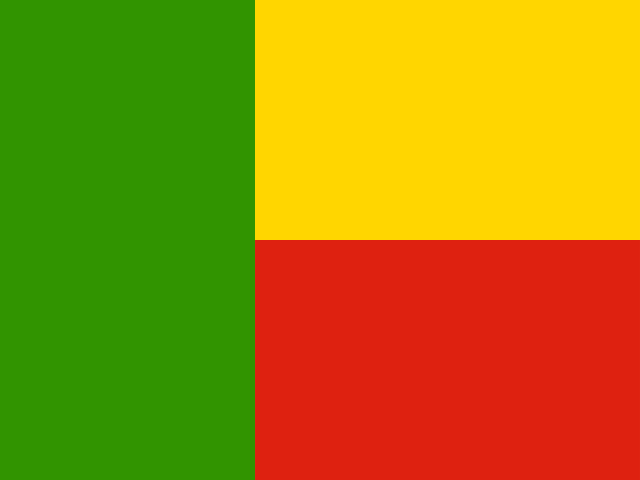
 Benin
Benin
Description of Benin
Benin, a small West African country nestled between Togo, Nigeria, Burkina Faso, and Niger, offers a rich tapestry of culture, history, and natural beauty. With a population of over 11 million people, Benin has made significant strides in political stability and economic development in recent years. From the bustling markets of Cotonou to the historic royal palaces of Abomey, Benin's diverse landscapes and traditions captivate visitors from around the world. Join us as we delve into the unique blend of tradition and modernity that defines the vibrant nation of Benin.
Population And Age Structure
Population, total: Benin's population of 12,643,123 is below the average population of 40,097,746. Benin is ranked 76th out of 194 countries in terms of population.
Population ages 0-14 (% of total population): Benin's 42.71% of population aged 0-14 is higher than the average of 27.34%. Benin ranks 19th out of 194 countries in this demographic.
Population ages 0-14, total: Benin's total population of ages 0-14 at 5,400,214 is below the average of 10,327,379. Benin is ranked 68th out of 194 countries in this age group.
Population ages 15-64 (% of total population): Benin's 54.20% of population aged 15-64 is below the average of 63.44%. Benin ranks 176th out of 194 countries in this demographic.
Population ages 15-64, total: Benin's total population of ages 15-64 at 6,852,380 is below the average of 26,003,407. Benin is ranked 85th out of 194 countries in this age group.
Population ages 65 and above (% of total population): Benin's 3.09% of population aged 65 and above is below the average of 9.22%. Benin ranks 164th out of 194 countries in this demographic.
Population ages 65 and above, total: Benin's total population of ages 65 and above at 390,528 is below the average of 3,766,959. Benin is ranked 113th out of 194 countries in this age group.
Summary
Benin has a relatively small total population compared to the global average, ranking 76th out of 194 countries. However, the country has a higher proportion of children aged 0-14, ranking 19th globally in this demographic. Benin also has a lower percentage of working-age adults (15-64) and elderly individuals (65 and above) compared to the global average.
These demographic indicators are important as they provide insights into the age distribution within Benin's population. A higher percentage of children could signify a need for investments in education and healthcare, while a lower proportion of working-age adults may impact the labor force and economic productivity. Understanding these demographic trends is crucial for policymakers to plan for social services, healthcare, and workforce development.
Population Miscellaneous
1. Benin's rural population is 6,521,955, which is significantly below the average rural population of 18,044,041. Benin ranks 73 out of 190 countries in this category.
2. The percentage of Benin's total population living in rural areas is 51.585%, higher than the average of 41.158%. Benin ranks 64 out of 190 countries in this regard.
3. Benin's urban population is 6,121,168, much lower than the average urban population of 22,425,747. Benin ranks 83 out of 194 countries in urban population.
4. With 48.415% of its total population living in urban areas, Benin falls below the average urban population percentage of 59.690%. It ranks 131 out of 194 countries in urban population percentage.
5. Benin's age dependency ratio is 84.51%, significantly higher than the average of 59.22%. This places Benin at the 19th rank out of 194 countries.
6. The crude birth rate in Benin is 37.114 births per 1,000 people, higher than the average of 19.384. Benin ranks 10 out of 192 countries in this aspect.
7. Benin's crude death rate is 9.364 deaths per 1,000 people, slightly above the average of 8.214. Benin ranks 55 out of 192 countries in this metric.
8. Benin's total fertility rate is 5.048 births per woman, significantly exceeding the average of 2.603. Benin ranks 10 out of 190 countries in terms of fertility rate.
Summary
Benin exhibits a unique demographic profile with a relatively lower urban population and a higher rural population compared to global averages. The country also stands out with a higher age dependency ratio, crude birth rate, crude death rate, and total fertility rate. These statistics are crucial as they indicate a higher burden on the working-age population to support dependents, potentially impacting economic productivity, healthcare services, and overall societal development in Benin.
Military
Benin's military expenditure of approximately $71.8 million is below the average of $12.9 billion, ranking 132 out of 149 countries. The country prioritizes other areas over military spending.
With a military expenditure of 0.46% of GDP, Benin's allocation is below the average of 1.9%. This places Benin at rank 140 out of 148 countries in this category.
Benin's arms imports of $1 million are significantly lower than the average of $205.5 million. This places Benin at rank 108 out of 113 countries in terms of arms imports.
Benin's total armed forces personnel of 12,000 is notably lower than the average of 165,908 personnel. This places Benin at a rank of 123 out of 164 countries.
With armed forces personnel comprising 0.27% of the total labor force, Benin's percentage is below the average of 1.28%, ranking the country 149 out of 164 countries in this category.
Summary
Benin's military expenditure, GDP allocation for the military, arms imports, total armed forces personnel, and the percentage of armed forces personnel in the labor force are all below global averages, indicating a prioritization of resources towards other sectors over defense. This strategic allocation is important as it reflects Benin's focus on development, social welfare, and economic progress rather than on military capabilities, potentially contributing to stability and growth in the country.
Natural Resources
Benin has a Forest area of 31,351.5 sq. km, which is significantly below the average of 211,606.11 sq. km, ranking 89th out of 191 countries.
The Land area in Benin is 112,760 sq. km, much lower than the average of 665,166.51 sq. km, ranking 99th out of 194 countries.
With a Surface area of 114,760 sq. km, Benin falls short of the average of 689,779.56 sq. km, ranking 101st out of 194 countries.
Benin's Arable land covers 2,800,000 hectares, which is below the average of 7,329,543.16 hectares, ranking 69th out of 190 countries.
The Land under cereal production in Benin is 1,537,675 hectares, lower than the average of 4,206,011.63 hectares, ranking 63rd out of 174 countries.
Benin experiences an Average precipitation of 1,039 mm per year, slightly below the average of 1,157.83 mm per year, ranking 87th out of 178 countries.
Regarding Renewable internal freshwater resources, Benin has 10.3 billion cubic meters, significantly less than the average of 240.41 billion cubic meters, ranking 123rd out of 178 countries.
Summary
Benin's land area, forest area, arable land, and renewable internal freshwater resources are all below global averages, indicating potential challenges for agricultural and natural resource utilization. The country's rankings in these categories also suggest that it may face constraints in land productivity and water availability compared to many other nations. Addressing these disparities is crucial for sustainable development, food security, and environmental management in Benin.
Resource Rents
Benin's total natural resources rents account for 2.43% of its GDP, which is below the average of 4.63%. This places Benin at rank 78 out of 175 countries in the dataset.
In terms of forest rents, Benin's value is 2.38% of its GDP, higher than the average of 1.53%. This places Benin at rank 32 out of 174 countries.
Benin's oil rents represent 0.05% of its GDP, significantly lower than the average of 2.51%. This places Benin at rank 76 out of 117 countries in the dataset.
Summary
Benin's total natural resources rents as a percentage of GDP are below the global average, ranking the country 78th out of 175 countries. However, in terms of forest rents, Benin performs better, ranking 32nd out of 174 countries with a value higher than the average. Despite this, Benin's oil rents are notably low compared to the global average, placing the country at 76th out of 117 countries in the dataset.
These findings are important as they indicate that while Benin has a relatively lower dependency on natural resources, particularly oil, its forest resources contribute significantly more to its GDP compared to other countries. Understanding these figures can help policymakers in Benin make informed decisions regarding resource management, economic diversification, and sustainable development strategies.
Commodities
Benin's cereal production stands at 2,203,105.09 metric tons, significantly below the average of 17,249,945.93 metric tons, ranking 88th out of 174 countries.
The aquaculture production in Benin is 3,136.91 metric tons, well below the average of 679,642.92 metric tons, placing Benin at the 104th position out of 180 countries.
In terms of capture fisheries production, Benin contributes 73,965 metric tons, lower than the average of 467,453.06 metric tons, ranking 83rd out of 190 countries.
Benin's total fisheries production is 77,101.91 metric tons, significantly under the average of 1,153,914.85 metric tons, positioning the country at the 87th spot out of 182 countries.
Regarding fertilizer consumption per hectare of arable land, Benin consumes 40.21 kilograms, which is below the average of 159.04 kilograms per hectare, resulting in a ranking of 126th out of 187 countries.
Summary
Benin's agricultural sector lags behind global averages in key production metrics such as cereal, aquaculture, and fisheries. The country's rankings, notably in fertilizer consumption per hectare of arable land, indicate room for improvement in enhancing agricultural productivity and sustainability. These statistics are crucial as they highlight areas where Benin can focus on to boost food security, economic growth, and livelihoods for its population.
Intellectual Property
Benin's Scientific and technical journal articles stand at 290.5, considerably lower than the attribute average of 15103.76, placing the country at a rank of 105 out of 192 countries.
In terms of Charges for the use of intellectual property, payments (BoP, current US$), Benin's value is 401153.03, significantly below the average of 3218843494.39. This places Benin at the 132nd rank out of 143 countries.
Benin's Charges for the use of intellectual property, receipts (BoP, current US$) are at 17447.49, also notably under the average of 3191687117.58. Benin holds the 114th rank out of 122 countries for this metric.
Summary
Benin performs below the global average in key macroeconomic indicators related to scientific and technical journal articles, charges for the use of intellectual property (both payments and receipts). These indicators are crucial for assessing a country's innovation and intellectual property rights protection, vital for economic growth and competitiveness in the global market.
Broad Economy Attributes
- Benin's GDP (current US$) is significantly below the average of $442,870,224,838.68, with a rank of 116
out of 189 countries.
- Benin's GDP, PPP (current international $) is also well below the average of $734,141,122,350.78, ranked
110 out of 181 countries.
- The GDP per capita (current US$) for Benin is notably lower than the average of $15,462.11, placing it
at rank 161 out of 190 countries.
- Benin's GDP per capita, PPP (current international $) is below the average of $21,251.89, ranked 152 out
of 181 countries.
- In terms of GNI (current US$), Benin falls short of the average of $452,040,815,370.70, ranking 115 out
of 185 countries.
- Benin's GNI, PPP (current international $) is notably below the average of $730,698,223,823.47, with a
rank of 110 out of 181 countries.
- The GNI per capita, PPP (current international $) for Benin is significantly lower than the average of
$20,615.75, ranking 154 out of 181 countries.
Summary
Benin's key macroeconomic indicators, including GDP, GDP per capita, GNI, and GNI per capita, all reflect values that are notably below the global averages. This indicates that Benin's economy is lagging behind when compared to other countries worldwide. These findings are important as they highlight the economic challenges and disparities faced by Benin in terms of overall economic output, individual income levels, and national wealth.
Broad Value Added
Benin's Gross value added at basic prices (GVA) is $14,321,533,559.96, ranking 109 out of 176 countries. This value is significantly below the attribute average of $360,070,943,595.12.
Benin's Agriculture, forestry, and fishing value added (% of GDP) is 27.11%, ranking 13 out of 182 countries, well above the attribute average of 10.86%.
Benin's Agriculture, forestry, and fishing value added is $4,252,546,317.38, ranking 79 out of 182 countries. It falls below the attribute average of $19,924,732,828.07.
Benin's Services value added (% of GDP) is 47.90%, ranking 149 out of 183 countries, below the attribute average of 56.72%.
Benin's Services value added is $7,513,530,859.62, ranking 122 out of 183 countries. This value is noticeably lower than the attribute average of $295,837,711,130.69.
Benin's Industry value added is $2,555,456,382.96, ranking 136 out of 183 countries. It is significantly below the attribute average of $118,421,095,413.50.
Summary
Benin's economy shows strengths in the Agriculture, forestry, and fishing sector, with a high percentage of value added to GDP and a decent ranking globally. However, the Services and Industry sectors lag significantly behind global averages, indicating potential areas for improvement and diversification to drive economic growth and development.
These findings are important as they highlight Benin's reliance on the agriculture sector, which can be both a strength and a vulnerability. Diversifying into other sectors like services and industry can help reduce dependency on a single sector, improve overall economic resilience, and boost job creation and innovation in the long term.
Manufacturing Value Added
Benin's Manufacturing, value added (current US$) is $1.52 billion, significantly below the average of $76.21 billion. This places Benin at rank 111 out of 173 countries in the dataset.
In terms of Manufacturing, value added (% of GDP), Benin's percentage is 9.69%, lower than the average of 11.90%. This places Benin at rank 105 out of 173 countries in the dataset.
Summary
Benin's manufacturing sector contributes significantly less to its GDP compared to the average of countries in the dataset, with a value added of $1.52 billion representing only 9.69% of its GDP. This places Benin at a lower rank in terms of both total value added and percentage contribution, indicating potential challenges in the country's industrial development and economic diversification.
These statistics are crucial as they highlight areas where Benin may need to focus on strengthening its manufacturing sector to drive economic growth, create more job opportunities, and enhance overall industrial competitiveness in the global market.
Money
Benin's consumer price inflation is 3.02%, below the average of 8.26%. The country ranks 63 out of 165 countries in this attribute.
Benin's GDP deflator inflation is 2.88%, below the average of 6.90%. The country ranks 76 out of 188 countries in this attribute.
Benin's broad money growth is 17.30%, slightly below the average of 18.03%. The country ranks 44 out of 139 countries in this attribute.
Benin's broad money as a percentage of GDP is 30.55%, significantly below the average of 71.75%. The country ranks 123 out of 139 countries in this attribute.
Summary
Benin demonstrates relatively low levels of consumer price inflation, GDP deflator inflation, and broad money as a percentage of GDP compared to global averages. However, the country's broad money growth rate is slightly below the global average. These indicators are crucial as they reflect Benin's economic stability, monetary policy effectiveness, and overall financial health in comparison to other countries worldwide.
Consumption Expenditure
Final consumption expenditure (current US$): Benin's final consumption expenditure is $12,463,814,339.65, below the average of $381,630,252,515.38. Benin ranks 113 out of 159 countries in this attribute.
Final consumption expenditure (% of GDP): Benin's final consumption expenditure as a percentage of GDP is 79.45%, slightly below the average of 82.37%. Benin ranks 84 out of 159 countries in this attribute.
General government final consumption expenditure (current US$): Benin's government final consumption expenditure is $1,788,188,517.42, significantly below the average of $93,676,578,238.03. Benin ranks 123 out of 158 countries in this attribute.
General government final consumption expenditure (% of GDP): Benin's government final consumption expenditure as a percentage of GDP is 11.40%, lower than the average of 18.71%. Benin ranks 134 out of 158 countries in this attribute.
Household and NPISHs Final consumption expenditure (current US$): Benin's household and NPISHs final consumption expenditure is $10,675,625,822.23, below the average of $290,127,571,157.69. Benin ranks 110 out of 158 countries in this attribute.
Households and NPISHs final consumption expenditure (% of GDP): Benin's household and NPISHs final consumption expenditure as a percentage of GDP is 68.06%, above the average of 63.68%. Benin ranks 63 out of 158 countries in this attribute.
Summary
Benin's final consumption expenditure, both in total and as a percentage of GDP, is below the global average, indicating potential room for growth and increased economic activity. The government final consumption expenditure is notably low compared to the average, suggesting possible limitations in public sector investment and services. However, household and NPISHs final consumption expenditure surpasses the global average percentage of GDP, showcasing robust private sector spending and potential for increased domestic demand and economic expansion.
These indicators are crucial for understanding Benin's economic development and sustainability. A lower government final consumption expenditure implies the need for strategic public sector investments to stimulate growth, while higher household expenditure signals a strong consumer base that can drive economic activity and investment.
Investment
Analysis of key statistics for Foreign Direct Investment, Net (BoP, current US$): Benin's value of -152,493,263.35 is significantly above the average of -1,615,235,980.51, ranking 68 out of 169 countries.
Analysis of key statistics for Foreign Direct Investment, Net Inflows (BoP, current US$): Benin's value of 174,019,952.06 is considerably below the average of 5,749,271,080.15, placing Benin at rank 116 out of 182 countries.
Analysis of key statistics for Foreign Direct Investment, Net Inflows (% of GDP): Benin's value of 1.11% is below the average of 2.61%, ranking at 115 out of 178 countries.
Analysis of key statistics for Foreign Direct Investment, Net Outflows (BoP, current US$): Benin's value of 21,526,688.71 is significantly below the average of 5,707,991,116.07, with a rank of 89 out of 156 countries.
Analysis of key statistics for Foreign Direct Investment, Net Outflows (% of GDP): Benin's value of 0.14% is below the average of 1.00%, placing Benin at rank 90 out of 155 countries.
Analysis of key statistics for Portfolio Investment, Net (BoP, current US$): Benin's value of 510,149,173.76 is below the average of 679,559,169.57, with a rank of 49 out of 159 countries.
Analysis of key statistics for Portfolio Investment, Bonds (PPG + PNG) (NFL, current US$): Benin's value of 5,220,000 is significantly below the average of 4,134,263,915.25, ranking 36 out of 59 countries.
Analysis of key statistics for Portfolio Equity, Net Inflows (BoP, current US$): Benin's value of -327,619.34 is significantly below the average of 9,197,145,994.70, with a rank of 68 out of 125 countries.
Summary
Benin's performance in key macroeconomic indicators related to foreign direct investment and portfolio investment is mixed. While the country ranks below average in terms of FDI inflows and outflows, it performs relatively better in net portfolio investment. The lower ranking in FDI indicators may indicate a need to attract more foreign investment to spur economic growth and development, while the higher ranking in portfolio investment suggests existing confidence in the country's financial markets.
Debt
Benin's total debt service as a percentage of GNI is 1.55%, which is below the average of 5.98%. Benin ranks 96th out of 120 countries in this attribute.
The public and publicly guaranteed debt service as a percentage of GNI in Benin is 1.36%, also below the average of 2.84%. Benin ranks 84th out of 120 countries for this metric.
Benin's external debt stocks as a percentage of GNI are 33.88%, significantly lower than the average of 65.42%. Benin ranks 92nd out of 120 countries in this category.
The total debt service on external debt in Benin is $240,667,548.7, much lower than the average of $9,811,195,839.23. Benin ranks 86th out of 123 countries in this aspect.
Benin's debt service on external debt that is public and publicly guaranteed is $210,515,685.9, below the average of $3,310,612,057.60. Benin is ranked 78th out of 123 countries for this metric.
Regarding external debt stocks that are public and publicly guaranteed, Benin's value is $4,414,104,228.50, well below the average of $28,695,879,144.98 for this attribute. Benin is ranked 77th out of 123 countries.
Benin's total external debt stocks amount to $5,259,325,040.30, which is significantly lower than the average of $73,845,530,111.82. Benin is ranked 84th out of 123 countries for this statistic.
Summary
Benin demonstrates a strong fiscal responsibility as indicated by its lower-than-average total debt service, public debt service, external debt stocks, and debt service figures in comparison to the global averages. Despite ranking lower in these metrics compared to other countries, Benin maintains a sustainable debt profile, ensuring financial stability and minimizing the risk of debt distress. This prudent management of debt positions Benin favorably for attracting investment, fostering economic growth, and mitigating potential macroeconomic vulnerabilities.
Broad Trade Attributes
- Trade (% of GDP): Benin's trade as a percentage of GDP is 44.83%, which is below the average of 82.34%. This places Benin at a rank of 129 out of 163 countries.
- Merchandise trade (% of GDP): Benin's merchandise trade is 41.76% of its GDP, lower than the average of 60.01%. Benin is ranked 125 out of 186 countries for this indicator.
- Trade in services (% of GDP): Benin's trade in services accounts for 8.29% of its GDP, significantly lower than the average of 24.63%. Benin ranks 135 out of 171 countries in this aspect.
- External balance on goods and services (current US$): Benin has an external balance of -798,187,314.65 USD, suggesting a deficit. This is notably lower than the average balance of 3,405,509,011.13 USD. Benin ranks 100 out of 163 countries in this category.
- External balance on goods and services (% of GDP): Benin's external balance as a percentage of GDP is -5.09%, slightly higher than the average of -5.97%. Benin ranks 91 out of 163 countries based on this statistic.
Summary
Benin's trade performance, both in terms of total trade and merchandise trade, falls below global averages, indicating room for growth in international economic engagement. The country's reliance on services trade is notably lower than the global average, suggesting a potential area for diversification and expansion. Benin's negative external balance on goods and services indicates a trade deficit, which may require strategic planning to address for long-term economic sustainability.
Net Trade
1. Current account balance (BoP, current US$): Benin has a current account balance of -273,966,712.89, which is below the average of $1,443,864,831.49. Benin ranks 90th out of 170 countries in this attribute.
2. Current account balance (% of GDP): Benin's current account balance as a percentage of GDP is -1.75%, above the average of -2.36%. Benin is ranked 89th out of 170 countries.
3. Net trade in goods and services (BoP, current US$): Benin has a net trade value of -435,724,020.28, below the average of $2,604,730,003.57. Benin ranks 93rd out of 171 countries.
4. Net primary income (BoP, current US$): Benin's net primary income is -121,363,105.47, above the average of -$903,807,529.74. Benin ranks 65th out of 170 countries.
5. Net secondary income (BoP, current US$): Benin's net secondary income is 283,120,412.86, higher than the average of -$269,227,340.40. Benin ranks 90th out of 170 countries.
6. Net trade in goods (BoP, current US$): Benin's net trade in goods is -156,238,553.99, below the average of $1,302,831,005.68. Benin is ranked 75th out of 171 countries.
7. Net capital account (BoP, current US$): Benin's net capital account is 175,002,514.06, higher than the average of $136,543,824.05. Benin ranks 51st out of 159 countries.
8. Net financial account (BoP, current US$): Benin's net financial account is -95,453,317.52, above the average of -$469,840,994.63. Benin ranks 81st out of 170 countries.
Summary
Benin's macroeconomic indicators show a mixed performance compared to the global averages. While the country's net secondary income and net capital account perform better than average, Benin lags behind in its current account balance, net trade in goods, and net financial account. These indicators are crucial as they reflect Benin's trade relationships, income flows, and financial stability on the international stage, impacting its overall economic health and potential for growth.
Broad Export Attributes
Benin's Exports of goods, services and primary income amount to $3.72 billion, which is significantly below the average of $146.24 billion, ranking 124th out of 170 countries.
The country's Exports of goods and services stand at $3.51 billion, also below the average of $122.94 billion, ranking 120th out of 170 countries.
Benin's Exports of goods and services (current US$) is $3.12 billion, below the average of $129.60 billion, with a rank of 120 out of 163 countries.
Exports of goods and services (% of GDP) for Benin is 19.87%, lower than the average of 38.19%, placing the country at 121st out of 163 countries.
The country's Goods exports are valued at $2.99 billion, below the average of $93.31 billion, ranking 118th out of 171 countries.
Benin's ICT goods exports account for 0.05% of total goods exports, significantly lower than the average of 3.81%, with a rank of 124 out of 142 countries.
Summary
Benin's export performance across various indicators, such as total exports, goods exports, and ICT goods exports, consistently falls below global averages and ranks relatively low compared to other countries. This indicates a need for the country to enhance its export competitiveness, diversify its export base, and potentially invest more in sectors like information and communication technology to improve its global trade standing and economic growth prospects.
Merchandise Exports
Benin's merchandise exports amount to $2,996,000,000, ranking 125th out of 187 countries. This value is significantly below the average of $89,542,711,229.95 for this attribute.
Benin's agricultural raw materials exports account for 64.64% of its merchandise exports, ranking 1st out of 151 countries. This percentage is considerably higher than the average of 2.97%.
Food exports make up 25.07% of Benin's merchandise exports, placing it 51st out of 152 countries. This value is slightly above the average of 24.06%.
Benin's fuel exports represent only 0.01% of its merchandise exports, ranking 137th out of 147 countries. This figure is notably lower than the average of 13.70%.
Ores and metals exports constitute 0.07% of Benin's merchandise exports, placing it 149th out of 152 countries. This percentage is significantly below the average of 9.10%.
The residual category for merchandise exports accounts for 0.01% in Benin, ranking 136th out of 166 countries. This proportion is notably lower than the average of 3.20%.
Summary
Benin has a unique export composition with a heavy reliance on agricultural raw materials and food exports, while having minimal presence in fuel, ores, and metals exports. This export structure emphasizes Benin's vulnerability to fluctuations in commodity prices and highlights the need for diversification strategies to enhance economic resilience and reduce dependency on specific export sectors.
Technology Exports
Benin's Manufactures exports account for 10.20% of its merchandise exports, which is below the average of 42.62%. This places Benin at rank 125 out of 152 countries.
Benin's High-technology exports amount to $1,410,633, significantly below the average of $16,655,934,079. Benin ranks 134 out of 151 countries for this metric.
Benin's High-technology exports represent 1.84% of its manufactured exports, well below the average of 10.15%. This places Benin at rank 121 out of 150 countries.
Summary
Benin's performance in key macroeconomic indicators related to its manufacturing and high-technology exports is notably below global averages and ranks relatively low compared to other countries. With Manufactures exports accounting for only 10.20% of its merchandise exports, High-technology exports amounting to $1,410,633, and representing just 1.84% of its manufactured exports, Benin faces challenges in diversifying its export base and integrating higher value-added products into its economy. Improving these indicators is crucial for Benin's economic development as it can enhance competitiveness, attract foreign investment, and drive sustainable growth in the long term.
Service Exports
Service exports in Benin amount to $510,372,003.67, significantly below the average of $28,917,292,503.82. Benin is ranked 124th out of 171 countries in this category.
ICT service exports in Benin are $602,843.96, considerably lower than the average of $4,578,501,153.77. Benin is ranked 161st out of 166 countries in ICT service exports.
ICT service exports as a percentage of service exports in Benin is 0.118%, far below the average of 11.75%. Benin ranks 166th out of 166 countries in this metric.
Communications, computer, etc. services as a percentage of service exports in Benin stand at 17.52%, lower than the average of 45.85%. Benin holds the 150th position out of 169 countries.
Transport services as a percentage of service exports in Benin represent 33.37%, above the average of 21.80%. Benin ranks 34th out of 169 countries in this aspect.
Travel services as a percentage of service exports in Benin make up 39.16%, surpassing the average of 26.40%. Benin holds the 41st position out of 167 countries.
Insurance and financial services as a percentage of service exports in Benin account for 9.96%, higher than the average of 6.46%. Benin ranks 35th out of 161 countries in this category.
Summary
Benin's key macroeconomic indicators reflect low levels of service exports, particularly in ICT services. The country ranks poorly compared to global averages in most categories, implying a need for development and investment in these sectors to enhance economic growth and competitiveness on the global stage.
Commercial Service Exports
Benin's Commercial service exports amount to $425,875,015.09, which is below the average of $28,508,218,402.80, ranking 125th out of 171 countries.
The Travel services (% of commercial service exports) in Benin are 46.93%, higher than the average of 27.89%, placing Benin 33rd out of 167 countries.
Benin's Computer, communications, and other services (% of commercial service exports) are 1.15%, significantly lower than the average of 42.44%, ranking 168th out of 169 countries.
Insurance and financial services (% of commercial service exports) in Benin stand at 11.93%, above the average of 6.97%, placing Benin 25th out of 161 countries.
Transport services (% of commercial service exports) in Benin represent 39.99%, higher than the average of 23.37%, positioning Benin 28th out of 169 countries.
Summary
Benin's commercial service exports are relatively low compared to the average, ranking 125th out of 171 countries. However, Benin performs well in travel services and insurance/financial services, ranking 33rd and 25th respectively, above the global averages. On the other hand, Benin's performance in computer, communications, and other services is notably poor, ranking 168th out of 169 countries. These indicators are crucial for assessing Benin's economic diversity, competitiveness, and potential for growth in the global market.
Broad Import Attributes
Benin's imports of goods and services (current US$) amount to 3.92 billion, significantly below the average of 126.19 billion, ranking 121 out of 163 countries.
The imports of goods and services (% of GDP) for Benin stand at 24.96%, lower than the average of 44.15%. Benin's rank is 129 out of 163 countries.
Benin's ICT goods imports (% total goods imports) represent 2.36%, notably under the 6.85% average. Benin ranks 131 out of 143 countries in this aspect.
With goods imports (BoP, current US$) of 3.15 billion, Benin falls far below the average of 92.01 billion, ranking 127 out of 171 countries.
In the category of imports of goods and services (BoP, current US$), Benin's 3.94 billion is considerably lower than the average of 120.32 billion. Benin ranks 128 out of 170 countries.
Benin's imports of goods, services, and primary income (BoP, current US$) amount to 4.28 billion, significantly lower than the average of 144.51 billion, ranking 127 out of 170 countries.
Summary
Benin's imports across various categories, including goods and services, ICT goods, and primary income, are notably below global averages, with rankings ranging from 121 to 131 out of 163 to 171 countries. This indicates a relatively lower level of international trade activity and integration compared to other nations, possibly reflecting limitations in the country's economic development and integration into the global market.
Merchandise Imports
Benin's merchandise imports amount to $3,555,000,000. This is significantly below the attribute average of $89,385,605,263. Benin ranks 132 out of 190 countries in merchandise imports.
The percentage of manufactures imports in Benin is 47.48%, which is below the attribute average of 66.76%. Benin ranks 146 out of 152 countries in this category.
Benin's agricultural raw materials imports account for 1.16% of its merchandise imports, slightly below the average of 1.27%. Benin ranks 71 out of 152 countries in this aspect.
Food imports constitute 32.93% of Benin's merchandise imports, significantly higher than the average of 15.89%. Benin ranks 4 out of 152 countries in food imports.
Fuel imports in Benin make up 17.80% of its merchandise imports, higher than the average of 11.38%. Benin ranks 19 out of 152 countries in fuel imports.
Ores and metals imports represent 0.61% of Benin's merchandise imports, significantly below the average of 2.57%. Benin ranks 134 out of 152 countries in this category.
The residual percentage of merchandise imports by the reporting economy in Benin is 0.04%, far below the average of 2.51%. Benin ranks 140 out of 180 countries in this aspect.
Summary
The analysis of key macroeconomic indicators for Benin reveals that the country has lower-than-average merchandise imports across various categories such as manufactures, agricultural raw materials, ores and metals, and residual imports. However, Benin shows a significant reliance on food imports, which constitutes a larger percentage of its total merchandise imports compared to the global average. Understanding these import patterns is crucial for policymakers and stakeholders to strategize on enhancing domestic production capabilities, reducing dependency on food imports, and improving trade balances to foster economic stability and growth.
Service Imports
- Service imports (BoP, current US$): Benin's service imports amount to $789,857,469.96. This is
significantly below the average of $27,615,356,170.47, ranking 129th out of 171 countries in the dataset.
- Communications, computer, etc. (% of service imports, BoP): Benin's percentage of service imports
allocated to communications, computer, etc. is 36.62%, below the average of 44.40%. The country ranks
110th out of 169 countries.
- Transport services (% of service imports, BoP): Benin allocates 52.14% of its service imports to
transport services, notably above the average of 32.90%. This places Benin at 23rd out of 169 countries.
- Travel services (% of service imports, BoP): Benin utilizes 9.73% of its service imports for travel
services, lower than the average of 14.14%. The country ranks 93rd out of 169 countries.
- Insurance and financial services (% of service imports, BoP): In Benin, only 1.50% of service imports
are directed towards insurance and financial services, much lower than the average of 8.53%. The country's
rank is 160th out of 169 countries.
Summary
In analyzing Benin's key macroeconomic indicators related to service imports, it is evident that the country has a lower overall volume of service imports compared to the average. Specifically, Benin allocates a higher percentage of its service imports towards transport services, while lagging behind in the allocation towards communications, computer, insurance, and financial services. These findings are important as they reflect Benin's priorities and investments in different service sectors, which can have implications for its economic development, technological advancement, and financial stability.
Commercial Service Imports
Benin's Commercial service imports amount to $787,259,830.82, significantly below the average of $27,102,746,128.60, ranking 127th out of 171 countries.
Computer, communications, and other services contribute to 36.42% of Benin's commercial service imports, which is below the average of 41.71%. Benin ranks 100th out of 169 countries in this category.
Benin's Insurance and financial services represent 1.51% of its commercial service imports, well below the average of 8.85%. The country ranks 161st out of 169 countries for this attribute.
Transport services constitute 52.31% of Benin's commercial service imports, exceeding the average of 34.71%. This places Benin at the 26th rank out of 169 countries in this aspect.
Travel services make up 9.76% of Benin's commercial service imports, lower than the average of 14.73%. Benin ranks 96th out of 169 countries for travel services.
Summary
Benin's commercial service imports are notably lower than the global average, with a significant portion attributed to transport services. The country falls below average in computer, communications, and other services as well as in insurance and financial services. These findings are crucial as they highlight areas where Benin may need to focus on improving competitiveness and diversification within its commercial service imports to enhance economic growth and resilience.
Information Technology Infrastructure
Benin has 226 secure internet servers, which is significantly below the average of 458,294. Benin is ranked 148 out of 193 countries for this attribute.
With 17.88 secure internet servers per 1 million people, Benin is well below the average of 14,067. Benin ranks 166 out of 193 countries in this aspect.
28.23% of individuals in Benin use the internet, much lower than the average of 64.77%. Benin is ranked 155 out of 180 countries for this indicator.
Benin has 29,981 fixed broadband subscriptions, significantly lower than the average of over 6.5 million. In this aspect, Benin is ranked 145 out of 185 countries.
Regarding mobile cellular subscriptions, Benin has 11,140,891 subscriptions, which is well below the average of over 42.5 million. Benin is ranked 83 out of 193 countries in this category.
Summary
Benin lags behind global averages in key indicators such as secure internet servers, internet usage, fixed broadband subscriptions, and mobile cellular subscriptions. With lower access to internet infrastructure and technology compared to the global average, Benin faces challenges in digital connectivity and communication which are crucial for economic development and participation in the digital economy.
Energy Consumption
Benin's renewable energy consumption accounts for 46.2% of its total final energy consumption, which is 14.02% higher than the global average of 32.18%. This places Benin at rank 56 out of 191 countries in renewable energy consumption data.
On the other hand, Benin's CO2 emissions stand at 7980.4 kt, significantly lower than the average of 171895.94 kt. With this figure, Benin is ranked 110 out of 188 countries in CO2 emissions, showcasing its relatively low carbon footprint compared to other nations.
Summary
Benin demonstrates a strong commitment to renewable energy with 46.2% of its total final energy consumption coming from renewable sources, surpassing the global average by 14.02%. Additionally, its relatively low CO2 emissions of 7980.4 kt position it favorably at rank 110 out of 188 countries. These indicators suggest Benin's sustainable energy practices and environmentally conscious approach, which may enhance its long-term economic and environmental resilience amidst global challenges such as climate change and energy transition.
Government Balance Sheet
Benin's Reserves and related items (BoP, current US$) are valued at 14,585,802.65, significantly below the average of 1,924,407,186.58. This places Benin at rank 91 out of 171 countries in the dataset.
Summary
Benin's Reserves and related items (BoP, current US$) are relatively low at 14,585,802.65 compared to the dataset's average of 1,924,407,186.58, ranking the country 91st out of 171 countries. This low ranking indicates that Benin may face challenges in terms of financial stability, currency value, and ability to handle external shocks or fluctuations in international trade.
Taxes
Benin's applied weighted mean tariff rate for all products is 9.86%, which is 4.65% higher than the average of 5.21%. This places Benin at the 26th rank out of 153 countries in the dataset.
Summary
Benin's applied weighted mean tariff rate of 9.86% is significantly higher than the global average of 5.21%. This indicates that Benin may have trade policies in place that could potentially impact its international trade relations and economic competitiveness.
Top Stats
Ranks in Top Decile For:
| Attribute | Rank/Total |
|---|---|
| Population ages 0-14 (% of total population) | 19/194 |
| Age dependency ratio (% of working-age population) | 19/194 |
| Birth rate, crude (per 1,000 people) | 10/192 |
| Fertility rate, total (births per woman) | 10/190 |
| Agriculture, forestry, and fishing, value added (% of GDP) | 13/182 |
| Agricultural raw materials exports (% of merchandise exports) | 1/151 |
| Food imports (% of merchandise imports) | 4/152 |
Ranks in Bottom Decile For:
| Attribute | Rank/Total |
|---|---|
| Population ages 15-64 (% of total population) | 176/194 |
| Military expenditure (% of GDP) | 140/148 |
| Arms imports (SIPRI trend indicator values) | 108/113 |
| Armed forces personnel (% of total labor force) | 149/164 |
| Charges for the use of intellectual property, payments (BoP, current US$) | 132/143 |
| Charges for the use of intellectual property, receipts (BoP, current US$) | 114/122 |
| Fuel exports (% of merchandise exports) | 137/147 |
| Ores and metals exports (% of merchandise exports) | 149/152 |
| ICT service exports (BoP, current US$) | 161/166 |
| ICT service exports (% of service exports, BoP) | 166/166 |
| Computer, communications and other services (% of commercial service exports) | 168/169 |
| ICT goods imports (% total goods imports) | 131/143 |
| Manufactures imports (% of merchandise imports) | 146/152 |
| Insurance and financial services (% of service imports, BoP) | 160/169 |
| Insurance and financial services (% of commercial service imports) | 161/169 |